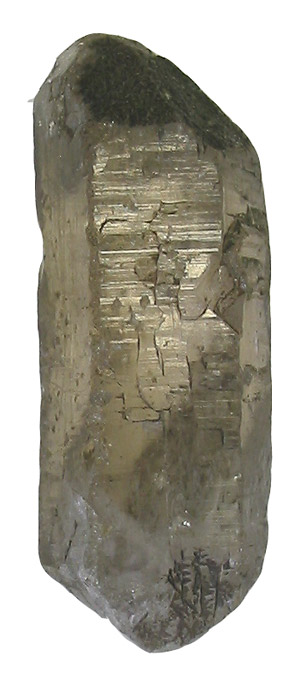
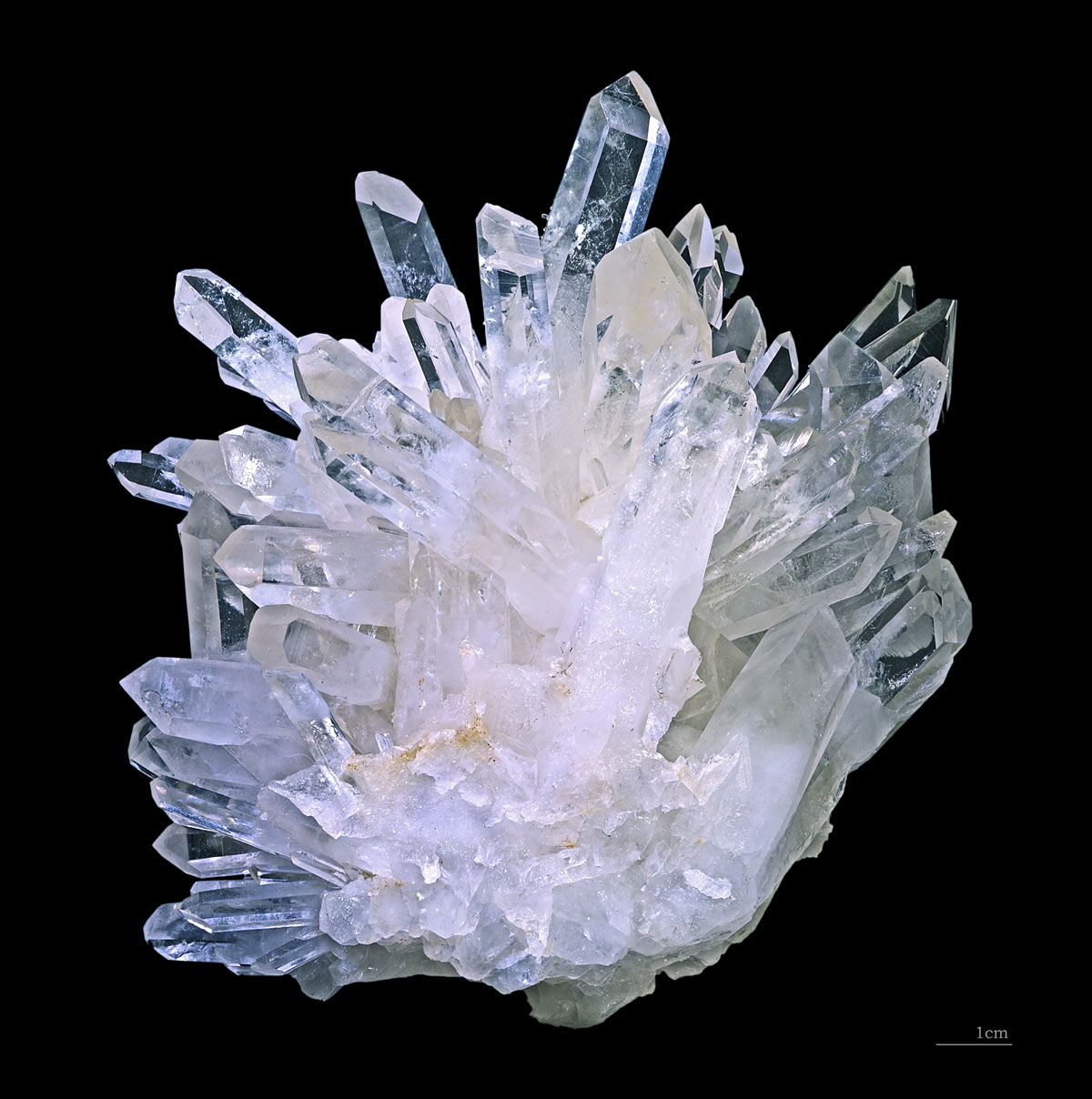
Quartz: a mineral forming a group that includes true Quartz, as well as Opal and rare minerals such as Tridymite, Cristobalite, Coesite, and Stishovite. Chemically, all these are composed of Silicon Dioxide with the formula SiO2. Its appearance ranges from transparent to opaque, with a luster from vitreous to greasy, and colors from colorless to milky to a full spectrum of hues. Quartz crystallizes in the Trigonal System and typically forms prismatic-hexagonal shapes with pyramid-shaped terminations. Common features in Quartz include penetration twinning (according to the Dauphiné and Brazil laws), contact twinning (Japan law), and grouping with other crystal individuals. Quartz crystal aggregates can be granular or massive. It is the main mineralogical component of silica-rich igneous and metamorphic rocks. It is found as an accessory mineral in many igneous, metamorphic, and sedimentary rocks. After Feldspars, it is the most common mineral in the upper part of the Earth’s crust. Large crystals have been found, weighing up to 130 kg (generally of pegmatitic-pneumatolitic origin). Noteworthy are the inclusions of other minerals or liquid-gas inclusions inside Quartz.