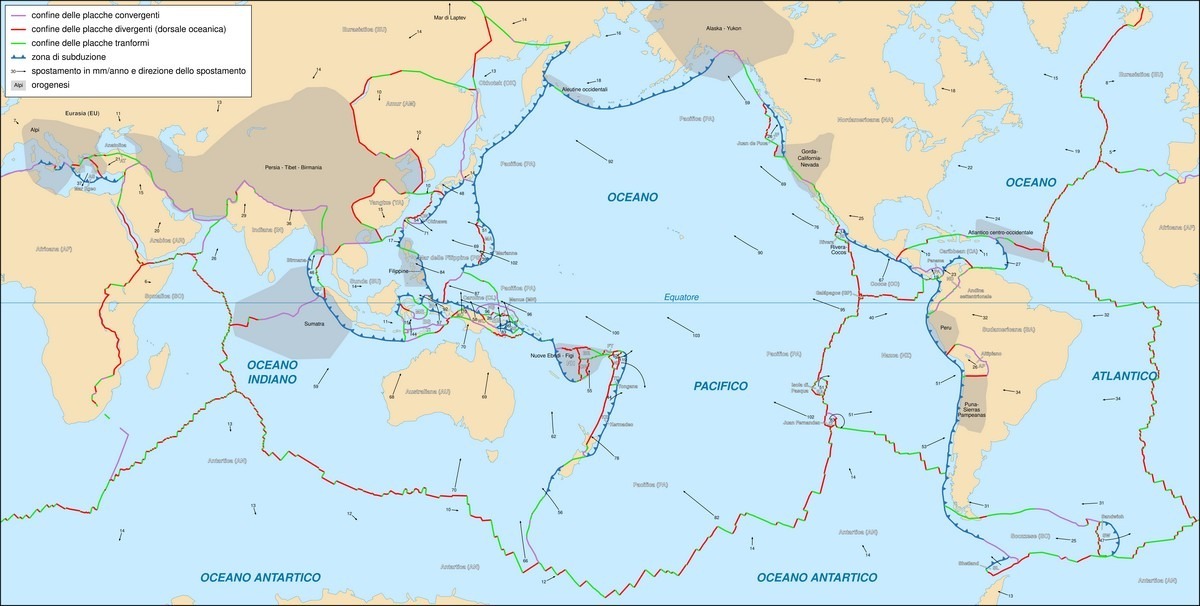
Tectonic Plates: Based on the theory of Tectonic Plates, the Lithosphere (outermost shell of the Earth’s Curst) is divided into several rigid Plates floating on the Asthenosphere. By floating these latter can: a) detach from each other b) get close and collide, c) get close and slide one next to the other. In the a) case if the detachment ceases after a short time, between the two Plates only a big cracks remains, called Rift Valley, a structure characterised by steep stair walls. This is the case of the big system of cracks of the Great Rift Valley that from the Dead Sea extends to the Great Lakes of Eastern Africa. If, instead, the detachment continues for long, this leads to the formation of a new sea that can become an ocean, like in the case of South American and African Plates that, along the mid-Atlantic Ridge, are detaching at a speed of 2 cm a year. In the b) case, if colliding Plates are two Oceanic Plates or an Oceanic and a Continental Plate, one bends and penetrates under the other drifted by the currents of the mantle. This Plate forms a Trench in front of the other and going down towards the deeper and hotter areas of the Mantle, melts and becomes Magma. This phenomenon is defined Subduction. In case two Continental Plates with the same density overlap, they form mountain ranges. Such phenomenon called Orogenesis originated, for examples, the Alps and the Himalayan range. In the c) case, when two Plates get close and slide one next to the other, along a contact line called Fault, there is neither production nor destruction of the Earth’s Crust. An example is represented by the Saint Andreas Fault in California, where the Pacific Plate slides next to the North American one.