This content was first published on IGR – Italian Gemological Review no. 22 in 2026. The information provided here is therefore current as of the original publication date.

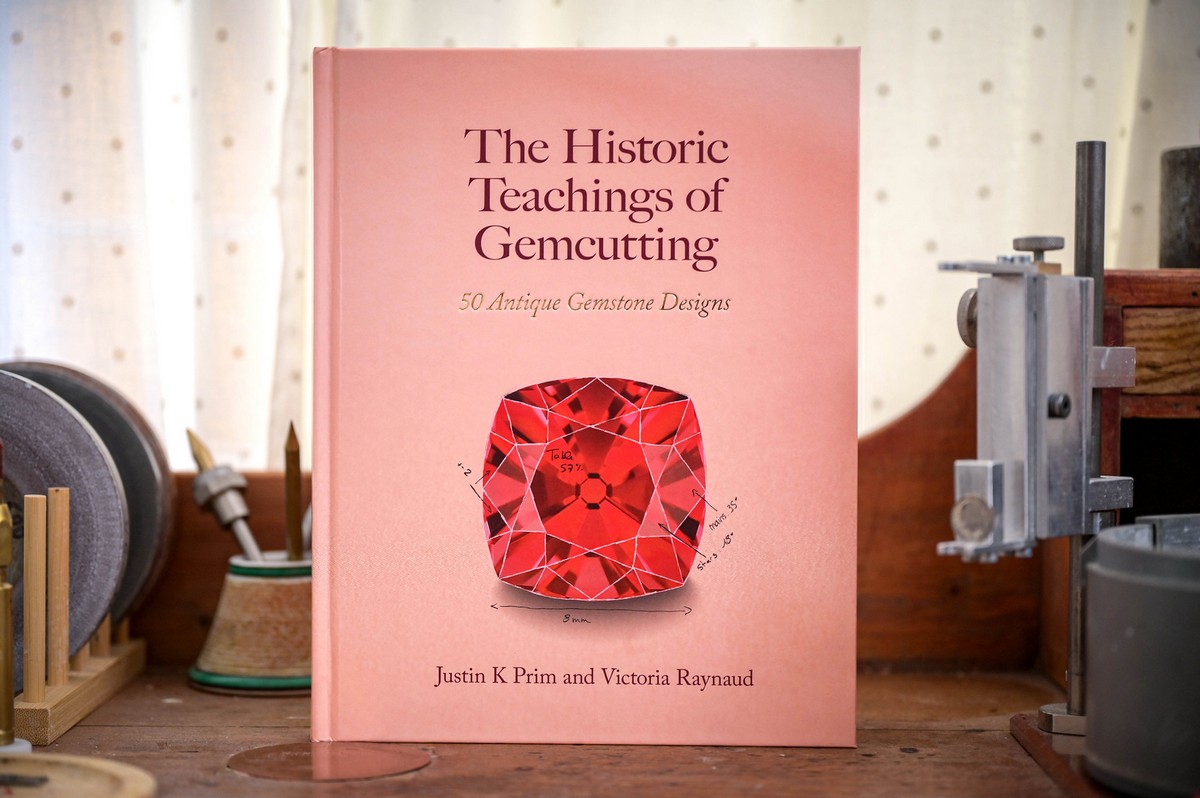
“The Historic Teachings of Gemcutting – 50 Antique Gemstone Designs” by Justin K Prim and Victoria Raynaud (Chicago–Lyon, Magus Publishing, 2025) is a finely produced 222-page hardcover volume that represents a coherent and mature continuation of the authors’ project to systematize knowledge on gem cutting, first launched with the successful “The Secret Teachings of Gemcutting” (Chicago/Bangkok, Magus Publishing, 2021), reviewed in IGR in 2022 (no. 14).
With this new work, the editorial scope is broadened: from a clear yet comprehensive treatment of the principal cuts used in contemporary trade, the focus shifts to a historical framework of faceting design, reconstructed across a time span of several centuries.
Europe, through its eastern trade routes, did not acquire only gem materials as raw commodities, but also the earliest technical notions for their working. In India, for instance, the bow-driven wheel was already in use at a time when, in the Old Continent, gemstones were still predominantly fashioned as cabochons or engraved. It would take the Renaissance — and above all the development of seventeenth-century jewellery — before the faceted gemstone assumed a central role in the West and embarked on an autonomous evolutionary path.
Prim and Raynaud retrace the successive stages of this historical process in meticulous detail through an analysis of lapidary styles, showing how evolution essentially consisted in the progressive enrichment of facet arrangements and configurations, initially limited to simple step structures. From the table cut with an unfaceted pavilion, documented as early as 1360, the technique gradually moves towards more complex constructions, with multiple tiers of faceting on both pavilion and crown.
Stylistic advances naturally mirror technical innovation, culminating in the nineteenth century with the introduction in France of the jampbeg, equipped with an indexed arm and a mast, dedicated abrasive laps, and increasingly efficient polishing stages — developments that Prim had already discussed in IGR no. 12 (“Lapidary technology through the ages: laps and polish”).
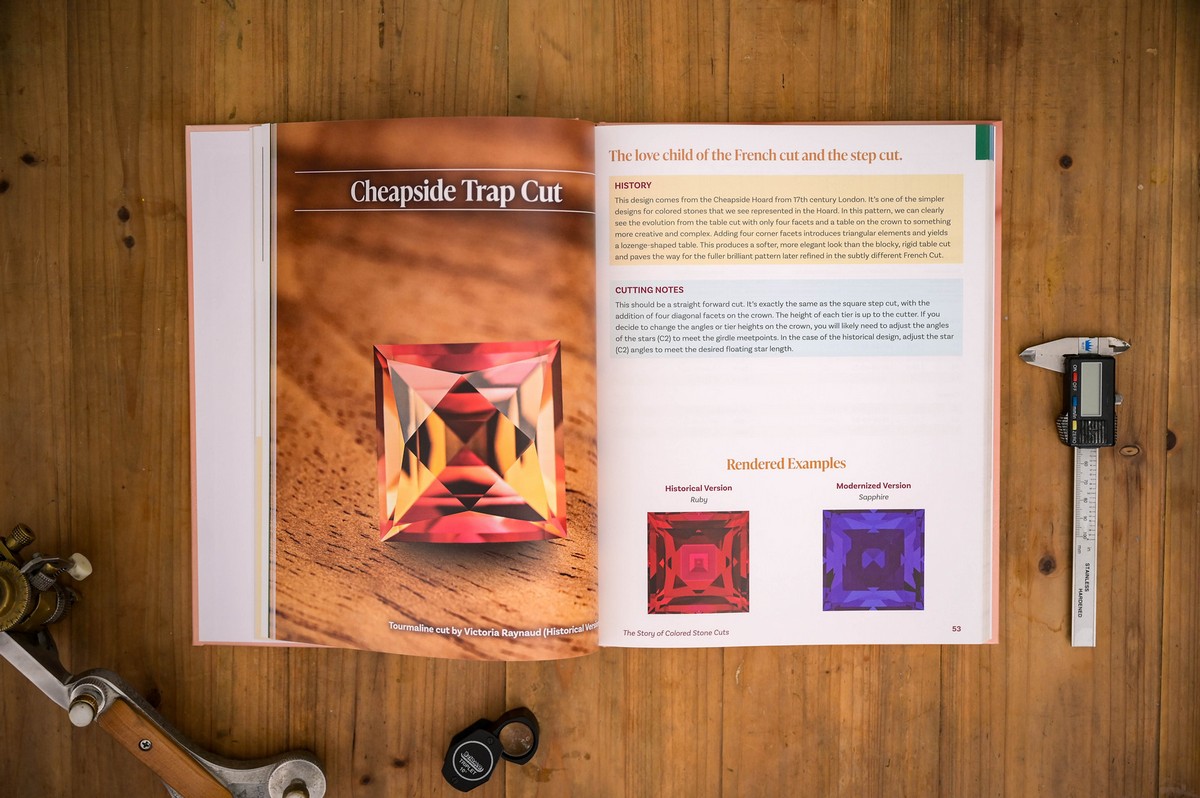
Innovations over the last three centuries enabled ever more complex geometries and increasingly sophisticated plane combinations: from the “primitive” single cut (eight facets on the crown and eight on the pavilion), to the old mine cut, a transitional stage towards the round brilliant cut — initially conceived for diamond and later applied to colored gemstones in the United States — up to the checkerboard cut, a table-less pattern that tends to “darken” the interior of the stone.
The culmination of the European tradition is identified in the mixed cut, brilliant on the crown and step-cut on the pavilion, which ultimately stands in contrast to the “American” trend of modern cutting, entirely based on variations of the optical principles underlying the brilliant cut.
At this point, Prim and Raynaud consciously adopt a philological approach, emphasizing that «there is no inherently better design, just as there is no single way to approach gem cutting», and that it is therefore more appropriate to rely on an understanding of «what has been done historically». This stance proves particularly persuasive, as it restores the gemstone to its nature as an artistic artifact and bearer of cultural values, rather than reducing it to an engineered product derived from purely technical applications. From this perspective, no lapidary style can be considered obsolete, and it is legitimate — when aesthetic outcome so requires — to depart from rigid commercial optimization criteria such as weight retention.
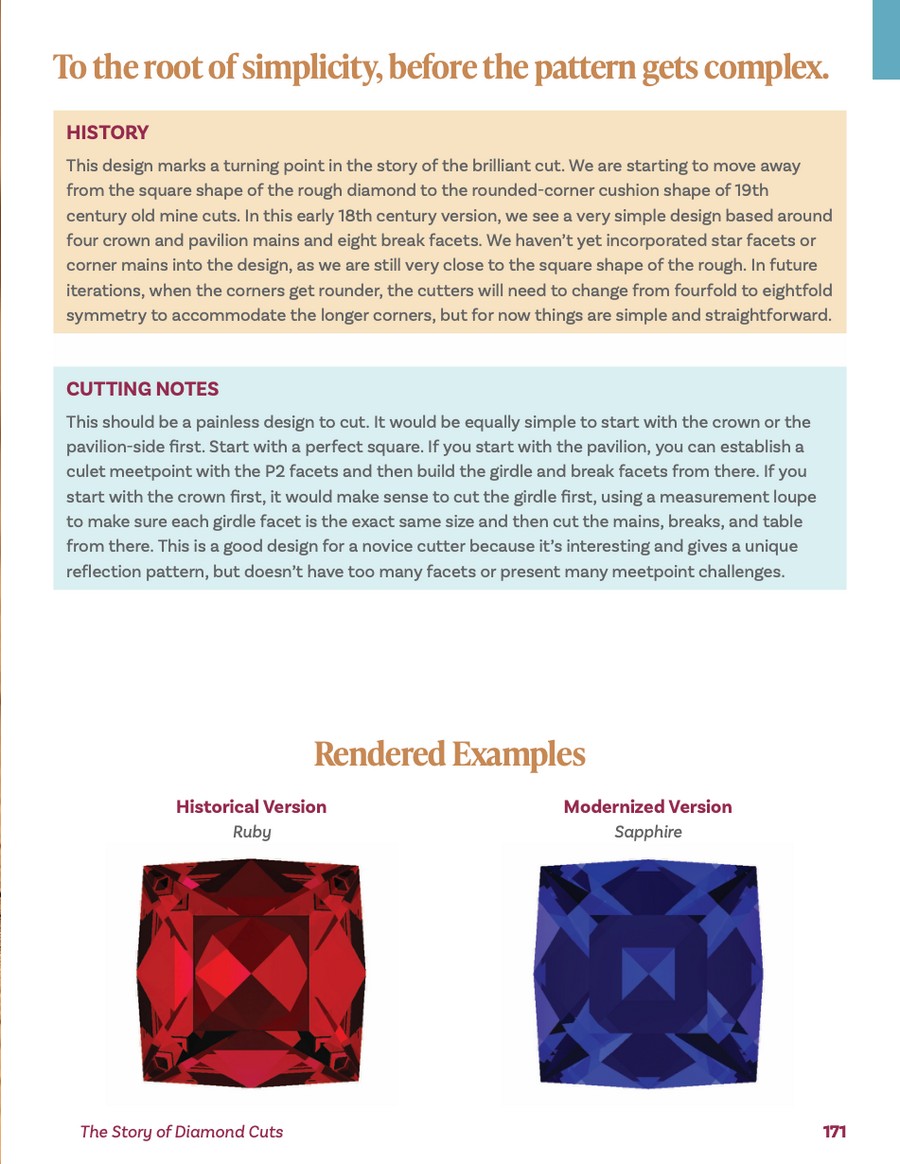
After the introductory considerations, the text mirrors the structure of the previous volume and presents a rich repertoire of cutting styles reconstructed through a careful study of the underlying “languages” of lapidary art. Each style is contextualized within the historical framework that generated it and is accompanied by execution diagrams, both in their original form — often constrained by the technical knowledge of the period — and in an updated version, enhanced with additional orders of facets.
“The Historic Teachings of Gemcutting” is a carefully conceived and edited work, illustrated with clear and effective diagrams, and fills a curious bibliographic gap. In our view, it rightfully deserves a place in the library of gemologists and cutters alike: not only as a solid historical study of the evolution of the cutting arts, but also as a highly practical operational manual, equally valuable to hobbyists and professionals.
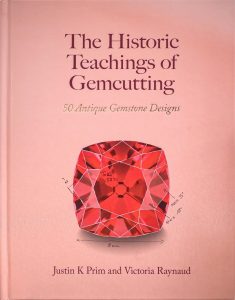
“The Historic Teachings of Gemcutting – 50 Antique Gemstone Designs”
Justin K Prim and Victoria Raynaud
Published in Lyon, France, by Magus Publishing in 2025.
222 pages, illustrated, hard cover, format 28 x 23 cm
ISBN: 9781737057819
Available in English language on www.magusgems.com
at the price of 120 US$ (about 102 €) + shipping.
Review by Paolo Minieri, published on IGR – Italian Gemological Review #22 – Spring 2026.