This content was first published on IGR – Italian Gemological Review no. 6 in 2019. The information provided here is therefore current as of the original publication date.

In September 2018 De Beers started selling synthetic CVD diamonds under its mark Lightbox. What’s behind this surprising move? Who are the competitors? How does communication change?
De Beers enters the synthetic diamond market and reduces the prices
Once the pricing strategy decided to launch Lightbox in September 2018 is considered, following the initial surprise, the tactic of the south African giant seems to be clear: a pendant with a synthetic diamond solitaire of one carat is sold at $800, plus the cost of the mounting… An equivalent synthetic diamond in the same period was offered at $3.700! But this is no diversionary tactic.
This product was sold out in a week. Competitors and commentators argued that the whole matter was but a temporary move to drive down the market quotations of synthetic stones and that the company didn’t have the required production capacity to meet the expected demand. Actually the goods have been shortly restocked.
Apparently synthetic diamonds are a quite attractive business. It is no coincidence that Lightbox is entering the market the very moment many producers were planning to shift towards retailing, in search of what was supposed to be an interesting margin.
In fact one month after the launch, Richline introduced its high priced synthetic diamond line “Grown with love”, directly marketed within the shops of Macy’s e JCPenney according to a policy probably chosen before De Beers reshuffled the cards.
This is why the marketing policies generally used by all the manufacturers focus on stones over one carat, a segment in which they think Lightbox’s offer might prove to be inadequate. In this area of products the planned retailing selling prices could allow to keep the profit margin expected before Lightbox entered the business. The higher the prices, the higher the perception of rarity and preciousness will be.
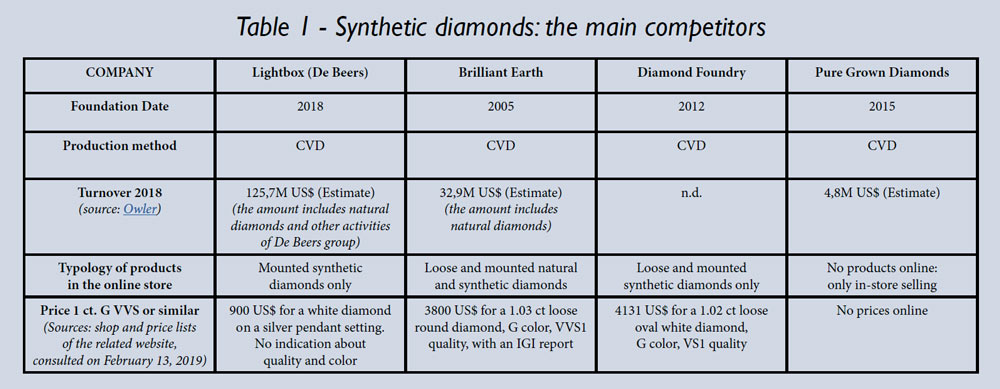
So Lightbox follows other brands such as Diamond Foundry, Brilliant Earth and Pure Grown Diamonds aiming for better position in a fast growing market where the recurrent strategy is based on online sales (Table I).
Which is the positioning policy of De Beers’ synthetic diamonds in relation to their main competitors?
Different languages. Lightbox is based on the price shock effect
The marketing strategies of synthetic diamonds in the United States show similarities but basically each company behaves according to its own targets. Let’s start from the sale channels. While Lightbox, Diamond Foundry and Brilliant Earth focus on the web as the main distribution tool, Pure Grown Diamonds remains in the more traditional in-store trade model.
As a direct retail oriented e-commerce platform, the shop of Lightbox takes the most important place of the website. What can be seen at a first glance is a new approach to disclose the prices. Jewelry with natural diamonds is typically offered discretely, quotations are often confidential, luxury is the message while quotations are in the background. The communication core is based on the uniqueness of the product. In the field of luxury low prices are not a marketing tool as good as desirability and exclusivity. Lightbox reverses these factors, prices are free-to-air and are innovatively explained in their different components of synthetic stones and precious metal (Figure 2).

The reference to ethical compliance is considered a competitive factor, a card that synthetic diamond manufacturers are insisting to play, mainly in the US market. Their alleged better environmental sustainability is frequently used as a primary weapon of their communication (Figures 7-8-9). Not surprisingly Lightbox does not not emphasize the issue, the target is to confine it in the context of natural diamonds responsible mining only.
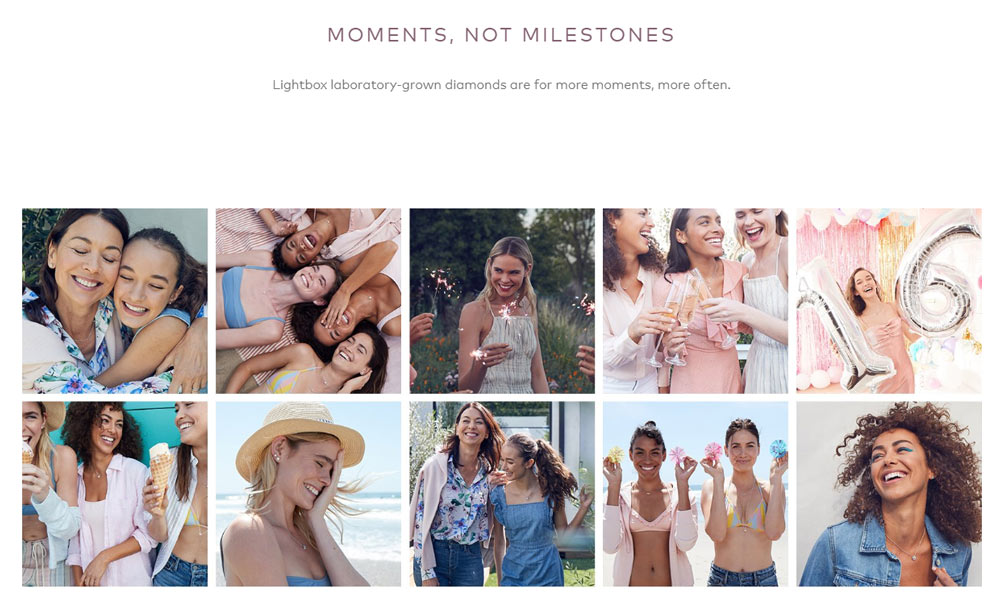
If compared to traditional business models which predominantly celebrate family and couple relationships, Lightbox seems to indicate a different invitation to purchase jewelry. It’s sufficient to give a look at how the homepage was set up in February 2019 (Figure 3) to promote Galentine’s day, a new term in fashion since 2017 to indicate 13 February, the day of celebration of female friendship, in opposition to Valentine’s day. The message in this case is addressed to women, an invitation to purchase gifts for friends, daughters, mothers and sisters.
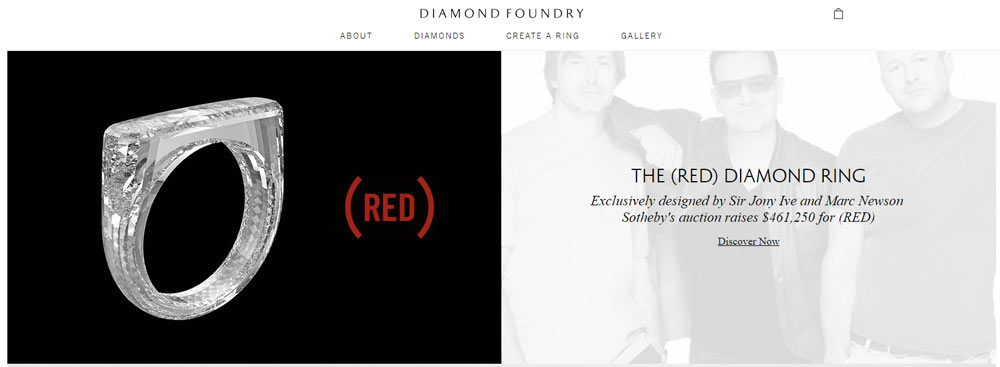
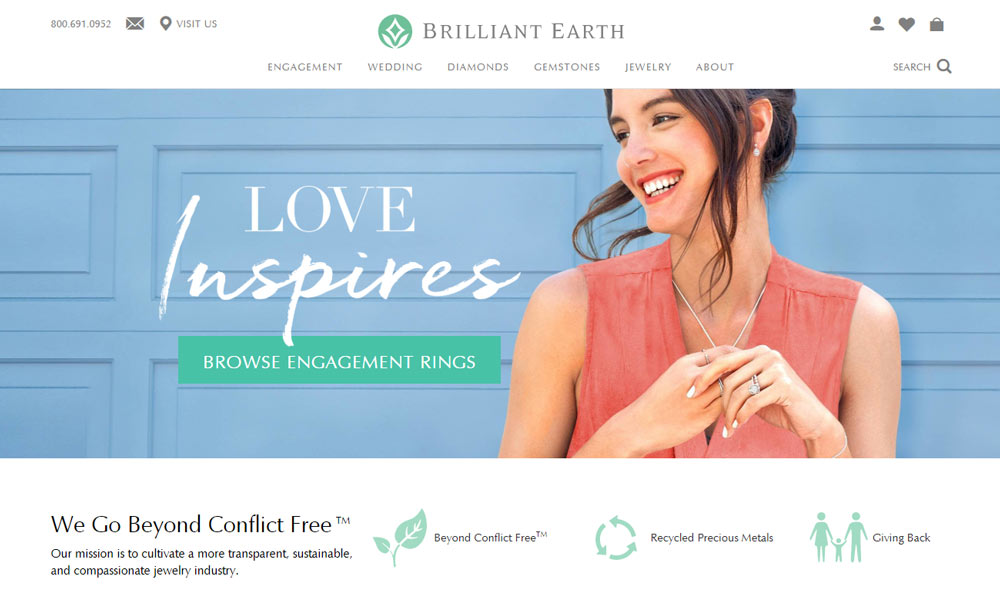
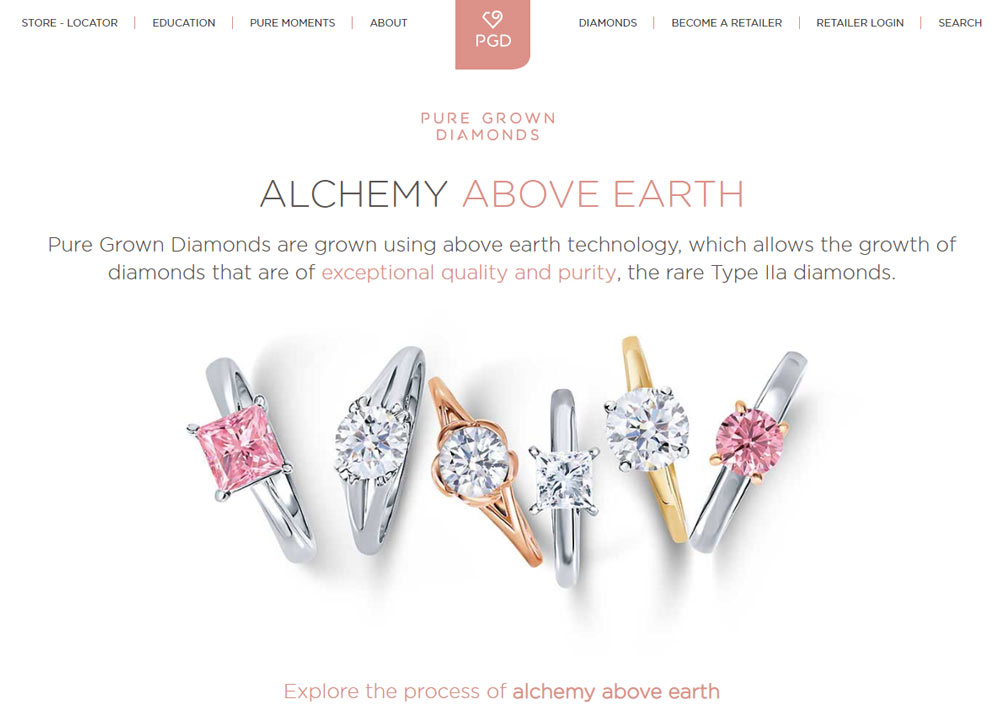
Diamond Foundry (Figures 5-6) opts for the uniqueness of the product. Its homepage of February 19, 2019 emphasized “(RED)”, a synthetic diamond ring created starting from a single piece of rough and made of 2000 to 3000 facets. Reference is also made to the issue of nature and environment protection as well as to the celebration of love and couple relationships. In this case the target overlaps with natural diamonds again. Brilliant Earth (Figure 7) and Pure Grown Diamonds (Figures 8-9) follow the same trend, graphic symbols and colors reveal the typical rediscovery of love and parental values and a sense of gratification after buying or receiving a synthetic diamond as a gift. This scheme reproduces the same features as natural diamonds.
The revolution, Lightbox issues no certifications. All the same and all beautiful, that is synthetic
Formerly, the producers of synthetic diamond have been following for years the strategy based on the creation of an image able to express all the preciousness of natural diamonds. They did not merely imitate celebratory styles or eco-friendly solicitudes. In fact, like natural gems, the synthetic diamonds of the main American brands have been complemented by gemmological certifications since the beginning. Brilliant Earth (Figure 11) and Diamond Foundry (Figure 13) copy, on the web, the classic model of on line quotations: features, price, certification. Also, in this case Lightbox marks a break: “Just like any hi tech product, we create our gems to a consistently high standard. Over and over again. So our solitaires don’t need certificates to describe them. What’s the point? They’re all the same. Equally beautiful, each and every one…”. They may be beautiful, but if they are all identical, they are not unique stones.
After all, the communication of the Lightbox product reveals, in a thorough and exhaustive way, the whole sense of De Beers vision of the future market. Synthetic diamonds are a reality, but they must be enclosed in a specific space not expected to invade that of natural diamonds. The aim of the sudden joining the scene by Lightbox is not only that of generating revenues through the quantities that the market is expected to request. Such a move is meant to obtain something more, that is to radically polarize the offer of stones enhanced in laboratories on a market range much more commercial than the natural diamond one. In this way, they will protect their historically consolidated prerogatives, the perception of uniqueness, desirability and, above all, quotations.
Old and new messages. Young people are the target
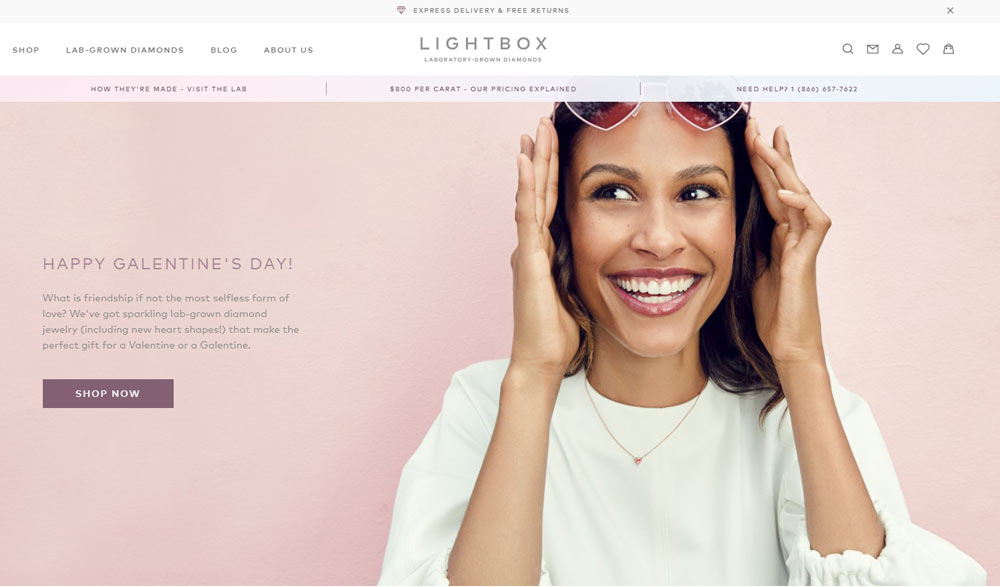
(Photo: lightboxjewelry.com, screenshot of February 11, 2019)

(Photo: brilliantearth.com, screenshot of February 11, 2019)
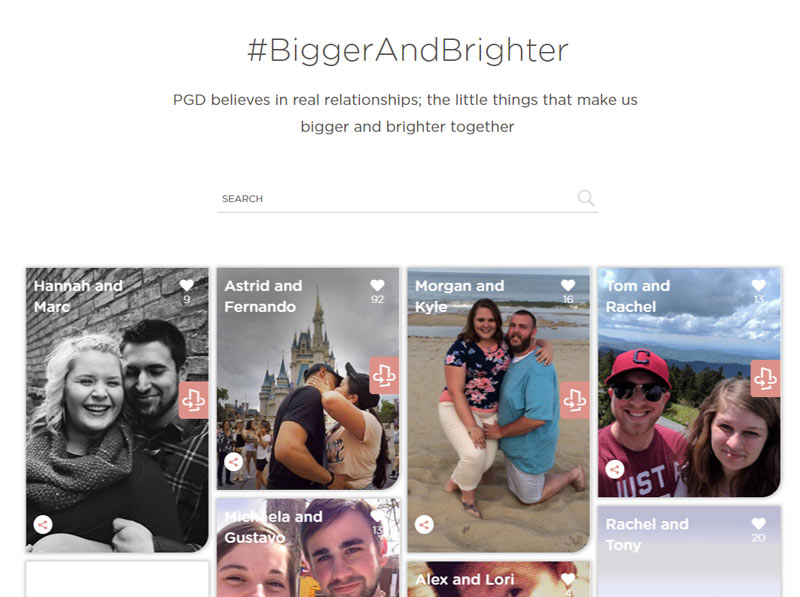
Only mounted, only to consumer and with no reports. Lightbox moves away from competitors
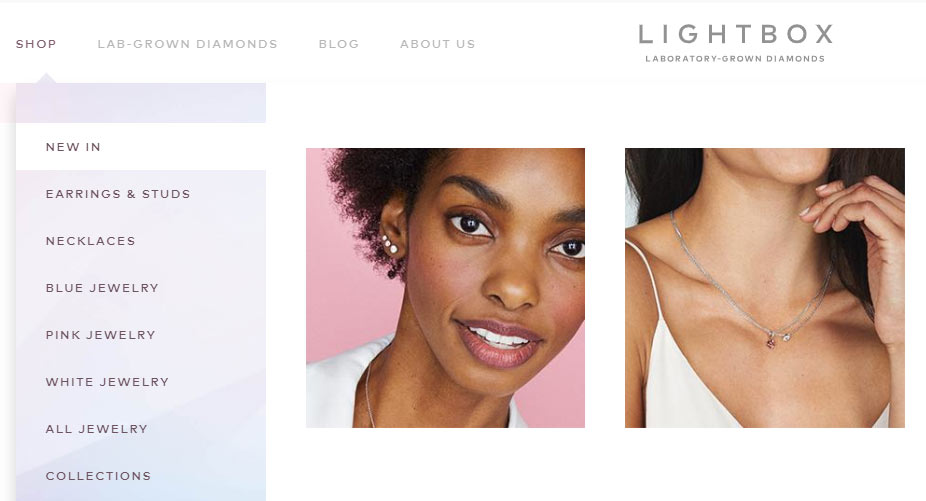
(Photo: lightboxjewelry.com, screenshot of February 19, 2019)
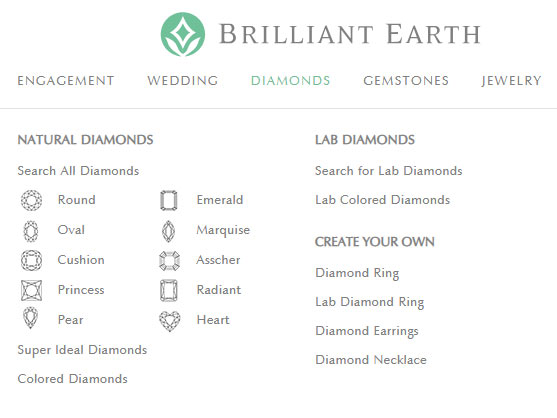
(Photo: brilliantearth.com, screenshot of February 19, 2019)
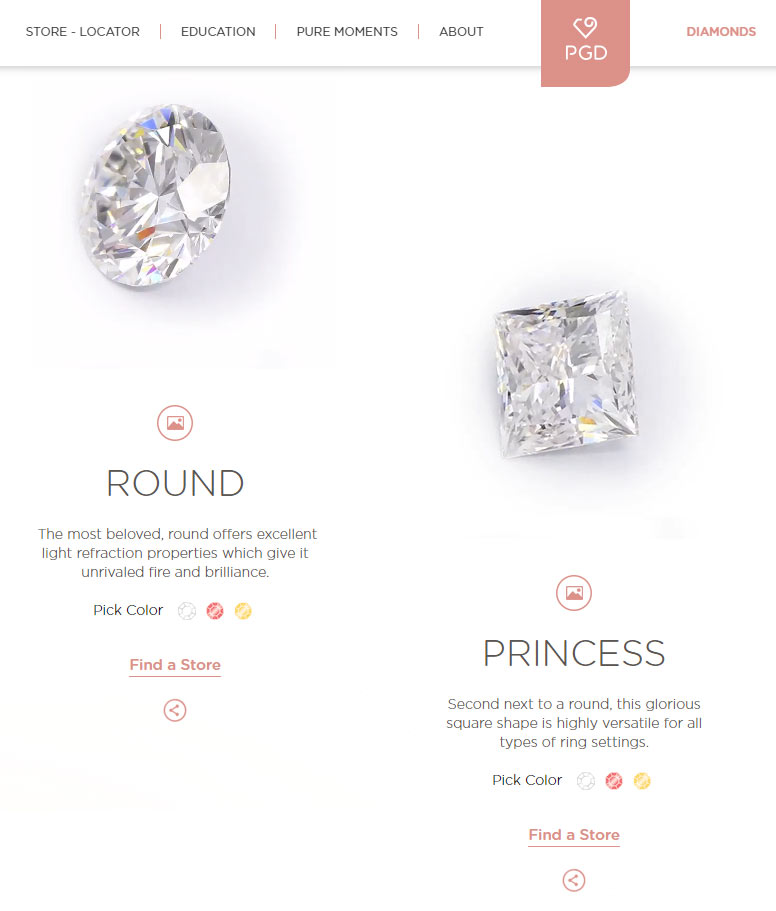
(Photo: puregrowndiamonds.com, screenshot of February 19, 2019)

(Photo: diamondfoundry.com, screenshot of February 19, 2019)
Article by Domenico Angelino, published on IGR – Italian Gemological Review #6, Spring 2019.