The Spring 2026 edition of Gems & Gemology, the scientific journal of the Gemological Institute of America (GIA), combines advanced analytical research, laboratory rigor, and historical reconstructions of the gem trade, presenting three feature articles alongside the usual technical columns and industry updates.
The first contribution, “A classification scheme of natural radiation stain morphology and texture on diamond” by Taryn Linzmeyer, Roy Bassoo, Sally Eaton-Magaña, Bernd Zechmann, Nathan D. Renfro, and John I. Koivula, introduces the first systematic scheme for describing the morphology and texture of “radiation stains” (green and/or brown spots) on the surface of rough diamonds exposed to natural irradiation in alluvial deposits. The study catalogs 84 diamonds, primarily from Guyana but with samples also from Venezuela, Namibia, and unknown origins, analyzed using photomicrography, DIC microscopy with focus stacking, photoluminescence spectroscopy (mapping the GR1 defect at 741 nm), and, innovatively, atomic force microscopy (AFM). The classification is based on four key parameters: color (green, associated with the GR1 defect, or brown), opacity (opaque, with a dark core, strong lattice damage, and weak Raman signal at 1332 cm⁻¹; or translucent, with a stronger GR1 signal and less amorphization), dominant shape (regular, circular or oval, isolated or connected; or irregular, lobate or net-like, also isolated or connected), and characteristics of the underlying surface coinciding with the areas affected by radiation stains. The latter are divided into four groups: presence of stains without visible texture (Group 1), presence of grooves or fractures (Group 2), expanded convex surfaces (Group 3), and micro-roughness or geometric micro-cavities (Group 4), interpreted as negative incisions due to preferential dissolution or as impressions of secondary uranium minerals.
The second article, “Diverse range of organic-rich cores in south sea non-bead cultured ‘keshi’ pearls” by Nishka Vaz, Abeer Al-Alawi, and Anukul Belanke, focuses on the internal characteristics of non-bead cultured “keshi” pearls, whose identification can be particularly complex due to their similarity to natural pearls. For this study, a group of 43 pearls with concentric, organic-rich cores was selected; the authors combined microradiography (RTX), micro-CT (μ-CT), EDXRF, and XRF, polishing five specimens down to the core for Raman analysis. These pearls are distinguished externally by their silky luster and large size; the surface shows extremely fine, overlapping terraced structures, sometimes arranged in spirals, as well as small subsurface white spots or protuberances. Internally, markedly asymmetric or elongated calcium carbonate cores (oval, pear-shaped, or spindle-shaped) are typical, along with the frequent presence of multiple fused cores. Growth anomalies are also characteristic, such as “step-down” structures, loosened layers, and dehydration fractures. Raman data confirm aragonite as the dominant phase (peaks at 1086 cm⁻¹ and the 701/705 cm⁻¹ doublet); in some areas, magnesian calcite (716 cm⁻¹) was detected. EDXRF shows very low Mn (<39.8 ppmw) and Sr between 1403–3301 ppmw, consistent with South Sea pearls from P. maxima; vaterite is absent.
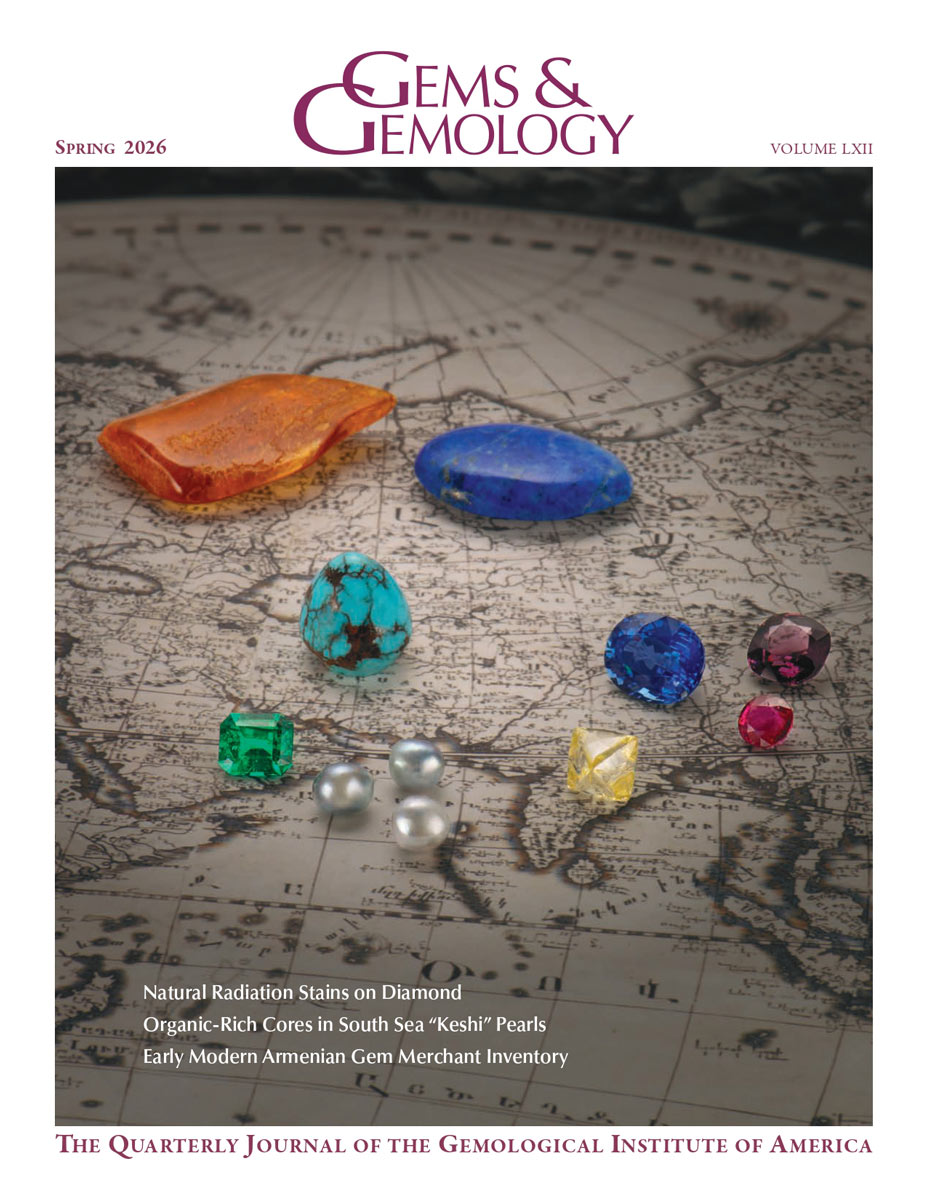
The historical-gemological article by Sona Tajiryan, “Records from a Luxurious Past: Gem Inventory of a Seventeenth-Century Armenian Merchant”, analyzes a 1688 probate inventory pertaining to Gregorio di Girach-Mirman, an Armenian merchant from New Julfa (Isfahan) active between Venice and Livorno, documenting over 100,000 gems and more than 1,700 kg of rough materials. Among the most notable assets are 10,191 loose emeralds, with a total weight of 5,021 carats, including extraordinary specimens of 172, 171, and 133 carats, almost certainly of Colombian origin (Muzo) and having reached Persia via Spanish routes or the Manila galleons. The diamond collection includes one loose specimen of 106.75 carats and another 15 diamonds totaling 46.875 carats, most likely from Golconda; to these are added 657 mounted diamonds and 119 smaller loose diamonds. Among the corundums and so-called “oriental topazes”, an 84-carat yellow corundum and two blue sapphires of 174 and 16 carats stand out, most probably originating from Sri Lanka. The section on rubies and spinels includes 262 loose rubies totaling 89 carats, most likely from Mogok, and 17 red spinels totaling 26 carats; Armenian merchants of the time already clearly distinguished spinel (la’al) from true ruby. Completing the picture is an enormous variety of other materials: Persian turquoise (94,915 cut pieces plus 92 pounds of rough, from Neyshabur), 4,036 pounds of lapis lazuli from Badakhshan, 431 pounds of Indian garnet, 1,270 pounds of Baltic amber, and 801 natural pearls collected in the Persian Gulf and the Gulf of Mannar.
In the Lab Notes section, several exceptional cases are reported, including a treated rough purple diamond with arrow patterns in DiamondView, an Ethiopian “chocolate” opal with a positive cerium anomaly, and a resin-filled cultured pearl sealed with a seed pearl.
Finally, In the Spotlight comments on the exhibition Cartier and Myths at the Capitoline Museums in Rome, which juxtaposes Cartier high jewelry and classical sculptures, highlighting the role of the golden section and Pythagorean geometry in the Maison’s proportions. Iconic pieces include the Medusa brooch (1906, pink coral), feline jewelry with pavé settings, and an Egyptian necklace featuring a statuette of Isis over 3,500 years old.