This content was first published on IGR – Italian Gemological Review no. 11 in 2021. The information provided here is therefore current as of the original publication date.

Traditionally gem reports are based on quantitative data. The quality of the gems is consequently perceived as based on objective informations measuring how far a gem deviates from the ideal parameters of color, purity, proportions (cut) and so on. But when it comes to rating such a system made of figures works much better for diamonds than it does for colored stones.
On this ground Gübelin Gem Lab launched a scoring system for colored gems based on wine ratings. The company website is a good explanatory source and provide in-depth information on the matter. It acutely explains this difficulty: “The end consumer depends heavily on expert’s advice, and it is quite impossible to get even an approximate value-for-money”. Considered for this service are gemstone such as: Corundum ruby, blue sapphire and the most common fancy sapphires including padparadscha; Beryl emerald, aquamarine, morganite and heliodor; Spinel (red-pink); Chrysoberyl, chrysoberyl alexandrite; Tourmaline elbaite (paraiba), rubellite and indicolite; Zoisite tanzanite; Garnet demantoid, tsavorite, mandarin; Topaz, imperial and red-pink. These types of gemstones qualify for the Gübelin Gemstone Rating as long as they are natural (i.e. non-synthetic), transparent and faceted or polished.
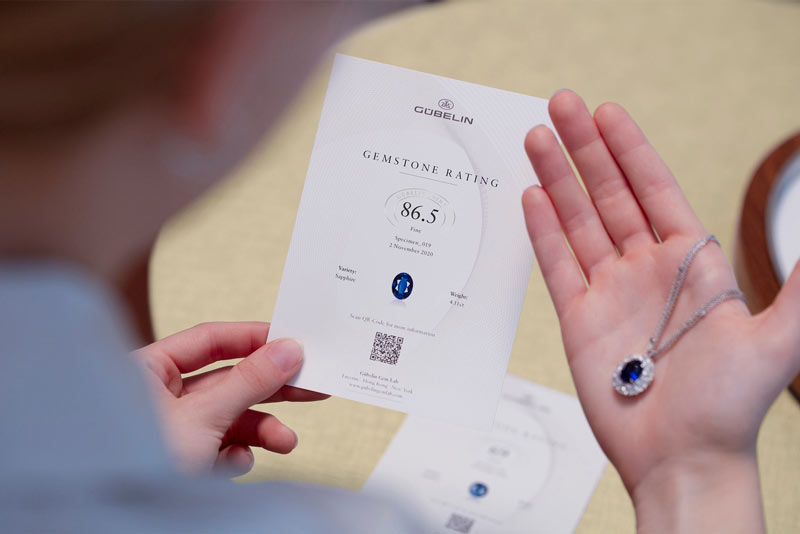
Gemstone rating should be considered a complement to traditional reports
First of all it must be pointed out that the Gemstone Rating document does not replace a traditional gemological report, but is rather its complement even though it can be requested as a stand-alone service, currently given only in the Lucerne laboratory. Apparently, the company’s policy is that of pushing the sale of the rating document together with the traditional report. If associated with it, the cost is 100 CHF (€ 92), if not associated the cost jumps to 250 CHF (€ 231).
“The rating is based on three categories” Raphael Gübelin – President of the House of Gübelin – declared. “The primary one being quality, which is complemented by rarity and salience. The main criteria – quality – consists again of color, clarity/transparency and cut/brilliance. Color is further broken up into hue, tone, saturation and homogeneity. Rarity comprises the type of gemstone, the presence, absence and type of treatment, and the size of the gemstone. Finally, the salience addresses the level of exceptionality, i.e. insofar as a gem is able to attract the attention of the observer, to stand apart from other gemstones. The overall result of the rating is expressed in an easy-to-understand numerical grade: the Gübelin Points”.
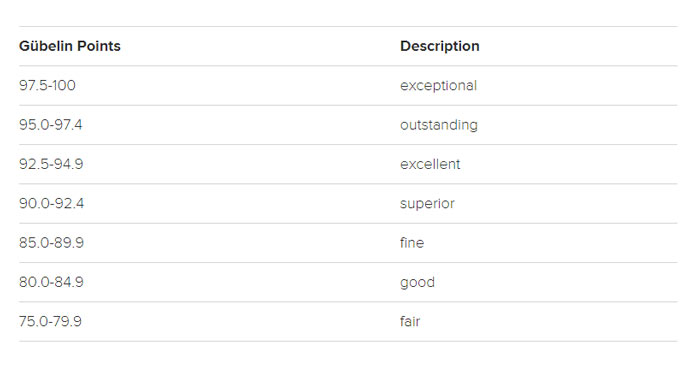
The Gübelin points, ranging from 75 to 100, intend to describe the specific properties of the more high-end gemstones. These points, supposed to impress the consumers’ mind, are the heart of the grading system and represent the long awaited “value” the market has been requiring, not yet expressed in a univocal and easily understandable way by colored stones traditional reports.
These, for example, lack comparative information among the various colored gems. As they currently are, reports do not explain to what extent a gem is available on the mining sites and on market or how severely they may have been treated.
Introducing a new parameter, salience
Inevitably, now that desirability is summarized in a number and a score is assigned, the judgement drives the observer beyond the perilous Pillar of Hercules of subjectivity. Gübelin is aware of the implications of its move: “Salience is the parameter with the least quantitative or scientific base. It contains an element of subjectivity… There seems to be a common consensus among gem connoisseurs about which gemstones – beyond the objective quality criteria – are highly attractive and “talk to them”. This shared perception made us introduces salience. It allows, for example, to compensate for the lower transparency rating that the typical Kashmiri sapphire with the velvety appearance will get. Or for the lower rating for color homogeneity in the most beautiful Padparadscha sapphires that typically show a slightly uneven color distribution”.
As well as for the duties of identification and provenance determination Gübelin claims to found its rating system “on the wealth of data the Gübelin Gem Lab has gathered on colored gemstones over its almost 100 years of history and experience”. Since we are in the presence of something innovative without conventional protocols, it would be interesting to see if the criteria that make a gem more or less salient will be released in the near future. This will certainly help the industry and gemology as a whole.
Admittedly, salience, defined as the “capability to stick out of the crowd”, is something related to the extent of exceptionality and attractiveness of a gemstone. As such, it has more to do with the cultural and environmental conditions in which the assessments take place and less with the objective characteristics of the quality category. Gübelin‘s website, in this regard is very clear: “certain parameters shift and drift over time, and demands to adjust rating parameters such as the rarity from time to time. This also affects the consistency of the rating result”.
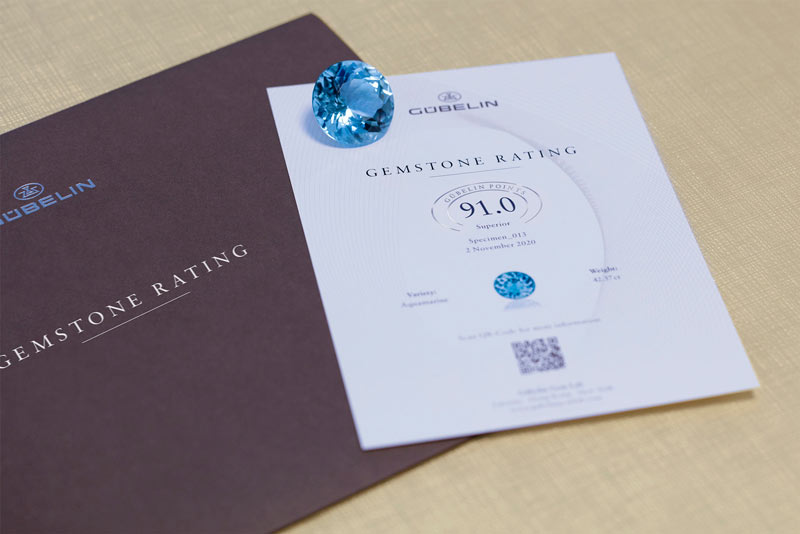
Geography remains on traditional gemstone reports while history affects the consistency of ratings
Interestingly, while on its traditional gem reports the geographic determination is provided “when possible”, the Gübelin Gemstone Rating documents never mention the provenance, since reportedly it might interfere with the consistency of the concept of rarity. It must be reminded that the origin determination is the real company’s flagship, and it might be inconvenient to offer this service at a lower price with a “reduced and shortened level of analysis not providing the level of certainty comparable to what is undertaken when testing a stone for a Gübelin Gemmological Report”.
Whoever will follow in the footsteps of Gübelin’s new initiative must come to terms with geography as well as history. The concept of rarity is directly linked to periods of time as “the mining activity and the quality of mined stones changes, as do customer’s preferences. Consequently, rarity parameters need to be observed, reviewed and possibly adjusted from time to time”.
The production of a judgment that can be spent on the market will certainly open a discussion among the experts. After all, gemology has always oscillated between the opposite poles of scientific research and its application to market demand. There are questions that arise. Will other labs follow suit? Will the Gübelin Points become a standard? Will consumers insist on the color gem score when buying stones?
Gem News published on IGR – Italian Gemological Review #11, Winter 2020-21