This content was first published on IGR – Italian Gemological Review no. 15 in 2022. The information provided here is therefore current as of the original publication date.

The “IV National Conference Diamond and Coloured Gems: Identification, Tracing and Ethic Aspects” was held in Ferrara, Italy, on July 7-8, 2022 at Palazzo Tassoni Estense. As was the case for last edition in 2021 held in Bari, IGR promoted the event, which was well attended, contributing as Media Partner to its dissemination, at both national and international level.
Fabrizio Nestola (Department of Geosciences, University of Padua) followed up on his presentation given at the previous edition in Bari where he had highlighted the difference between lithospheric and superdeep diamonds, the latter being useful for the study on the planet’s evolution.
This time, however, he made us part of a new development concerning the superdeep diamonds research field: through the careful study of their inclusions, an unexpected element has emerged, that is some deep diamonds moved downward and then upward in the mantle, and this was never studied before. It is therefore possible to state that the diamonds, so to speak, “travel” in the mantle since the phenomena highlighted within them are associated with specific depths.
Prof. Nestola, who managed a five-year (2013–2018) research on the matter funded by the European Research Council Starting Grant, has for some time now devoted himself and his team to the study of processes that occur in the Earth’s mantle at great depths. The object of his recent study is a highly included 1.3-carat African alluvial sample analyzed by micro Raman spectroscopy and SIMS (Secondary Ion Mass Spectrometry).
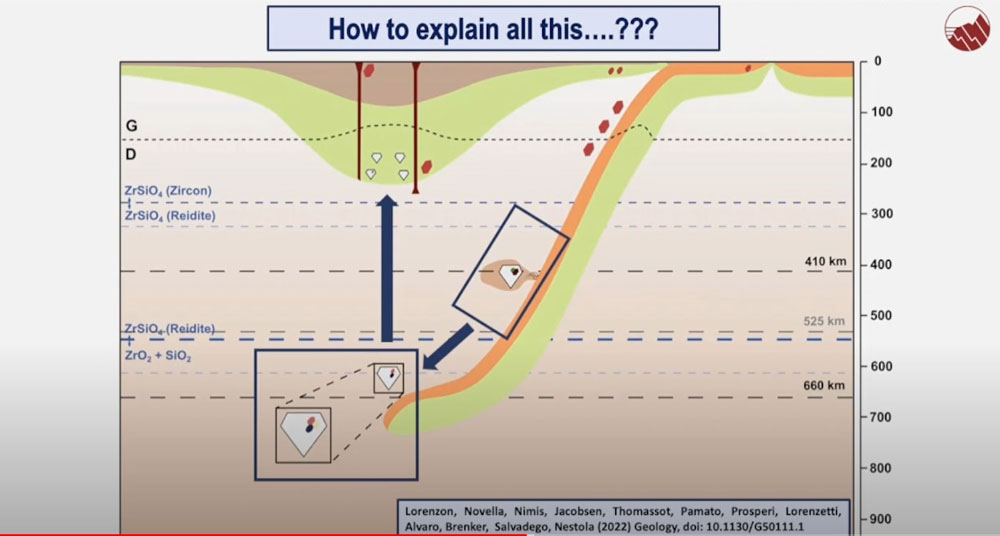
Raman analysis showed a 10-micron inclusion that was composed of ringwoodite ((Mg,Fe2)SiO4), a high-pressure form of olivine that can be found between 525 and 660 km depth, tetragonal zirconia (ZrO4), also a high-pressure polymorph of baddeleyite stable at 600 km depth, and finally coesite (SiO2) the high-pressure form of quartz. The association of these minerals turns out to be unusual and never before discovered and therefore can only be explained by a “trip” of the diamond into the mantle. The team therefore assumed that olivine and zircon were present in the upper part of the mantle, these two minerals were then included within a diamond that was forming and then went down into subduction along with a plate. Here the olivine and zircon, being no longer stable, turned into ringwoodite, tetragonal zirconia and coesite before being then transported to the surface. The full study by Professor Nestola and his team can be downloaded at the following link: https://pubs.geoscienceworld.org/gsa/geology/article/doi/10.1130/G50111.1/614064/Ringwoodite-and-zirconia-inclusions-indicate.
Sofia Lorenzon (Department of Geosciences, University of Padua), as part of research conducted under the direction of Prof. Nestola, presented to the audience the results of a group work on the genesis and depth of formation of ferropericlase inclusions within superdeep diamonds. Ferropericlase [(Mg,Fe)O] is the most common inclusion in superdeep diamonds (those that form at more than 300 km depth). However, due to discrepancies between experimental and natural data on this mineral, the origin of ferropericlase diamonds remains controversial. The results of single-crystal X-ray diffraction analysis on a series of ferropericlase inclusions in superdeep diamonds from Juina (Brazil) and Kankan (Guinea) indicate that ferropericlases with different chemistry are preexisting to diamonds (as inclusions exhibit random-type orientations) and formed at different depths in the Earth’s mantle and thus not only in the lower mantle.
Pia Antignani (LabiGem) reported on a work whose purpose is to identify the origin of diamonds in an extraterrestrial rock found in the Egyptian desert in 1996. For this purpose, an X-ray microdiffraction analysis was performed on the carbon phases contained in Hypatia (the name given to the rock). Diffractometric data allowed the identification of various mineral phases within the samples: nanometer polycrystalline diamonds, compressed graphite, lonsdaleite (a high-carbon pressure polymorph) and metallic iron. The presence of these phases allows for the assumption that the diamonds in Hypatia were formed by a shock impact that occurred in space. The research project will continue: many questions about how and when this impact occurred still await answers.
Article by Paolo Minieri and Stefania Coppola, published on IGR – Italian Gemological Review #15 – Autumn 2022.