This content was first published on IGR – Italian Gemological Review no. 15 in 2022. The information provided here is therefore current as of the original publication date.

The “IV National Conference Diamond and Coloured Gems: Identification, Tracing and Ethic Aspects” was held in Ferrara, Italy, on July 7-8, 2022 at Palazzo Tassoni Estense. As was the case for last edition in 2021 held in Bari, IGR promoted the event, which was well attended, contributing as Media Partner to its dissemination, at both national and international level.
Peter Tollan (Gübelin Gem Lab Ltd.) led the audience on a virtual tour of the company’s laboratory, founded in 1923 and now based in three locations: Lucerne (headquarter), New York and Hong Kong. The relatively simple instrumentation, based on crystallographic techniques, has evolved to include more sophisticated geochemical techniques that better meet the ultimate challenge, that is the determination of geographic origin. A modern laboratory also differs from a research center in terms of speed of its performance (a report is produced in 2 to 8 working days), it must be profitable enough to allow further investments, the technology must be efficient and such that it can be duplicated, always using nondestructive testing techniques.
The three instrumental pillars are: FTIR, XRF fluorescence, UV-Vis ultraviolet spectroscopy, often in combination. In case further investigation is necessary these will be implemented including LA-ICP-MS and Raman and photoluminescence spectroscopy.
FTIR (Furier Transformation Infrared Spectroscopy) detects possible heat treatments through hydrogen defects. Diagnostic mineral inclusions as well as the presence of fillers in emeralds can be found as well. UV-Vis ultraviolet/visible spectroscopy, interacting with the chromophore elements of the crystal lattice, generates characteristic absorption bands and discriminates, for example, Paraiba from other tourmalines of similar color, blue spinels with and without cobalt, and basaltic sapphires from the metamorphic ones.
X-ray fluorescence, through ionized radiation, determines changes in the orbital structure of atoms within the crystal lattice, resulting in the release of element specific characteristic fluorescent X-rays. This technique can identify ruby treatments by detecting lead and is also useful for origin determination, a task that requires, where XRF is not sufficient, an additional step.
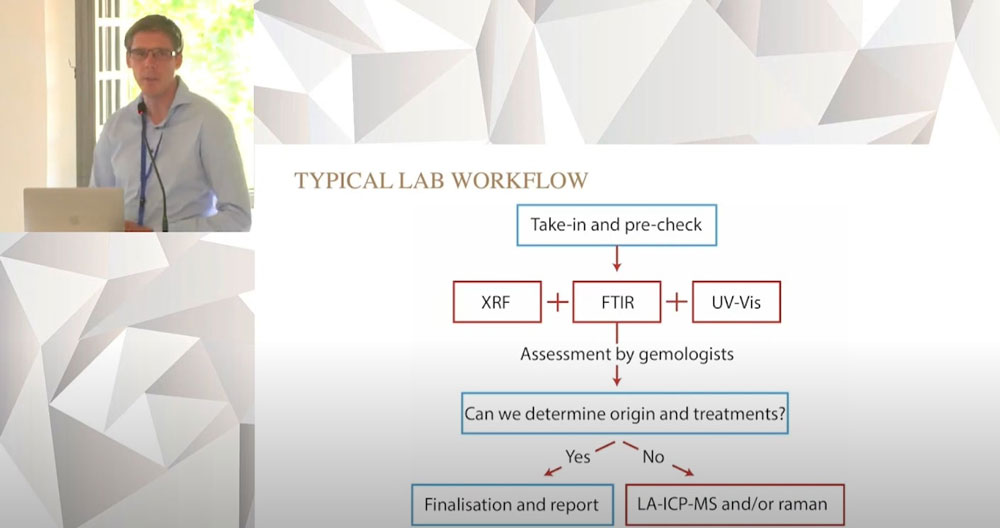
Indeed, the provenance identification is increasingly paramount in the lab’s work: the value of a 19.88-carat Kashmir sapphire sold for $4 million is 5 times the price that a gemstone with similar characteristics from Madagascar would have fetched.
Identification of provenance is then further pursued through LA-ICP-MS (Laser Ablation-Inductively Coupled Plasma-Mass Spectrometry).
As early as in 2006 the laboratory acquired the first available technology for such an application, which today has become a must among every reputable testing center. Through a pulsed excimer (arF) laser, focused on the abrasions made on the girdle, a small amount of ablated sample material is transported to the Ar plasma in He carrier gas. The ionization of the material by the plasma allows the separation and the detection of ions as well as the characterization of trace elements on the basis of mass-to-charge ratio.
Requiring an abrasion of just 0.000002 carats, this technique is more effective than the others (XRF) because it has lower limits of detection, more diagnostic elements are read, specifically the light ones such as magnesium (which can discriminate, for example, Madagascar sapphires from Thai or Cambodian sapphires) and lithium present in emeralds; and the results are then referred compared to a library. The LA-ICP-MS is the only technique that can detect beryl-diffused corundum and is also useful for dating zircon inclusions.
Raman spectrometry uses a high-intensity laser exciting homo-nuclear bonds and resulting in Raman scattering of the incident light and a wavelength shift (Raman-shift) related to the vibrational energy of the molecule. In luminescence spectroscopy, a high-intensity laser causes the excitation and the subsequent relaxation of electrons resulting in a characteristic emission of light. Through Raman spectrometry, species and varieties (e.g., tsavorite) or spinel heat treatment (the peak of the unheated is sharper) can be quickly identified.
In the very short-term, the use of new technologies, based on the collection of isotopic data, is on the horizon, though these have drawbacks due to their high cost and space requirements: the splitstream LA-ICP-MS, and the SIMS (Secondary Ion Mass Spectroscopy). The future basically lies in the development of artificial intelligence applied to gems, a project on which Gübelin is already working on in collaboration with CESM and which consists of the creation of data-driven identification algorithms (FTIR, UV-Vis, XRF, LA-ICP-MS) for each gem of ascertained origin.
Article by Paolo Minieri and Stefania Coppola, published on IGR – Italian Gemological Review #15, Autumn 2022.