This content was first published on IGR – Italian Gemological Review no. 14 in 2022. The information provided here is therefore current as of the original publication date.

Can a jewellery item be introduced without the buyer being told exactly what it actually is? In Italy, in light of what we have been able to ascertain, there is ample room for fluctuating ambiguity. It is frequently not understood which gemstones are actually mounted on jewelry products.
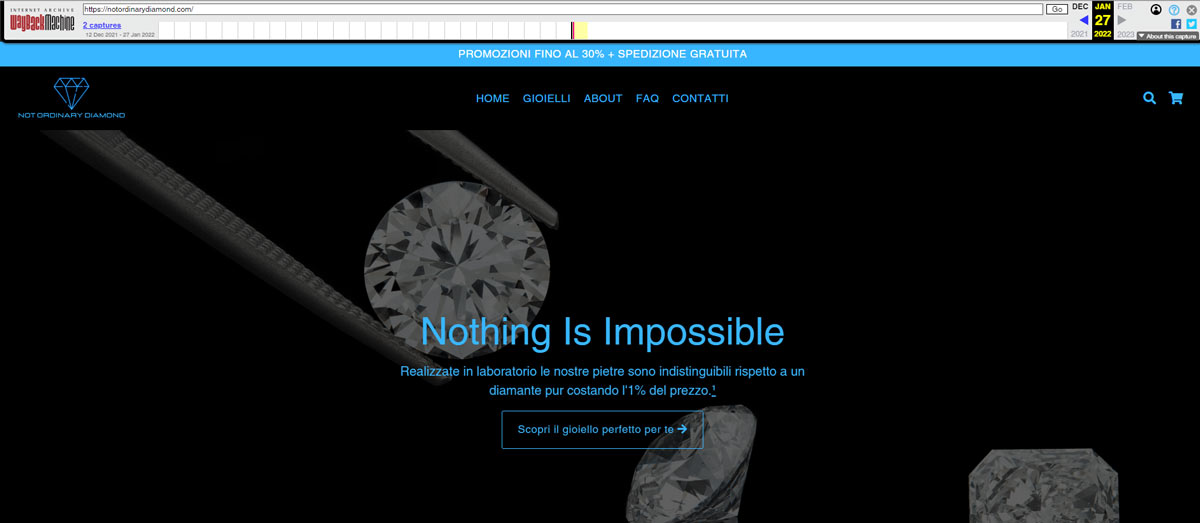
On January 27th, 2022 we went to check out what was being reported at the website N.O.D., Not Ordinary Diamond, an acronym that is clearly referring to a diamond which is not common. A cut stone appears on the home page. The text at the bottom states: «As they are made in a laboratory our stones are indistinguishable from diamonds even though they cost 1% of the price» (Figure 1). These words mean something quite specific: what is that thing that, being produced in a laboratory, cannot be distinguished from a diamond (and being not given any further qualification, reference is therefore indisputably made to a natural diamond)? Well, that’s easy to say: a synthetic diamond, which is precisely what the name of the company indirectly implies, unless the term “non-ordinary diamond” is to be understood as referring to natural diamonds.
Has the riddle been resolved? Not at all. Whether or not this product is actually a synthetic diamond is not specifically declared. In the above text there is a note that is hidden. So we go to read this note: «Upon a random sample of 10 ordinary people observing only at naked eye comparing a VS1 diamond of 0.3 ct to one of our stones of the same size». What an unusual practice. Ordinary people has graded 0.30 carat cut gemstones at naked eye and found them indistinguishable from diamonds. No naming clearly and explicitly comes up except for this equality, N.O.D. product = (apparently indistinguishable) from natural diamond. The unknown is what remains.
Scanning the manufacturer’s web page again, the “indistinguishable lab product” seems to be alluding to a synthetic diamond. Further supporting this assumption is another statement: «To date, the only affordable alternative to diamonds have been the classic synthetic stones used by most known brands». These classic, low-cost synthetic stones that serve as alternatives to diamonds are likewise unmentioned and left hazy: are they alluding to cubic zirconia? So if N.O.D. stones are not the “classic” synthetic stones, then they must unavoidably be newer, more sophisticated synthetic stones belonging to the ultimate generation. Is it about a new Italian lab-growing procedure? According to what we read, it seems so: «[…] In the last 2 years, with the help of a gemmology and precious stone specialist, we have carried out 27 different experiments to develop our stones». Cubic zirconia has been on the market for 4 decades, synthetic diamonds for at least 20 years, so we must conclude that here we are faced with an absolutely new product. What is it all about? If you try to learn more about the website you will be disappointed as you will only get a few clues. IGR has tried to contact N.O.D. to ensure that the seller has the right to have a say about its disclosure policy wherever else this information may be available. Unfortunately we have to note that as of March 3rd, 2022 we have not received any reply.
Note by the editorial team, published on IGR – Italian Gemological Review #14 – Spring 2022.
Read also the related article: LAB NOTES – In Italy gemstones can be sold and bought with absolutely no information about what they really are. A case study (Raffaella Navone and Emanuele Costa), published on IGR – Italian Gemological Review #14 – Spring 2022.