




This content was first published on IGR – Italian Gemological Review no. 4 in 2018. The information provided here is therefore current as of the original publication date.

Did foreign large mining companies change the conditions of local people for the better or for the worse? Violence would or would not automatically break out if rubies were extracted only by small artisan diggers competing with each other? Though Gemfields achieved a significant success in increasing the revenues of Mozambique, the assessment of its ethical compliance is still in progress and controversial following extended negative press and an adverse legal claim. However, this is a complex issue requiring careful and accurate investigations, not a game between good and bad guys.
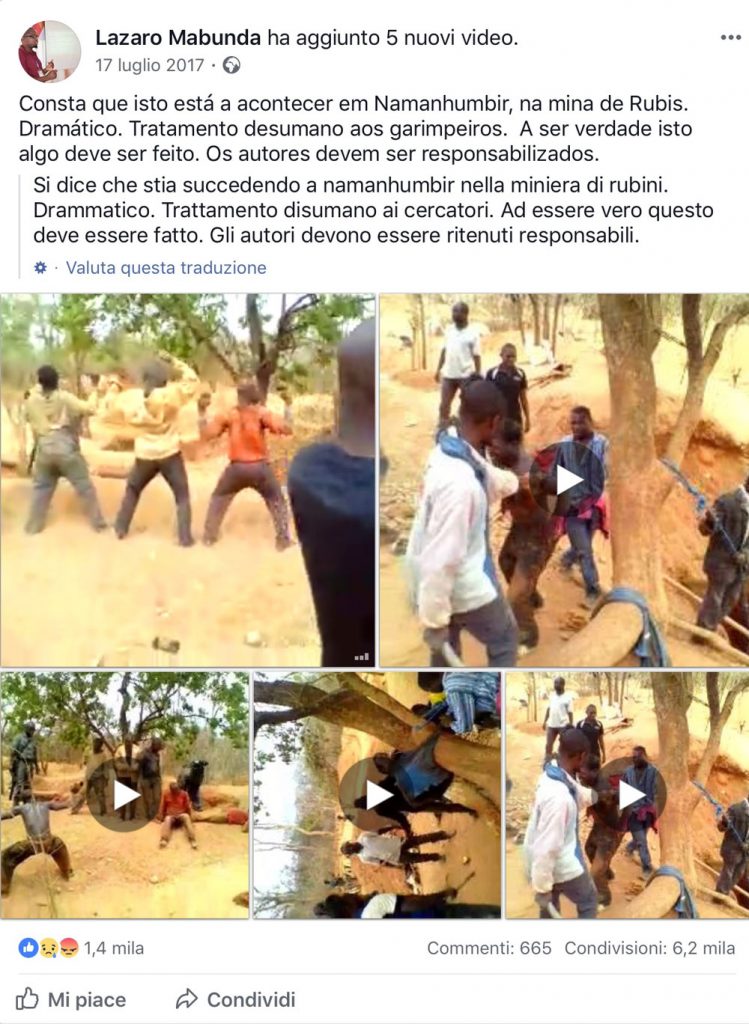
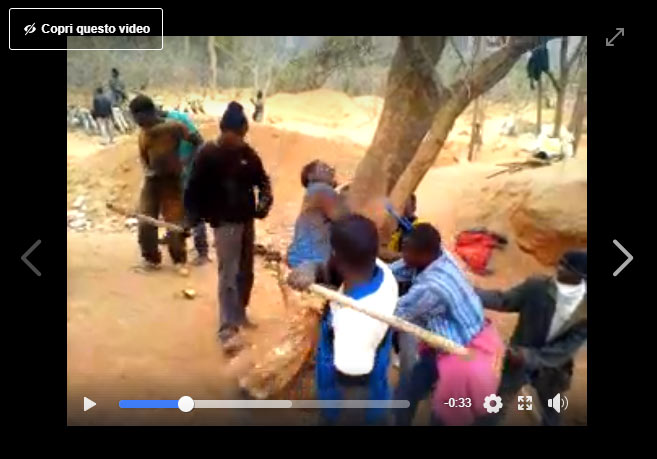
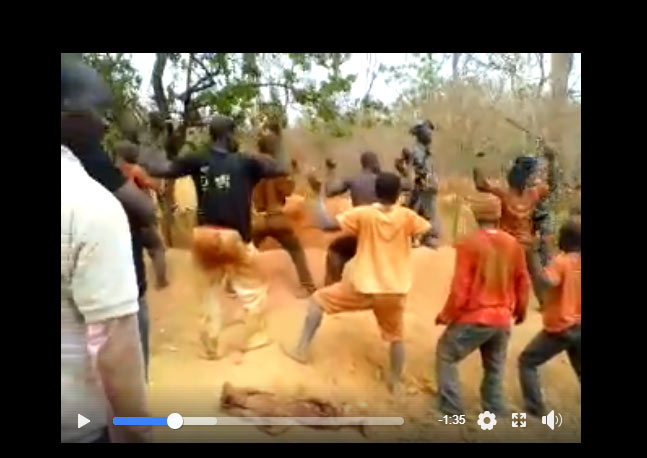
The case of alleged abuses breaks out as 4000 illegal miners are forced out of the region
On July 17th, 2017 Lazaro Mabunda, a young Mozambican journalist, posts on Facebook an explicit video (1400 sharings in few hours, numerous outraged comments, a Police investigation) showing alleged abuses and violences perpetrated against the garimperos reportedly in Namanhumbir, in the province of Cabo Delgado where the rich deposits of Montepuez rubies are located (Figure 1). They are weird humiliations, a sort of self-inflicted whipping, but also batterings. Since the discovery of the rich ruby deposits in 2009 tensions and disorders have not been a novelty, involving artisan miners fiercely fighting each other as the ruby rush started. Violence and accidents were daily occurrences. Since when, six years ago, exclusive rights of exploitation have been granted to the multinational mining giant Gemfields, an area as wide as 340 square km has become the main world supplier of rubies and the situation has changed. The concession spread fear among local communities that they would be cut off from the precious stone trades, along with fortune seekers, although two areas near Namahaca and Nacaca (this particularly is unearthing good quality rubies) have been granted for local small miners’ use. In the latest of the many expulsions in April 2017, the Forças de Defesa e Segurança (FDS) on behalf of the governmental authorities, had banished from the northern and border regions about 4000 illegal miners, mostly foreigners coming from Senegal, Somalia and Tanzania. Who are these people? They are the ones who rushed in the region before Gemfields as soon as a new ruby Eldorado appeared available in Mozambique. The exploitation of rubies originally followed a well-known African artisan and inefficient gemstone mining pattern. In fact, since the ‘80s gemstones have been mined in neighbouring countries such as Kenya and Tanzania in the darkness of black and unofficial economy, being the activity largely based on collusion with local authorities and on opaque financing of foreign buyers. So, before the settlement of Gemfields, African brokers (mainly from Tanzania, Guinea, Mali or Senegal), not allowed by the law to operate in Mozambique, had been financing groups of local people from all around the country to mine the potentially rich area, providing them with food, shelter and, if necessary, some medicines. They granted no salary but, if rubies were found, just a share of the income, usually between 10 to 25%. Then, the investors conveyed the production to Montepuez Town and sold to the traders, mostly from Thailand, who moved there financing in turn the brokers. Despite the volatility and precariousness of the situation in this state of illegality, according to domestic reports, local people were somehow satisfied to make direct business with foreign buyers taking collateral advantages due to an increased demand of goods and to house renting.
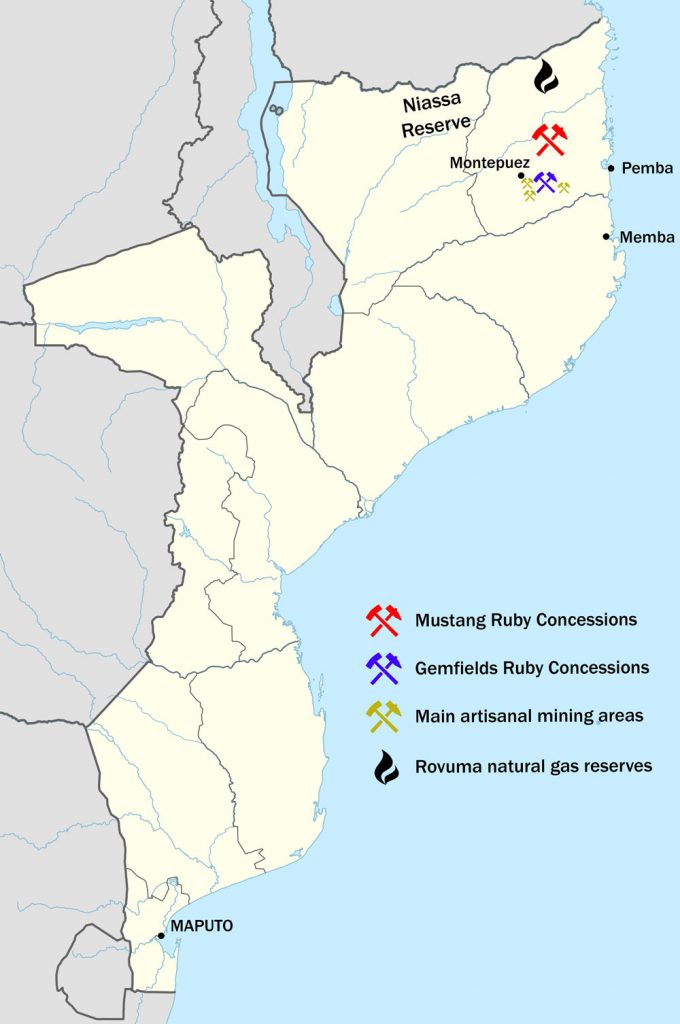
In fact these only recently are experiencing the growth of mining activities related to the newly discovered deposits of ruby and natural gas.
It must be noted that these mining sites have been set up not far from the protected environmental reserves.
A new conflict between artisan miners and Gemfields breaks out after the application of the new Law of Mines
This considerable handful of gem prospectors – local or adventurers alike – continuously trespassing in search for rubies is, each time, evidently opposing such mining companies as Gemfields and its 75% controlled local subsidiary MRM (Montepuez Ruby Mining) that own exclusive permits on specific areas where they made remarkable investments. Nevertheless, after some conflicts at the early stage of settlement of Gemfields, the presence of artisan miners did not necessarily always lead to significant violence. Things changed for the worse after the enforcement in 2016 of Law 20/2014, called Law of Mines (Lei de Minas) which modified the rights of exploitation. This turned the status of small artisan miners trespassing the borders of licensed or protected areas all over the country from “unlicensed” to “illegal” with the risk to face several years in jail. Therefore, consequent new cases of violence reported in the FB post follow those earlier conflicts generated by instability and illegality resulting from a rather spontaneous and unorganized exploitation.
Currently, the photograph of the Montepuez area shows that old and new players are many: an international big mining company with its domestic security forces, Governmental Police, inhabitants whose economy depends on the territory, to be moved outside the exploited areas, gem seekers in search of big deals, hundreds of buyers from Thailand and Sri Lanka opening seats to continue their purchase of rough rubies from artisan miners. Almost immediately after the shocking post of July 2017 Custódio Duma, President of the National Commission for Human rights intervenes judging the reaction of the police as inappropriate and worth a punishment, despite the irregularities, the miners could have committed. The case rapidly blows and on 19th July an investigation is started within the police forces meant to identify those responsible for the abuses against illegal miners. The Police of Mozambique now acknowledged that those are the places where rubies are found in the Montepuez region and orders are given in Portuguese by regular policemen, and those were tortures. Rumours become credible and the posted material is now fully trustworthy.

Investigative journalism had already turned the spotlights on…
Which are the reasons behind this sudden rise in sensibility for human rights in a difficult country? Mozambique, also given the involvement in the ruby trade of individuals belonging to its political-economical establishment, did not seem an arena particularly open and sensitive towards the reasons of weak social parties although it is recognized that there is some space for free press.
There should have been some sore point or some megaphone turned on. In fact, when carefully reading the reports starting from 2016, we can clearly notice that some well-documented investigations – certainly more important than a simple post – authorized the rising of many suspects on possible violences and abuses that happened time to time at different intensity. It must be noted that also an interesting video by GIA dated of October 2015, while providing an exhaustive description of the Montepuez deposits (236 millions carats estimated only in a first 36 square km lot), didn’t omit to show gun shots and conflicts with illegal prospectors. However, at that time, no particular consequences were recorded among the public opinion.
Al Jazeera was the first to investigate, in 2015, reporting two suspected murders of young illegal prospectors by the Força de Intervenção Rápida (FIR), special police units. In the broadcast video, the General Attorney of Montepuez Pompilio Xavier Wazamguia names 18 cases of murders that could be attributed to security governmental forces deployed to protect the deposits. Then, in May 2016 100Reporters, a Responsible Journalism Association draws the attention on the mine concessions of Montepuez. The result was a truly stringent j’accuse with precise and articulate confirmations that undermines the ethical pretensions of Gemfields. Estacio Valoi, an important Mozambican journalist is the mind behind these reports. He obtained in 2017 the Environmental Journalism Award for his investigations.
But some newspapers had to apologize…
In that same year, 2016, some African media tried to denounce threats and homicides of artisan miners, who became illegal starting from the 2012 agreements that granted the exclusive exploitation to the British-South African mining group. However, it did not end well for those newspapers. Following the intervention of the South African Press Ombudsman, for example, the newspaper Mail & Guardian was obliged to apologize to Gemfields and to its partner Montepuez Ruby Mining (MRM) for the article “Moz villagers digging for rubies ‘shot and left to die’” and the subsequent editorial “Christo Wiese, Mila Kunis and the blood rubies of Mozambique”. The words by Johan Retief, responsible for the decision of the South African Authority are somewhat illuminating: those articles “create the impression, without sufficient justification, that MRM and by association also Gemfields were in some way involved in the killing of people in the area. This includes the impression that MRM was safeguarding an unethical monopoly through force by its security company; that it directed government forces to commit violent acts against people who had been mining illegally within the concession area; that it had, with the help of Mozambican forces, turned the region into a militarized zone”. Also ZAM Magazine, a platform of investigative journalism on African themes had to modify some details on its report correcting what Gemfields considers as inaccuracies. Words are as heavy as stones when it comes to the reputation of a mining group for which one of the strongest points is represented by ethical compliances.
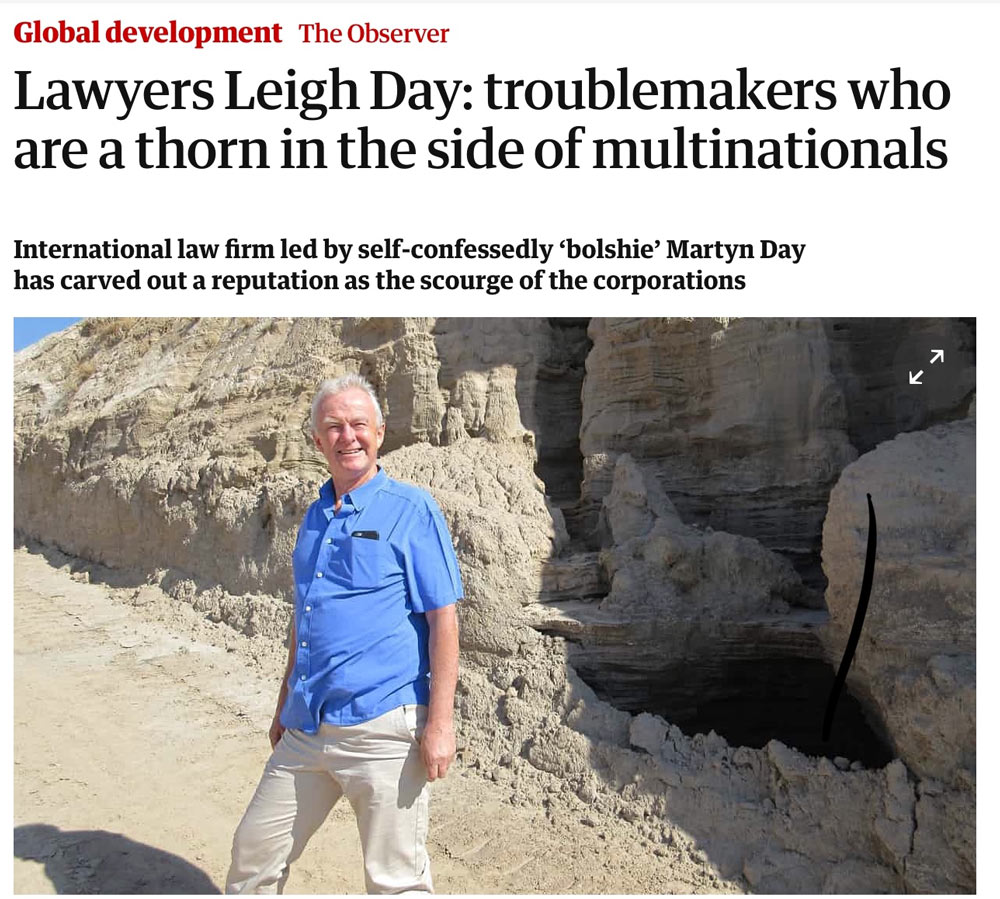
Lawyers break in. Leigh Day announces its next attack to Gemfields
Yet, the laconic post by Lazaro Mabunda we started from, managed to make the public opinion react more rapidly and incisively than many other articles. Now the wind has changed, the Telegraph resumes the topic making it stand out from the relevant news in the European continent, traditionally lazy when it comes to telling African events. After this wider and more detailed international coverage it still remains to understand to which extent the public opinion is able to determine whether the alleged violence is to be related to internal fights of illegal miners or to military and private security forces defending the licensed area. But, above all, the novelty is the lawsuit filed at the High Court of England and Wales by the British law firm Leigh Day against Gemfields on behalf of 29 people living near the concession. As, at present, the documents have not been filed yet, we can not enter into the merits of the question. What is known is that Leigh Day, specialized in cases of human rights violations in Africa and in disadvantaged countries, had obtained until 2015 compensations for its clients for a sum equal to 150 million pounds winning against such corporations as Shell, Trafigura, BP, Xstrata, Anglo American and Unilever. However, Leigh Day had also lost some lawsuits with controversial consequences like in the case of al-Sweady on suspected tortures against Iraqi military soldiers by British troops. The judgement, based on false testimonies, proves to be against the law firm.
But now the threat for the mining group does not come from more or less brave or influential freelance reporters. They must organise a far different mobilization against charges that turn on undesired judicial spotlights destined to end again on media headlines. In the wake of the claim in April 2018 a local ONG proposed changing the terms of the Montepuez Ruby Mining company’s operating license so as to retain more of the enterprise’s profits. Sharp legal weapons are in motion to please those in the public opinion who are keen on seeing signs of neo-colonial policies in Africa.
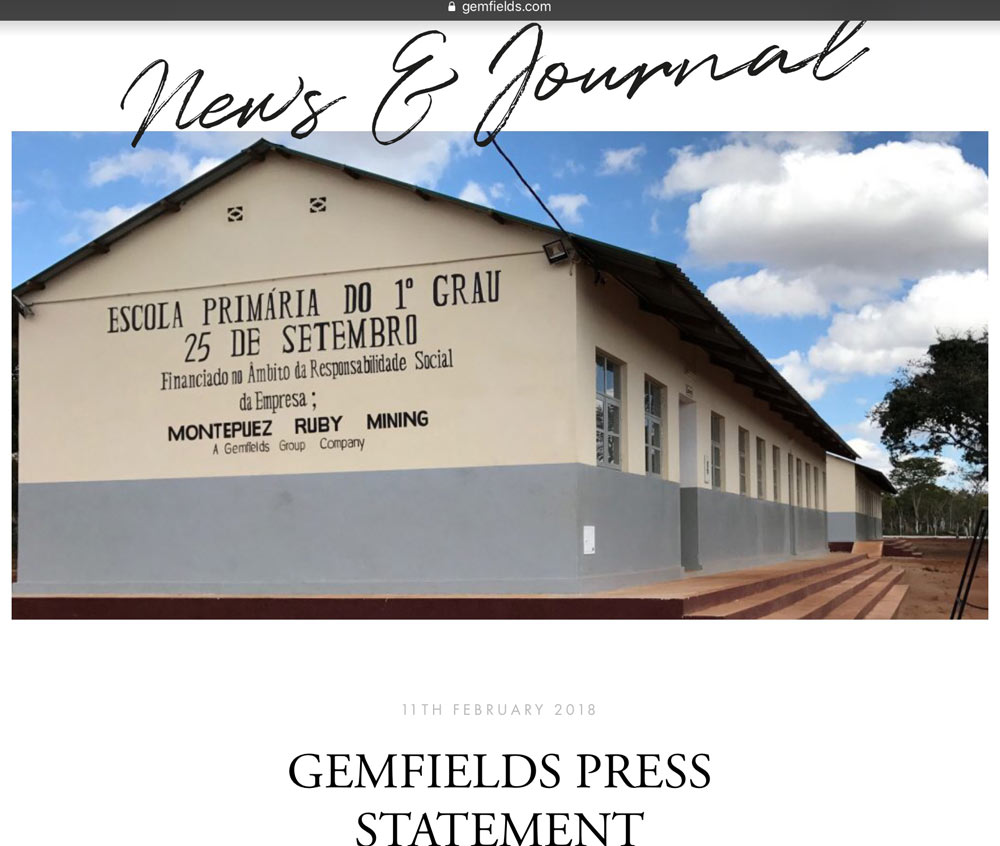
What is Gemfield defending? Its own ethical credentials
Gemfields doesn’t take time to react. It issues a press release on 11th February 2018, where it turns down all charges connected to the “law firm, Leigh Day, which is well known […] for leveraging adverse media coverage”.
These adverse themes are basically connected by the mining group with the allegations made by Mail and Guardian about the use of force, for which the two newspapers were obliged to make an amendment and apologize to Gemfields.The document contains two important elements: the first to be underlined is the fact that Gemfields decided to promptly issue such a document even though we are in a preliminary phase. It is rare in such cases that a firm position is taken so promptly, being mostly adopted a prudent and fence-sitting attitude delegating all actions to lawyers, playing for time to evaluate any development. Silence would evidently undermine Gemfield claims of full ethical compliance, casting shadows on its actual conduct in the field of Social Responsibility, in spite of several implemented projects worth more than 1.1 million US$ including infrastructure for education, health and agriculture. As issue no.2 of this Magazine has reported, Gemfields is active also in environment conservation in Niassa region. A failure in rejecting these negative allegations would increase the doubts over achievements that seemed to be acknowledged in the field of environmental sustainability and of respect for local communities, which are not accessory though central factors in Gemfields industrial project. The company aims at marketing not simple rubies, but rubies that the supply chain will be able to trace up to their origins finding out that they are extracted for the advantage of the local community and governments without causing environmental damages. And, as over the next few years the market will reward those able to show ethical credentials, it is unconceivable that these are put into question without having, as a consequence, an impact on the very same commercial value.
The second element emerging from the press release is contained in the circumstances Gemfields admits are subject to controversies and criticalities: “The claim alleges that Gemfields and MRM are liable for human rights abuses including the deaths and mistreatment of artisan miners and the seizure of land without due process. Those acts are, in many instances, alleged by the law firm to have involved the Mozambican police and/or other Mozambican government forces, for which the claim seeks to hold Gemfields and MRM liable”.
In its press release Gemfields acknowledges that “in the past, instances of violence have occurred on and off the MRM licence area, both before and after our arrival in Montepuez. These have often been between rival groups of artisan miners and their handlers competing for control of territory, or involving security forces, typically in preserving the safety and wellbeing of employees, service providers and members of the local community. However, where such incidents have occurred, including instances involving our own employees, MRM has taken decisive and appropriate steps, working closely with the authorities, including providing humanitarian assistance to artisan miners and community members)”.
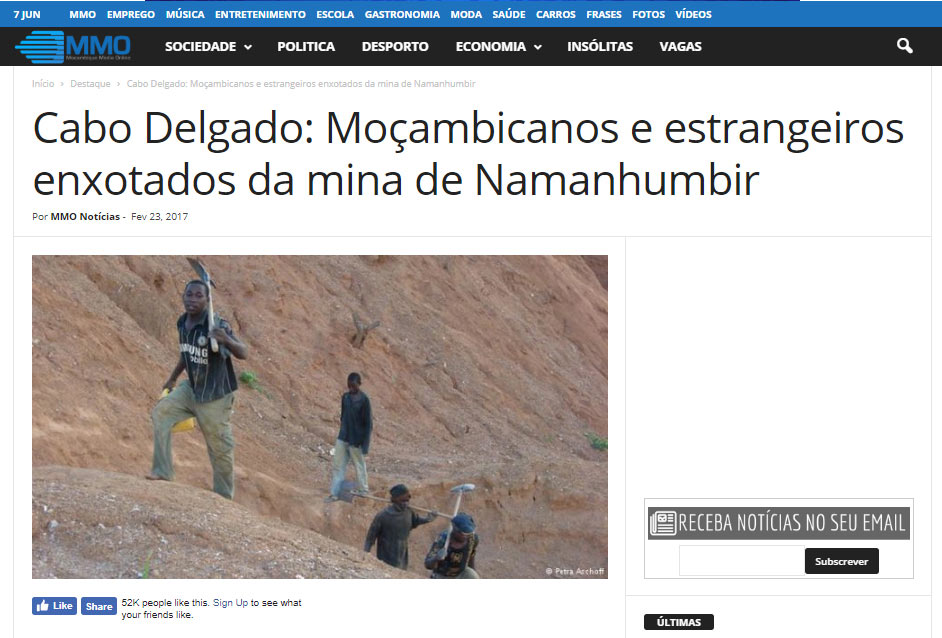
The agreement with Gemfields, a strategic option involving the political establishment of Mozambique
These literal quotations of the press release issued by Gemfields are useful as, in turning the charges down, it openly acknowledges the existence of an atmosphere of violence debilitating and discomforting the settlement of the company on a strict and indisputable ethical basis. This raises two main preliminary questions for the CSR specialists: the possession of the land and the permission to use the force in the territories allocated by the Government for mining purposes.
We should make a step back to reconstruct the context and place in the right framework the consequences of the impact of a complex and articulate industrial reality as that of modern mining prospection and extraction in a peculiar and fragile area as Cabo Colgado, Montepuez.
Mozambique was a country under a mainly coastal Portuguese control starting from the seventeenth century, with a colonial penetration active in inner areas only at the beginning of the last century. Frontiers have been built during negotiations with neighbouring European countries encompassing a territory with five different ethnic-linguistic groups. For centuries this fragile reality was locked by an archaic colonial regime deaf to any change.
The independence obtained in 1974 then led to a far worse problem, a civil war that ended only in 1994 with the consolidation of FRELIMO, a party inspired by Marxist ideals, to the power. As a result, Mozambique inherited an economic structure influenced by typical communist policies. Economic figures show an extremely weak condition (pro capita GDP equal to 634$ in 2012) due to the dependence on agriculture (83% of workers), the outflow of capitals abroad and to a long period of instability. The prospects for the development of Mozambique mainly rest on the mining sector since, in 2012, deposits of natural gas were discovered along the coast (estimated reserves for 20 billion barrels) and rubies were found in the Montepuez area.
In 2009 the mineral richness in rubies has put Mozambique face up to a strategic choice. On the ground there is only Mwiriti, an inexperienced local company, which owns the area as a hunting concession being there much before the discovery of rubies reportedly thanks to its employee Suleiman Hassan. Some local sources attribute the finding to inhabitants of the area and are skeptical about the fact that the process of acquiring additional land rights and licensing has been carried out in full accordance with Mozambican legislation. Among the owners of Mwiriti, outstanding political personalities can be found such as Raime Pachinuapa, Raimundo’s son, former commander of the Frelimo guerrilla and former Governor of the Cabo Delgado region. So the Mozambican government decided to grant MRM a 25-year mining and exploration license for 81,000 acres of Mwiriti in Montepuez. The company tried firstly to play the ruby card by itself with the help of “Dragon Gems Enterprises” a Thai company (that was previously working near the tourmaline mines in Mavuco), but that partnership did not last long as Mwiriti was in trouble with thousands of people invading their concession along with a poor outcome.
There was another option. It appeared clear that a precious resource could be developed only by a strong partnership able to centralize the international distribution of this gem gaining a sure income for the state coffers. And Gemfields that has all the necessary requisites to play this role, couldn’t work without local agents to establish itself in such a wide concession, so difficult to patrol against the small miners that previously gravitated around the area. Therefore, the association ends with combining the interests of the mining company with those of some members of the political establishment in power.
The country is young and without an entrepreneurial establishment endowed with the required experience. As a matter of fact Mozambique, in order to find its way out of the inadequacy of small scale artisan mining, mortgaged its extractive resources in return for the investments granted by large multinational groups. The positive or negative effects of this policy are still to be evaluated.
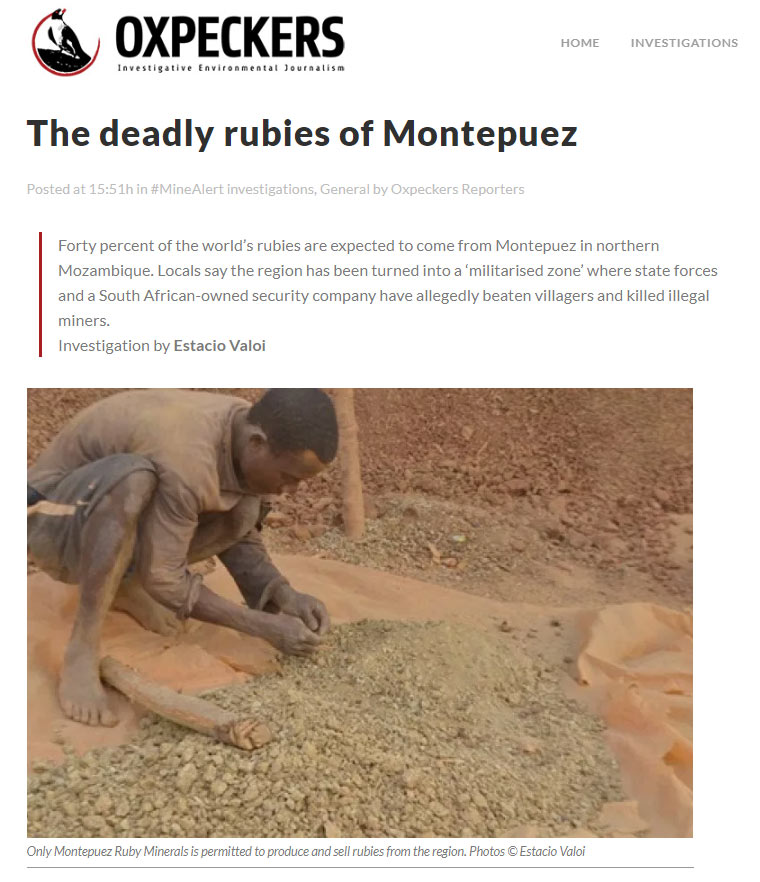
The controversial acquisition of land and the ambiguity of the use of the force
Many of the objections of the local community to Gemfields and MRM concern the fact that the rights on the concession of surfaces potentially rich in rubies would have been obtained by local personalities, partners of Gemfields, leveraging the ambiguities of the Land Law of 1997 imposing the principle of the DUAT (Direito de Uso e Aproveitamento das Terras, right of use and benefit of land). The land is owned by the State but is leased for long period against the submission of usage plans. The rights can be passed but they are originally free. As also World Bank recognized, this process led to the accumulation of big properties in an undetermined condition that cut out the poorest communities that could rely on a lower bargaining power to apply for the use. Based on what revealed by the local communities and according to reports, Raimundo Pachinuapa would have acquired the rights on the lands to the detriment of members who were not able to manage the various steps of DUAT and then he obtained from the Government the permit for the prospection of rubies for his company Mwirity which, in 2011, became Montepuez Ruby Mining (MRM) whose 75% is controlled by Gemfields.
The ambiguity in the process for the acquisitions of land rights is matched by the ambiguity in the use of the force. The protection of mining rights saw the initial involvement of regional corps and FIR, elite troops, all military individuals belonging to the national government. Montepuez Ruby Mining (MRM) reportedly provides soldiers with logistic support and strictly collaborates with them, flanking 109 internal security agents and about 470 employees of Arkhe Risk Solutions, a local agency of the South African Omega Risk Solutions. The private security, armed with 12 pellet shotguns and two guns, is obviously strictly controlled and has a limited engagement in conflicts. In the more recent reports those military forces are allegedly supporting the fights with illegal garimeperos evacuating them by force and filling artisan pits dug with bulldozers, while before they were concerned only in defending the property and tolerated garimperos working few dozens of meters from MRM people without many issues. However, also armed gangs named Nacatanas (Machete in Portuguese) are reported as active in concessions, attacking, pillaging and fighting back the intruding miners under the nose of the military troops that would allegedly grant them support and impunity.


And here are the conclusions. Ethics and territorial decoupage
Even though Gemfields made a remarkable effort to support the development of the exploited areas, economic success and ethical balance don’t necessarily correspond. We should measure and distinguish the various cases caused by the impact of the extraction of precious raw materials on the areas of their discovery. Here we notice that Gemfields operates in a region that geographers would define as originating from a process of space creation. In fact, the northern region has been cut off, following the peacemaking process, to encompass through governmental concessions, one or more mining enclaves that are functional to the modern exploitation of the Ruby deposits. This resulted in changes of settlements of local people and in modifications of the local economy. If to produce ethical stones a new space is required, this same space should meet ethical criteria and evaluate the socio-environmental vulnerability of the territories. In a socially responsible perspective some researchers, as the geographers Jason Prno and Scott Slocombe show in their study on the governance of mining areas, in their attempt to fulfil the local communities involved in this new process of space shaping, suggest to consider a social license in addition to the mining license. However, a fact is that there are allegations that the government concession was granted after a controversial and contested hoarding of landed properties. The assignment of a brand new mining district has changed the features of that territory, creating new hierarchies between newcomers and former residents including temporary small artisan diggers. A modified order inevitably provokes new placements of settlements. Therefore, the process changes the scale of responsibilities and the map and relevance of the stakeholders. More rapid and traumatic the creation of a settlement, greater the implications of CSR.
The question is about whom can (or can’t) be regarded as a primary stakeholder. Shall a mining company answer only to the closest involved parties like its own employees, its suppliers of services and their families? Is a solid contribution to the preservation of the environment in other important areas in Mozambique a viable compensation for the unbalanced intervention in a specific area? The mining concessions granted by the Government to some political members of its establishment makes Gemfields a privileged partner of a wider advantaged joint venture. The Government of Mozambique is both a supplier of exploitable territories and a true partner as it gets revenues in return of the mining concession. In this framework the availability of land and the use of force are responsibilities equally shared between these subjects. And it seems unlikely that Gemfields wants to be easily cut out of the game by delegating to Police forces the horny issue of the use of force. Likewise, the company enjoying the acquired rights, thanks to the supply of surfaces for the construction of a tailor-made territorial enclave, would have to answer not only to its direct employees but to the whole community that settled in this area, to their expectations and livelihood. Once again, ethical compliance proves to be more than just obeying to fixed rules and codes, more than respecting primary stakeholders or tracking rough gemstones up to the manufacturers. It is crucial to put any single case in its social and historic framework being wary at the meantime of misinformed western advocates of simplistic crusades that might prove to conceal interests and ulterior motives. This is not an easy game between good guys and bad guys or large and small companies but a key issue for the whole economies of developing countries.
Article by Paolo Minieri*, published on IGR – Italian Gemological Review #4, Summer 2018.
*The author expresses gratitude to Vincent Pardieu whose generous support was decisive to acquire first hand information on the issue.


