This content was first published on IGR – Italian Gemological Review no. 6 in 2019. The information provided here is therefore current as of the original publication date.

A unique laser inscribed serial number will allow to track the geographic origin of diamonds sold by Tiffany from 0.18 carats up. The press release dated January 9, 2019 took by surprise only few traders. The race to provide an ethical plus officially started.
The Diamond Source Initiative is part of the overall renewal of Tiffany
“Consumers want to know the origin of the things they buy, like the name of the farm that supplied their milk or the source of the feathers in a down jacket”, this is the punctual comment on the decision of Tiffany, released by the New York Times and referred to a wider context of changes prompted by its leadership. It’s time “to push the company to re-think its brand according to its original inspiration” the new CEO, the Italian Bugliolo explained.

Changes had already become visible in 2017, the motto was: innovation grafted onto tradition. For example, the Blue Box Café on Fifth Avenue, where one can have breakfast at Tiffany’s starting from 29 US$. Or the idea of employing Lady Gaga as brand ambassador. And there is the new remix of “Moon River”, the legendary 1961 song from the film “Breakfast at Tiffany’s” which explains a lot about the strategy for the future (Figure 1). The old melody fades away, and rapper A$AP Ferg together with actress Elle Fanning rhythmically appears over the black-and-white pictures, taking us into the future of the brand. Notes and pictures seem to want to enchant the people the New York maison has identified as its public of the future, young consumers who do not share the values of a good old engagement ring with their parents and grandparents. In other words, data show that these Millennials may be less interested in family anniversaries, but they are sensitive to the integrity and transparency of the chain of diamond suppliers. The strategy of a major luxury enterprise cannot postpone the task of reassuring customers about the ethical nature of the supply chain.
Between the old protocol and the new Blockchains
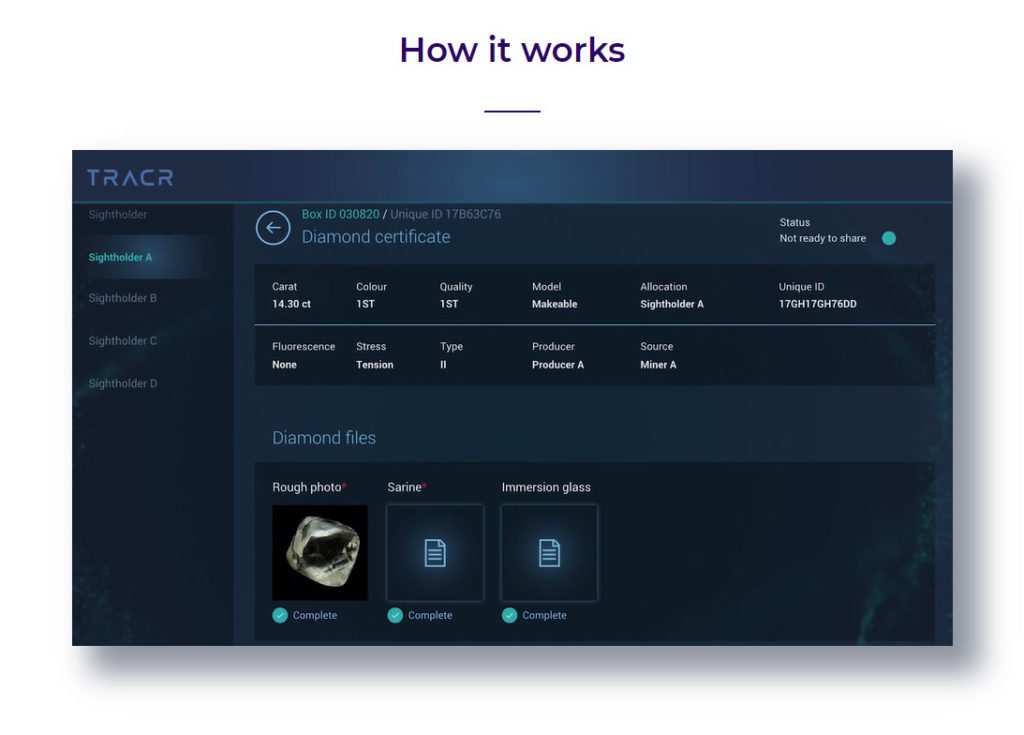
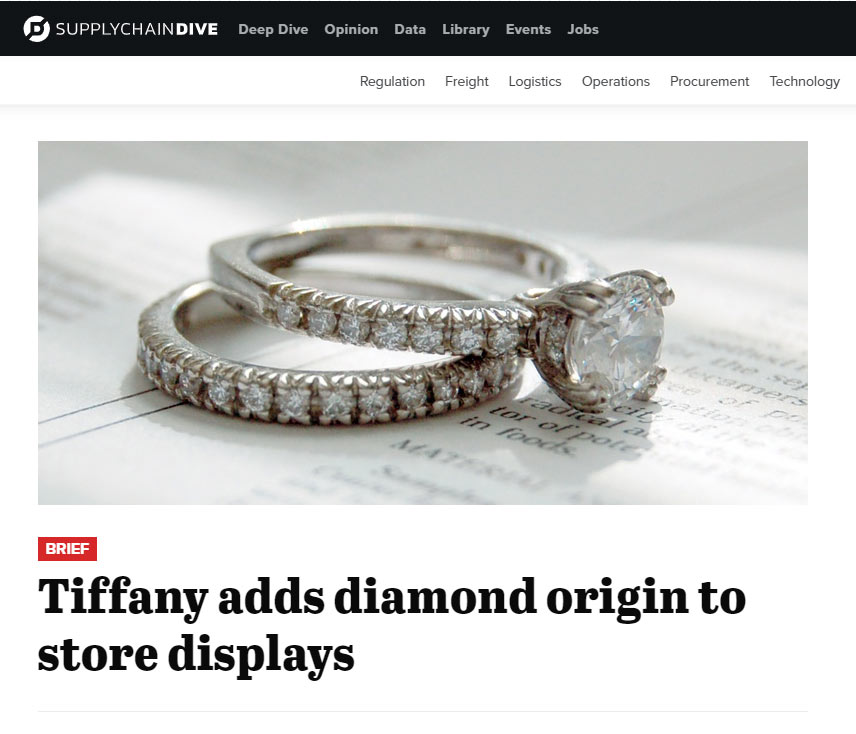
However, it is no simple job. With the new race towards blockchains, the bar has been set higher. Many organisations, from startups Everledger and Arianee to De Beers’ Tracr project (Figure 2) are already working on developing encrypted registries for general tracing, especially of diamonds. In China, Chow Tai Fook is working together with GIA to permit verification of the route taken by their diamonds. On such a crowded and complex stage, where can one start? Tiffany has analysed the weapons it already has. Since 1999, it has been using its own Diamond Source Warranty Protocol which however does not indicate the geographical origin of the diamonds. It only reassures the consumer that they do not come from countries which violate human rights. “The company also maintains a proprietary and secure database linking a diamond’s serial number to its provenance and craftsmanship journey”, said a spokesman (Figure 3).
However, today the efficacy of an overly general code, more than twenty years old, is in doubt. The same age as the Kimberley Process Certification Scheme, a responsibility and diligence validation tool for procedures of acquisition of uncut diamonds, which can no longer be used to boast extra merits by brands which want to be at the forefront of traceability. This was a transnational agreement which on paper guaranteed the whole production chain. Recently, some NGOs have criticised this protocol, since it merely contrasts the use of diamonds to fund civil wars, and is not suitable for fighting other kinds of abuse – those against human rights. In short, Kimberley certification as a standalone is out of date.
How did Tiffany find the way to reveal the path their diamonds take? Analysing their own production chain and going back to the geographical origin of the uncut diamonds. Manufacturing steps like cutting and faceting are the easiest to track down thanks to their proximity to end consumers. Tiffany in fact declares that between 80% and 90% of its supply of diamonds above 0.18 points comes from its subsidiary Laurelton Diamonds, which cuts diamonds in Belgium, Botswana, Mauritius, Vietnam and Cambodia, using rough diamonds coming from Botswana, Canada, Namibia, Russia and South Africa. Being able to control the cutting company from which almost all diamonds in collections come is a big advantage. However, critical issues increase when one has to trace back.
Ethical credentials are not for free
At the starting point, the extraction giants who supply Tiffany’s “self-produced” fraction – Alrosa, Dominion Diamond Mines, Rio Tinto and De Beers – are actually able to guarantee and prove their compliance with environmental sustainability requirements and respect of those involved in the mining processes. But a major player like Tiffany is mainly interested in showing which country the uncut diamonds come from, rather than letting their suppliers get all the merits as guarantors. And this is where something unexpected happened. De Beers controversially decided to forbid its customers to reveal the geographical origin of those rough diamonds it supplied. The great extracting group, in fact, being very present and well known on the retailing market too, wants to keep a close hold on its ethical credentials which it can document for its mining activities. So it sells uncut to its cutting customers, guaranteeing compliance with ethical criteria of responsibility, but in a geographically undifferentiated manner. De Beers merely guarantees that the gems have been extracted and transported in an ethically diligent manner, but refers their origin only to Botswana, the country where all the uncut material from De Beers’ sites around the world converges to be stored and selected. Indeed only recently, and on pressure from the industry, has De Beers allowed its customers to indicate DTC as the producer, leaving exclusive use of the De Beers trademark to its ForeverMark line. This situation has forced Tiffany to use the definition “Botswana sort” for those diamonds received from De Beers.
Tiffany’s Diamond Source Initiative is without doubt one of the first procedures developed by important and prestigious brands (Figure 4). This first phase will be followed in 2020 by the addition of further information on the cutting and polishing features of gems; while those which came before the introduction of laser inscription of the new initiative will be governed by the 1999 Code.

But synthetic diamond manufacturers too want their part of the ethical cake
Not all opinions have been positive about the initiative. The adventure has just begun, but the ethical prerogatives of the new system are already under discussion. Not by hair-splitting NGOs or radical lawyers, specialists in finding something wrong with any transparency initiative. The fact is that for Tiffany, sustainability is traced entirely within the confines of natural diamonds. Synthetic diamonds “have their use and they have their place, but I think luxury consumers will continue to desire the rarity and amazing story of natural diamonds”. These words, pronounced by the Senior Vice President of Diamond and Jewelry Supply of the group, brought about lively reaction, picked up by Forbes, from Jason Payne, CEO of Ada Diamonds, a producer of synthetic diamonds. In an open letter to Tiffany’s official, Payne disputed the sustainability results of major mining enterprises, who – he claims – pollute Canadian rivers with their carcinogenic agents and use invasive and harmful systems for the oceans with their huge ships specialised in extracting diamonds from alluvial deposits in the sea. So, why not use synthetic diamonds if we want to give a truly environmental friendly pass to luxury?
US producers of synthetic diamonds have long founded their arguments on the supposedly greater environmental sustainability of their stones. Production of synthetic diamonds would make the whole polluting business of mineral extraction useless. Even assuming that this is the case, if the great brands fail to use synthetic diamonds, the ethical appeal will never be associated with that of luxury and exclusivity. “I highly encourage you to reconsider your position – Payne affirms – as your risk-averse view of lab diamonds will age as well as Microsoft’s 2007 view of the iPhone”. This reference to such famous and winning predecessors does make one think that we are watching a struggle to develop an ethical consumption model of the kind Millennials appreciate.

Country names, recognisable brands. What about tomorrow?
“We do not believe one source within our network is better than another. We do believe Tiffany’s ability to provide information about provenance is superior to [what] any other global luxury jeweller [is doing]”. In an interview with Style, Tiffany’s CEO, Mr Bogliolo, not without a note of satisfaction, thus sums up the move to reveal the place of origin to consumers. Opinions of observers like Human Rights Watch, for example, are definitely positive, since a leader opens up the path and creates trends. So we can be sure that all the main international actors in jewellery and luxury will follow this example or perfect their ethical guarantee systems.
However, if we take a closer look at the sequence of information issued by Tiffany’s Diamond Source Initiative, for example on the craftsmanship journey and on cutters’ credentials, we can see that they are exactly what new systems are trying to guarantee using Blockchains. Tiffany clearly thought it would take too long to develop an efficient encrypted and recognised registry, so they decided to make the first move by taking advantage of the competitive edge afforded by the vertical integration of its cutting systems. In transparency, one can see that tracking – though in all likelihood designed to reach individual mines using new registered digital technologies – currently refers to the nations as a whole where extraction giants operate. Practically speaking, the ethical guarantee lies simply in the name of the state which, together with the great mining companies, shares in fully documenting compliance with ethical requirements towards the environment and to people involved in the work. The most reliable way is to induce consumers to identify safe diamonds with a safe country. In the official release, we read: “Tiffany & Co. is committing to 100% geographic transparency for every newly sourced, individually registered diamond, and will not source any diamonds with unknown provenance (even if responsible sourcing is assured) moving forward”. Ethical compliance, though proven, is useless unless it is validated by belonging geographically to a “reputable” country. In a certain sense, at least during an initial phase, uncut sorting operations go alongside a selection based on the choice of national geographical entities which can be translated into immediately recognisable guarantees. Peaceful and well-governed Botswana will score better, of course, than turbulent and corrupt Zimbabwe. Consequently, in order to confer legitimacy on responsibly extracted diamonds, one must first confer legitimacy on a whole nation. Sooner or later, Blockchains too will have to evaluate how to guarantee a place, for example, to producers of diamonds from alluvial deposits, from other countries in addition to Sierra Leone, where ethical certification steps are made very complex by the small dimensions of extracting businesses.
Article by Paolo Minieri, published on IGR – Italian Gemological Review #6, Spring 2019.