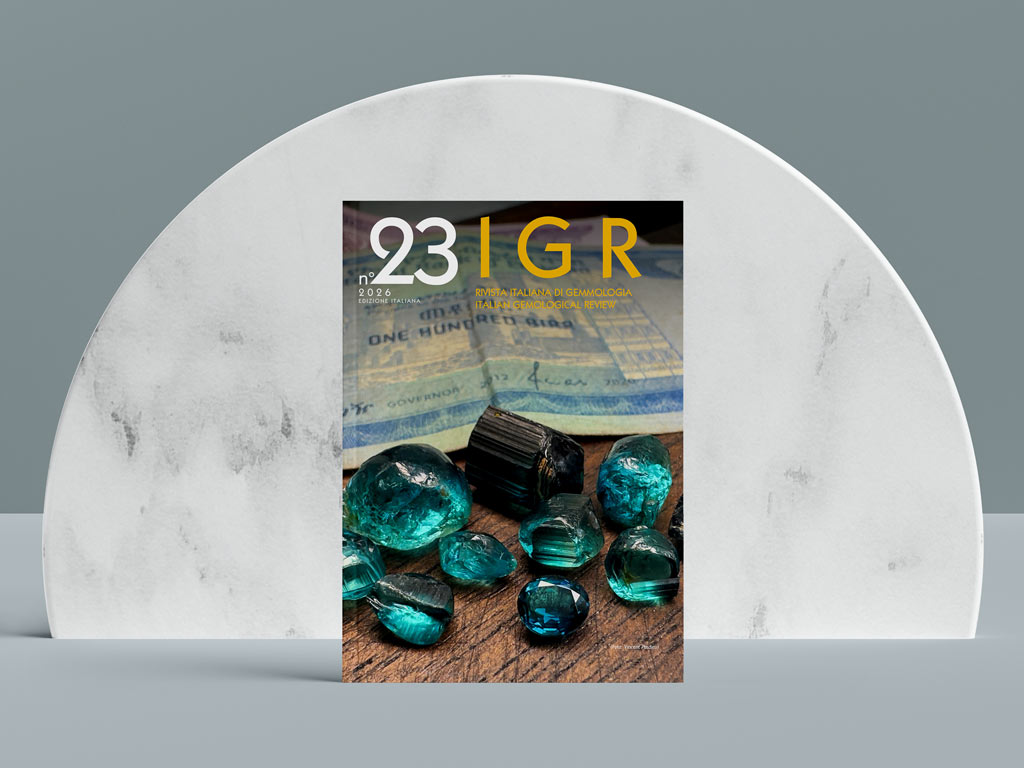
This content was first published on IGR – Italian Gemological Review no. 10 in 2020. The information provided here is therefore current as of the original publication date.

In April 2019, 40 km east of the village of Betroka, in a rural area of the province of Toliara in Madagascar, the manganese variety of Milarite, Laurentthomasite, was discovered. It has been named after its discoverer Laurent Thomas, a geologist, researcher and mineral trader who has been working in Africa, particularly in Madagascar.

Laurentthomasite [Chemical formula Mg2K(Be2Al)Si12O30] was found within a pegmatite (contemporary with these granite bodies) in a series of biotite and amphibole-rich gneisses (Besairie, 1959; Tucker et al., 1999; Kröner et al., 2000) and is associated with orthoclase, massive quartz, rare light green apatite crystals, beryl, albite and magnetite (Cristiano Ferraris et al., 2020).
Unfortunately it is not among the hardest gems as its hardness is in fact just 6 on the Mohs scale. Its strong point, however, is its particular color, varying from cobalt blue to yellowish green.

Further readings:
- Ashwal, Lewis D., and Robert D. Tucker. “Geology of Madagascar: a brief outline.” Gondwana Research 2.3 (1999): 335-339.
- Besairie, H. “Contribution à l’étude des sources minérales et des eaux souterraines de Madagascar.” Travaux du Bureau Géologique 92 (1959).
- Cristiano Ferraris et al. “Laurentthomasite, Mg2K(Be2Al)Si12O30: a new milarite-group-type member from the Ihorombe region, Fianarantsoa Province, Madagascar” (2020).
- Kröner, A., Hegner, E., Collins, A. S., Windley, B. F., Brewer, T. S., Razakamanana, T., and Pidgeon, R. T.: Age and magmatic history of the Antananarivo Block, central Madagascar as derived from zircon geochronology and Nd isotopic systematics, Am. J. Sci., 300, 251–288, 2000.
- https://www.mindat.org/min-53556.html
Gem News published on IGR – Italian Gemological Review #10, Autumn 2020