




This content was first published on IGR – Italian Gemological Review no. 10 in 2020. The information provided here is therefore current as of the original publication date.

What is going on with the issue of precious coral species identification? Studies on DNA fingerprints have already successfully started a few decades ago in the field of environmental conservation to evaluate the conditions of the habitats of hard coral reefs. More recently, the CIBJO, under the guidance of its Coral Commission chaired by Vincenzo Liverino, has promoted the application of specific studies with the purpose of achieving a distinction among the various species of precious coral. This distinction is in fact crucial for the destiny of the coral industry as a whole, which can survive and flourish in the future only if based on a high sense of responsibility and promoting the protection of endangered species in compliance with the lines suggested by international environmental protection conventions such as CITES.
The problem lies in the fact that even the most advanced gemological equipment while allowing, by means of spectrophotometry, the identification of the genus corallium, is not applicable to detect the individual species. In practice, the instruments generally used in gemology can help the trade make a distinction only between precious corals (corallium) and those “common corals”, which are sometimes marketed with misleading coloring treatments to appear similar to some species of valuable coral used in jewelry.
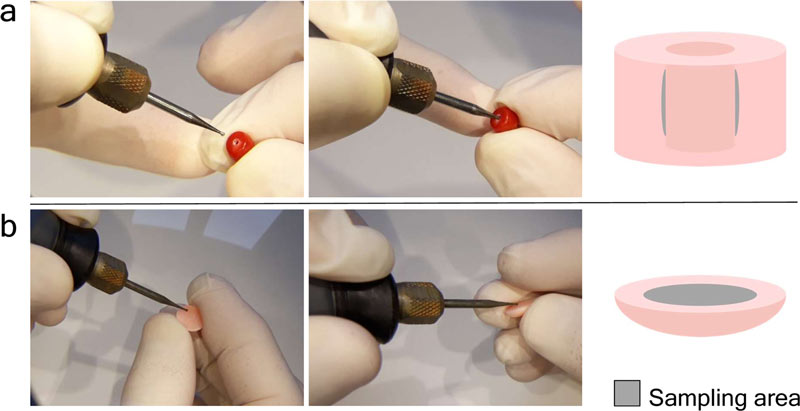
The right way to achieve a solution to the identification of the species is therefore the one biologists are using in their work, the DNA tracking. At this point, however, further difficulties arise since tracking involves an invasive analysis. As early as in 2019 the Federico II University of Naples, in collaboration with the Coral Commission of CIBJO and with IGI (Istituto Gemmologico Italiano), had established a DNA based procedure that allows the identification of coral species, but only at the cost of a destructive test that heavily impacts on the beauty of the jewels and undermines their value. This test, carried out by Dr. Anna Di Cosmo, full Professor of Zoology at the Department of Biology, in fact, involves the extraction of part of the material with a thin pointed drill. Being between 20 and 50 mg (0.12-0.25 carats) the quantity of the material removed is significant.
In May 2020 there is a turning point. SSEF in collaboration with the University of Zurich presented in “Scientific Reports (Nature Group)” a peer-reviewed in-depth study: “DNA fingerprinting: an effective tool for taxonomic identification of precious corals in jewelry”. In this paper a nearly non-destructive technique is developed, requiring considerably less sample material than other methods, with testable DNA being recovered from as little as 2.3 milligrams (0.0115 carats) of material. Using a set of 25 worked coral samples, five candidate DNA extraction protocols has been tested to retrieve DNA from jewelry precious coral samples. At the end the best responding protocol was selected taking in consideration the key factor of minimizing the destruction of the precious material.
The study is likely to set a standard for future research that can widen the reference data by sequencing multiple specimens for each species and developing additional markers.
Gem News published on IGR – Italian Gemological Review #10, Autumn 2020


