This content was first published on IGR – Italian Gemological Review no. 13 in 2021. The information provided here is therefore current as of the original publication date.

This is a reply to two articles published by two authoritative Italian newspapers, Il Corriere della Sera (“Rubies, emeralds and sapphires, the case of Lab-Grown gemstones”) and La Repubblica (“For Morellato after Ferragni the ecological diamond is coming”). “Lab-Grown” Diamonds or rather Synthetic Diamonds? Natural Diamonds grown in a laboratory and yet not Synthetic? Made in Italy? While hearing such announcements, your Bad-mouthed Jiminy Cricket was seized by uncontrollable convulsions, and it was only after assuming massive doses of Cricket-Valium that he was able to partially resume his intellectual faculties. His thoughts are expressed below.
What the papers say
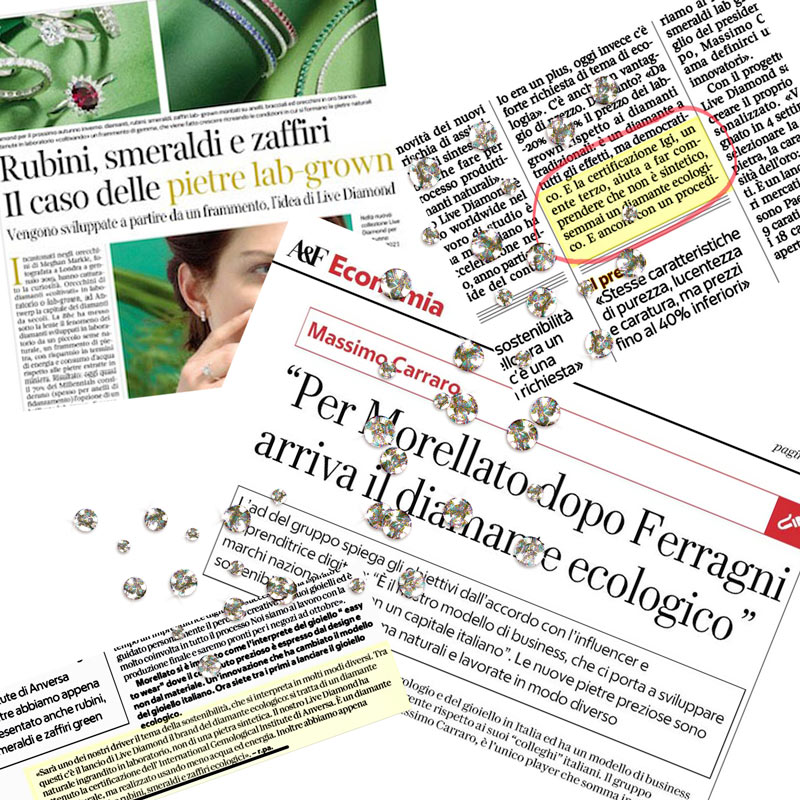
Let’s proceed with order and resume, like for like, what the newspaper “Il Corriere della Sera” of July 3rd, 2021 has proclaimed urbi et orbi on page 28 in its column entitled “Liberi Tutti (Free All)” signed by Enrica Roddolo under the captivating title “Rubies, Emeralds and Sapphires – The case of Lab-Grown Stones” (Figure 2).
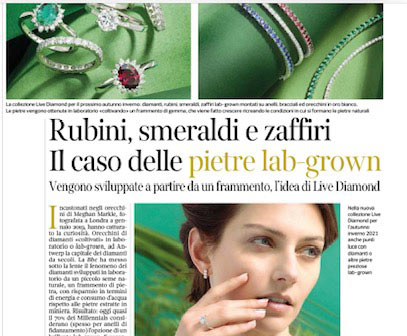
Then we will see as well what the daily newspaper “la Repubblica” of July 12th, 2021 reported in its column “A&F Economy” under the intriguing heading “For Morellato, after Ferragni the Ecological Diamond is coming” (Figure 3) including an interview with the CEO of the group, Massimo Carraro (capital letters and attributes have been assigned to the various materials for highlighting purposes, Editor’s note):
“Corriere della Sera”: «[…] Since last autumn, lab “grown “Diamonds” are also coming out from a true Italian company: Live Diamond. And in July the Diamonds will be joined by the first Italian Lab-Grown Colored Gemstones: Ecological Rubies, Emeralds and Sapphires, giving life to precious and environmentally friendly jewelry pieces, Francesca Ginocchio of Live Diamond, Morellato Group’s Global Marketing Advisor has announced […]».
“La Repubblica”: «[…] This includes the launch of Live Diamond, the Ecological Diamond brand: it is a Natural Diamond grown in a Laboratory, not a Synthetic Stone. It is a real, Natural Diamond, but made using less water and energy […]».
Your B.M.J.C. (Bad-Mouthed Jiminy Cricket) cannot but rejoice at Nuncio’s words. Yet let’s give a look at the Standard
So eventually (and, after considering what is said and how the terms have been used, the comprehension is not difficult) an all-Italian company is coming out with its own lab-grown Diamonds or (in a more convenient translation) with its own Synthetic Diamonds. Diamonds are defined by UNI’s (Italian Agency for Regulatory Standards) Standard 11828:2021 “Synthetic Diamond – Terminology, Classification, Characteristics and Test Methods” as follows:
«Synthetic Diamond (in English: Laboratory-Grown Diamond; Laboratory-Created Diamond): A Synthetic “Mineral” that essentially presents the same chemical composition, crystal structure and physical properties (including optical properties) as a Natural Diamond.
Note 1 – In languages where there is no acceptable translation for the English terms “Laboratory-Grown Diamond” and “Laboratory-Created Diamond”, such as Italian, for translation the term “Synthetic Diamond” should be used only.
Note 2 – The following abbreviations shall not be used: “Lab-Grown”, “Lab-Created”, “Lab-Diamond” or “Syn-Diamond”.
Indeed this is specified in Italy in the last born strictly binding UNI Standard 11828:2021 (complementing the Standard UNI 9758 on Natural Diamonds) with the intention to fill a legislative void concerning the regulation of gem material sales, after the failure of many attempts to get a more comprehensive law introduced, since 2004.
In the event of any doubt as to the nature or origin of this material, reference should be made to articles 3.27.2.1 and 3.27.2 of the aforementioned Standard 11828:2021, which mirrors those of the Standard on the same subject and states, verbatim:
«Synthetic “Mineral”: Artificial gemological material possessing chemical and physical characteristics corresponding to those of natural materials». «Artificial Gemological Material: Organic and/or inorganic substance produced by technological processes».
Once it has been clearly established (by force of a Regulatory Standard) that what is discussed in those articles is nothing more than Synthetic Diamonds, (i.e., Synthetic Minerals, Artificial Gemological Materials produced through technological processes) and nothing else, any possible misunderstanding by the less knowledgeable people, the general public and, more specifically, by the end consumer will be avoided. This leads us now to focus on the verb “to come out”, as stated in the sentence: “Since last fall lab-grown Diamonds also are coming out from an Italian company”.
Italian Synthetic Diamonds?
This is what at first they are supposed to be, according to the sentence. And indeed, once the intransitive verb “to go out” is assigned the meaning of “appearing and emerging”, we can’t refrain from raising hymns of joy, jubilation and happiness because it is since February 16, 1953 (date of birth, in Stockholm, of the first sample of gem quality by the Swedish ASEA) that we have been waiting for Italian made Synthetic Diamonds. At long last, hallelujah!
A side note: how is it then that this amazing and memorable event went unnoticed by the Italian and international gemmological-jewelry-ornamental community? Due to their historical importance, such events should have been immediately brought to the attention of the scientific, technological and economic community…
Or is it by any chance just a sophist phraseological prestidigitation able and suitable to gain credit, in other words, a Goldoni-style “witty invention”? We would like to have more light shed on this matter, given our intellectual limits (more than a few neurons cannot be accommodated in the Cricket’s old head…).
“New Diamonds” (HPHT) / Synthetic Diamonds / Synthetic Gemstones / Natural Diamonds. Are all these just misunderstandings (tarot cards arcanes)?
What is yet obscured by mystery, still within the field of Synthetic Diamonds, is however the following statement: «In order to clear the field from possible equivocation with Synthetic Diamonds and precisely because of the very novelty of the New Diamonds, there is a risk of equating them with Synthetic Gems, which have nothing to do in terms of materials and production process with Natural Diamonds» (“Corriere della Sera”).
Excuse me please if I am a little slow on the uptake. We could even agree on the assertion that «Synthetic Gemstones (are we still talking about Diamonds? Editor’s note) have nothing to do in terms of materials either with Natural Diamonds (should these materials be understood as constituent substances or as materials used in the growth process? Editor’s note), or for their production process». We could, but only after the issue raised by the question marks has been answered.
What is mysterious to us, however, is the first part of the assumption, from which one might at first understand that the New Diamonds, precisely because of the novelty inherent in them, should not be mistaken for Synthetic Diamonds.
Have we correctly understood?
Well, and then what are the “New Diamonds”, considering the novelty they are representing?
If it is the «phenomenon of Diamonds developed in the Laboratory from a small natural seed, a fragment of stone […] generally grown in the Laboratory with a process called High Pressure High Temperature System…» (“Corriere della Sera”), as claimed in another paragraph, what is it if not Synthetic Diamonds? (See the above mentioned UNI norm 11828:2021, art. 3.2 “High Pressure-High Temperature (HPHT): process under conditions of high pressure and high temperature aimed at modifying the color of the Diamond or producing a Synthetic Diamond”).
A little more than a little confusion…
And further, if by that statement («In order to clear…») something else was meant, would someone be so kind as to inform us about and also specify what exactly is intended by Synthetic Gems and how these can be assimilated to Synthetic Diamonds (or to New Diamonds, this cannot clearly be understood)? And, now that we are here, would it be possible to clarify which Synthetic Gemstone, New Diamond or Synthetic Diamond «has nothing to do as for materials, production process with Natural Diamonds» (“Corriere della Sera”)? We would be immensely grateful to be rescued from the darkness of mental confusion in which we have fallen…
“New Diamonds”. Are they really new?
New? Excuse me, doesn’t the Japanese company Sumitomo’s large-scale production of synthetic HPHT diamonds date back to the mid-1980s? Are we misremembering? 36 years ago. New? Perhaps we are confused with the newer CVD (Carbon Vapour Deposition) production method, although it is only relatively recent: 2003 (Apollo Diamonds, USA), that is, 18 years ago.
HPHT Synthetic Diamonds / Natural Diamonds: same clarity?
The specific statement of Dr. Ginocchio (“Corriere della Sera”), where the process leading to the creation of the “New Diamonds” is described, is surprising: «It starts from a small fragment of precious gem that is grown in the laboratory where we restore the same conditions in which natural gems are created. And the result is Diamonds, Rubies, Emeralds and Sapphires with the same characteristics of clarity, brilliance and carat of mined gems…».
As for Rubies, Emeralds and Sapphires we are going to drop the following shot, so striking as to make the elytrons (the first pair of chitinized and hardened wings of the Gryllidae family members) crawl. That is, an equivalence is assumed to exist between the clarity characteristics of Synthetic and Natural gemstones (could we also be made aware of such a great miracle, since these characteristics also depend on the production method adopted, among other things?), and of carat (carat? and what, do synthetic stones form already cut and ready-to-wear?). For this assertion no foundation can be found (why not spending a buck and ask the opinion of someone who knows just a little bit more, before coming out with such a nonsense?). So let’s keep within the perimeter of Diamonds only.
Now, it is true that to grade the clarity (transparency) of HPHT (High Pressure High Temperature) produced Synthetic Diamonds the same criteria used for the so-called mined (Natural Diamonds) gems are adopted. But if you claim that they have the same (internal) characteristics as their natural counterparts and that they are equivalent to them in terms of clarity grades, sorry, you have to step back please. If anything, this can be the case with the lower degrees of clarity (VS, SI, Pique), since the Method uses a mixture of molten Nickel Cobalt and Iron as a solvent-catalyst for the dissolution of Graphite (nutrient) in the synthetic’s capsule. As a consequence residues of this mixture trapped inside the growing crystal (as inclusions) can be commonly found in HPHT Synthetic Diamonds and this results in a rather low degree of clarity, given the size of these residues. So much for the equivalence, especially regarding the nature of inclusions! Much better grades of clarity (and also of color) can be reached by means of the CVD method (Carbon Vapour Deposition), where the conditions of growth are such that the inclusions are difficult to resolve. Just for the sake of clarification, huh?
Synthetic Diamonds, eco-friendly and democrat?
And here we come to the nerve center of the whole thing, to the “core business” of the promotional campaign, because after all this is what it is all about. Here we are jumping on the back of the (Crazy) Horse belonging to the unrestrained loose rein Integralist Ecologism à la Greta Thunberg, which is so fashionable, which is so trendy, fueled by that sword of Damocles that hangs over our heads (the destruction of Planet A, since Planet B is missing).
And so let’s get into it and accordingly let’s label as Eco-friendly not only vegetables or electric cars, but Diamonds as well (and, to make sure we’re not missing anything, even Rubies, Sapphires and Emeralds and who knows what else). In order to catch the Millennials who, short of money and ideas in these hard times, are jumping/they will be jumping on the diamond, ruby & Co. substitutes, for mere financial reasons, namely a 20%–40% less for “Lab-Growns”, compared with their natural counterparts. Shouting “what is beautiful is not what is beautiful, but what appears as such”. Apparently, the important thing in this age is not to be, but rather to appear.
Do you want to get to the heart of the story? Please read on the issue 12 of IGR (Italian Gemological Review), Jiminy Cricket’s rant entitled “Pandora’s Box and the attempted diamond assassination on the occasion of May 5th”. An account is given there including detailed data and figures on how reckless the designation of Ecological Diamonds is. And, as long as it is not unequivocally proven that the numbers provided by Trucost ESG Analysis (S&P Global Group), the most credible and internationally recognized independent agency for environmental risk analysis, are not true, any claim that Synthetic Diamonds are Ecological shall be regarded as unfounded and misleading if no evidence is provided in support. Or shall we exhume the assumption that goes: «Repeating a lie a thousand times makes it a truth»? (Dr. Joseph Goebbels, Minister of Propaganda for the National-Socialist “Millennial” German Third Reich).
And what do the figures provided by Trucost etc. tell us, with reference to Diamond Foundry, the California-based CVD Synthetic Diamonds’ Manufacturer? They indicate that CO2 emissions per any carat of cut gemstone is 511 kgs for Synthetic Diamonds and 160 kgs for Natural Diamonds. Three times higher. And also that the electricity consumption of Diamond Foundry’s plant amounts to 19 Megawatts, corresponding to the consumption of 14,000–19,000 households, much higher than that of the entire natural diamond mining cycle. And also that 98.46% of the renewable energy used by Diamond Foundry comes from non renewable sources, in contrast to the reported environmentalism. Moreover, as far as water consumption is concerned, the invitation to provide figures has been gracefully declined.
Who tells it right and who does not?
Any incontrovertible figure, information and reference that could contradict the above mentioned figures, data and references is welcome if it is in the position to show specific cases of other producers of known identity and strictly related to the gems involved in the promotional action at issue. We will only be glad to contribute to the affirmation of truth, in the name of gemological science.
And now the alleged “Democratic Diamonds” qualification is being taken into consideration. Here a specific meaning is associated with diamonds: that of democratic. Is such a term to be intended as: «conforming to the theoretical and practical principles of democracy, that is of that form of government in which supreme power is vested in the people and exercised by them directly or indirectly through a system of representation usually involving periodic free elections» (Encyclopedia Britannica). Alternatively, is that maybe to be referred to the idea of Popular-Democratic Diamonds, according to which democracy «is where the egalitarian principle lies in the supposed economic-social interest of the popular classes» (G. Devoto, C. Oli, Dizionario della Lingua Italiana)? The last one seems to us more appropriate, in the present case. If not, the meaning of that qualification must be better explained, please.
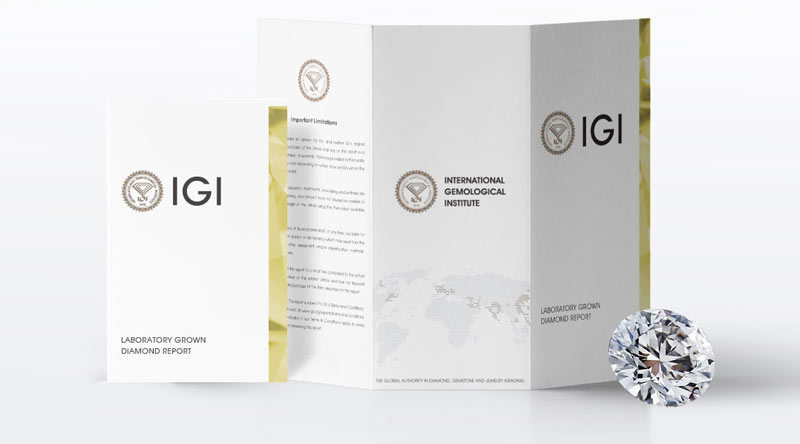
An IGI (International Gemological Institute) certification stating that the “New Diamond” is not a Synthetic one, but rather an Ecological Diamond?
It is there, written in black and white: «And the IGI (International Gemological Institute) certification, a third party body, helps to understand that it is not Synthetic, but rather an Ecological Diamond».
This is not what we know. The IGI (International Gemological Institute) “Laboratory Grown Diamond Reports”, while providing the same identification and quality grading system as their natural counterpart (Size, Proportions, Mass-Weight, Clarity, Color, Cut), also explicitly indicate both on the front cover and in the Description section that they actually are “Laboratory Grown Diamond Reports” or “Laboratory Grown Diamonds”. Non solum, sed etiam (not only but also) the Report (“Certificate”) is written on yellow paper, to distinguish it from the Report issued for its Natural counterpart which is issued on white paper; and along the girdle a laser-inscription shows both the Certificate serial number and the wording “Lab-Grown” (Figure 4).
This being the case, would we be exaggerating if we were to raise doubts not only on the logical construction but also on the correctness, and truthfulness of what has been put in black and white in the above mentioned paragraph?
Italian Rubies, Sapphires and Lab-Grown (Synthetic) Emeralds?
The news that in July 2021, the Diamonds «would be followed by the first Italian made Lab-Grown colored gemstones such as Rubies, Emeralds and Sapphires» truly sends us into exaltation – I would say – in mystical ecstasy!
Mi Deus, for Lab-Grown Rubies (i.e. Synthetic, since the regulatory considerations mentioned above for Diamonds are also valid for Colored Gems) it is since 1896 that we long, we aspire, we are drooling to have an Italian source; for (Synthetic) Sapphires, since 1910; for (Synthetic) Emeralds, since the 1930s (although it was the Italian Giorgio Spezia to invent the Crystallization Method by means of the Hydrothermal Process in 1905). Magnificat!
Or is this a result of “witty inventions”?
Environmentally friendly Rubies, Sapphires and Emeralds (Synthetics)?
Not unlike the aforementioned Synthetic Diamonds, the proper and due respect has not been paid to the information sources that are widely available to the industry. Yet this doesn’t amaze us as much as the fact that even the aforementioned materials are labeled as environmentally friendly.
Up to now we presume that they have never been Ecological (never before such expressions have reached the Cricket’s antennae) and we must consequently assume that new and innovative production techniques must certainly have been developed and that new technologies and equipment must have appeared, so that the usual well known Production Methods may be dumped all of a sudden in the landfill of history. Or that, supposedly, the classic Flame fusion (Verneuil), Flux Fusion Czochralski and Hydrothermal Methods have undergone such a revolutionary innovation as to deliver us nowadays no longer the traditionally ordinary Synthetic Rubies Sapphires and Emeralds, but even Ecological ones. Here again, why are we kept in the darkness about such achievements? Would it be possible to be all informed about such amazing mutations? We fear to be in the position of pear fruits that happen to ripen during the November frost: backlogged…
All this having been ascertained, and having examined how much we can consider correct and true the striking affirmations contained in the cited articles published by those who are traditionally regarded as the two Princes of the Italian press, one could well ask:
- Whereas it is true that the specific column (in the “Corriere della Sera”) intends to evoke, in its title itself (“Free Everyone”), a breath of liberty of opinion with no boundaries (usually a separate editorial space is reserved and made available to “hidden” or “veiled” advertising campaigns);
- Considering that in the column “A&F Economy” of “la Repubblica” the whole thing is revealed in the form of unquestionable officialdom, including so many authoritative affirmations;
is there or is there not a moral (ethical) obligation to transmit non-polluted or potentially polluting messages to the public, as long as we are talking about ecology? When consumer protection is at stake, transparency and clarity were, are and have to remain a must, or can misleading messages be spread like wildfire, “free everyone-type”?
Where have professional ethics gone? Ethics, if you’re there, would you please give me me a call?
Ok, as they say in Naples, “every cockroach looks good to his mother’s eyes”. Everyone tries to “feather his own nest”. Come on! Enough is enough! Also because a promotional strategy involving the famous and celebrated Italian influencer Chiara Ferragni is all but hidden (“la Repubblica”). Now, it is a fact that the “influenced” people amount to 24 million and that they are hanging on the tumid and sensual lips of the beautiful and fascinating digital entrepreneur, even to choose a pair of underwear. And it’s also a fact that these 24 million are mostly members of the aforementioned generations M and Z, the supposed backbone of the present and future precious gemstone consumers. So, is it right or not to wonder how much it is legitimate to disseminate messages escaping, sic stantibus rebus, the critical skills and the will of discernment of M and Z young generations? Isn’t it, by chance, that the border has been trespassed and we are entering what old Latins used to describe as circumventio-onis (trickery, fraud)? God forbid.
Your ever-deferential Bad-Mouthed Jiminy Cricket
Counter-Current Gemology from the “Bad-Mouthed Jiminy Cricket” Luigi Costantini, published on IGR – Italian Gemological Review #13, Autumn 2021