This content was first published on IGR – Italian Gemological Review no. 16 in 2023. The information provided here is therefore current as of the original publication date.

The LMHC (Laboratory Manual Harmonization Committee) is a joint committee composed of a number of gemological laboratories, CGL (Japan), CISGEM (Italy), DSEF (Germany), GIA (USA), GIT (Thailand), Gübelin and SSEF (Switzerland). For about two decades, it has been working at the standardization of terms related to gemological reports and has dealt with specific papers on such topics as lattice diffusion of foreign elements, glass filled fissures, residues from the heating process in Corundum and Emerald fissure filling, to mention a few of them. On March 14, 2023, in Basel, at its 30th meeting since its foundation the LMHC revised some of its previous papers and discussed two new issues that are interesting to gemology.
The first is about some cases of sapphire irradiation with radiotherapy equipment used in the medical field for cancer treatment, a technique that has been used for a while and occasionally resurfaces on the market. As many dealers know, a prolonged exposure to a light source in many cases makes the irradiated gemstones’ color (mostly yellow sapphires) fade away as their original pale hue is restored. The goal is to attain a common wording for the description of these treatments.
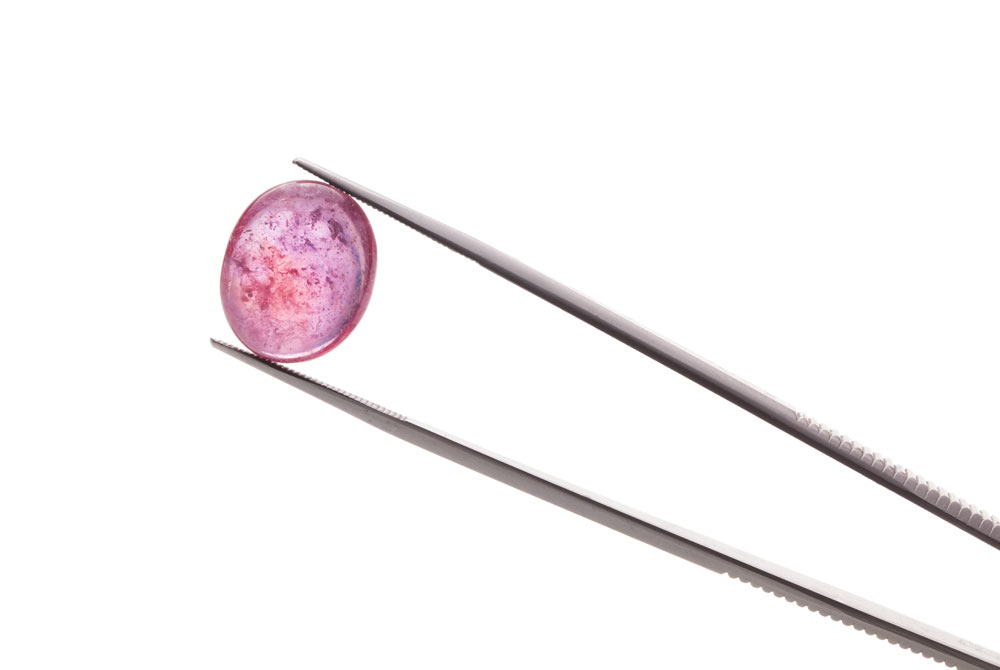
The second issue involves low-temperature heating (below 1,000 °C) of rubies and pink sapphires. IGR reached out to Michael S. Krzemnicki, director of SSEF, who informed us that his Institute recently released a newsletter, to possibly soon being followed by a detailed scientific paper to be published in the Journal of Gemmology, in which more information will be provided about current research on this matter.
The SSEF lab note showed that, being FTIR spectrophotometry not always conclusive, a method can be proposed based on the heat induced modification of the Raman spectrum, obtained by confocal MicroRaman, of a zircon found as an inclusion in the corundum under investigation.
However, it remains to be ascertained whether this approach can be resolutive since zircon inclusions are assumed to be found at all times in the corundum for which the heating level is sought.
Gem News published on IGR – Italian Gemological Review #16, Summer 2023