This content was first published on IGR – Italian Gemological Review no. 2 in 2017. The information provided here is therefore current as of the original publication date.

The lack of interest among gemologists towards the importance of cutting classification
The essence of gemologist work is to analyze and confirm characteristics influencing value of this or that gemstone. And, while evaluation is the final purpose of our work, we need to cover maximum number of these characteristics to let appraiser get the most objective conclusion. I will not talk about factors well investigated already, which you are more than me experienced with. I mean material of gemstone; it’s color, clarity, origin and treatment. I want to enlighten two factors; first of them seems to be well known, but practically is not used by gemologists and almost does not influence gem evaluation. The second one has never been used for gemstones at all.
Gemstone market is changing, and the name of this change is development. It is obvious, only something dead does not change. But what directions is the gemstone market developing? I just say, that I don’t mean diamond market. This market is too formalized, too conservative and too monopolized to be tested objectively. Let’s concentrate on colored stones market – more dynamic, more spontaneous and, accordingly, more predictable for a good expert.
It is easy to notice that development directions for gem market are strictly connected with the same price-forming characteristics I just said about. Remind: the first, that influence the price, is material of gemstone and it’s origin. And the first direction we can mention is creation of new material (like Nano-Sital, for example) and lab growing of well-known ones. The second direction – treatment – is connected with characteristics of color and clarity. But the third direction is not reflected in Gemology, although it presents on the market, and I see here our fault, my friends. I mean developing of gemcutting.
Really, other directions are developed due to gemologist’s forces, but gemcutting is developed, sooner, against them. Rather to say, it is developed in spite of absence of their attention. Gemcutting brands appear spontaneously in different countries. Well-faceted stones are more welcomed for the same (or almost the same) price. But nobody can define this “almost” while says more or less objectively how much cut of one stone is better than another.
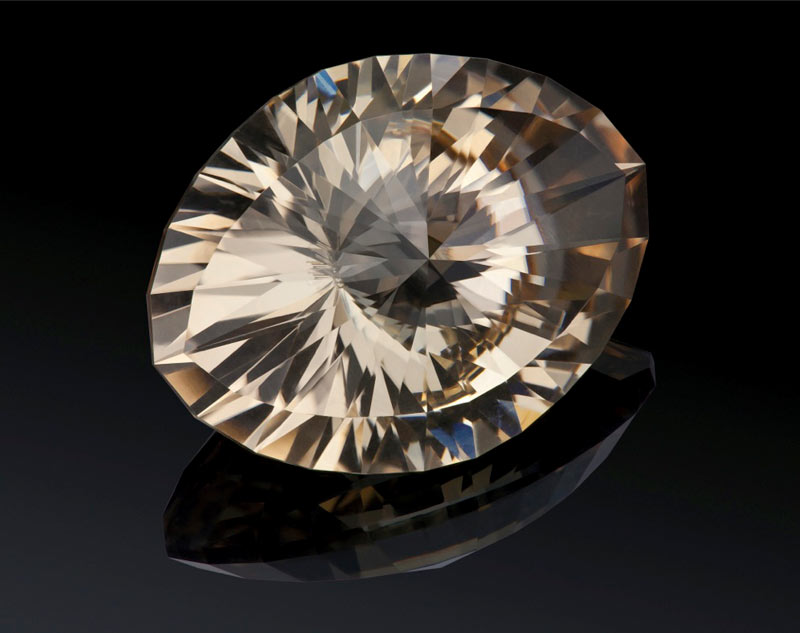
Pattern points, combination of separed design elements
Just one lab today – I mean Spain Gemological Institute – includes cut grading into colored gemstone certificates. For this purpose they use grading system similar to created by GIA for diamonds: symmetry, proportion, finish grade – five gradations for each criterion. But what means five gradations, say, for all spectrum of finish grade? It is discrete scale with huge interval of points. Also there are no strict regulations to define these gradations, and evaluation is quite subjective.
What can we suggest right now? During last years I created universal cut grading system. In this system I summarized all my experience of participation, judging and organizing technical faceting competitions as well as teaching experience in Russian Federation and Thailand. The key moment of this system is taking gemstone not only as whole one, but also as combination of separate design elements or pattern points, which should be tested during examination. It allows us to take into consideration such important thing as complexity of design. That is one story when three facets of 17 have defects and absolutely another – the same three facets in amazing artistic design of 300 facets and more.
Well, pattern point – what is this? This definition covers the following: facet, edge, meetpoint and pair of symmetrical facets according to faceting design. Here meetpoints are not all corners, but only those, which join four facets or more. This point should be strict point, not line. Of course, some preliminary procedure is needed before cut examination. We have to count the total number pattern points on pavilion, crown and girdle – if it consists of separate facets, connected with facets up and down. Then – to look the stone attentively using 10-times loupe and count number of pattern points with some defects into special spreadsheet. Defects could include: scratches, pits, chips, caverns, uneven meetpoints or pairs of symmetrical facets different in shape or size. It is useful to divide all defects into three categories:
- barely visible through the loupe;
- easily visible through the loupe, but barely visible by naked eye;
- easily visible by naked eye.
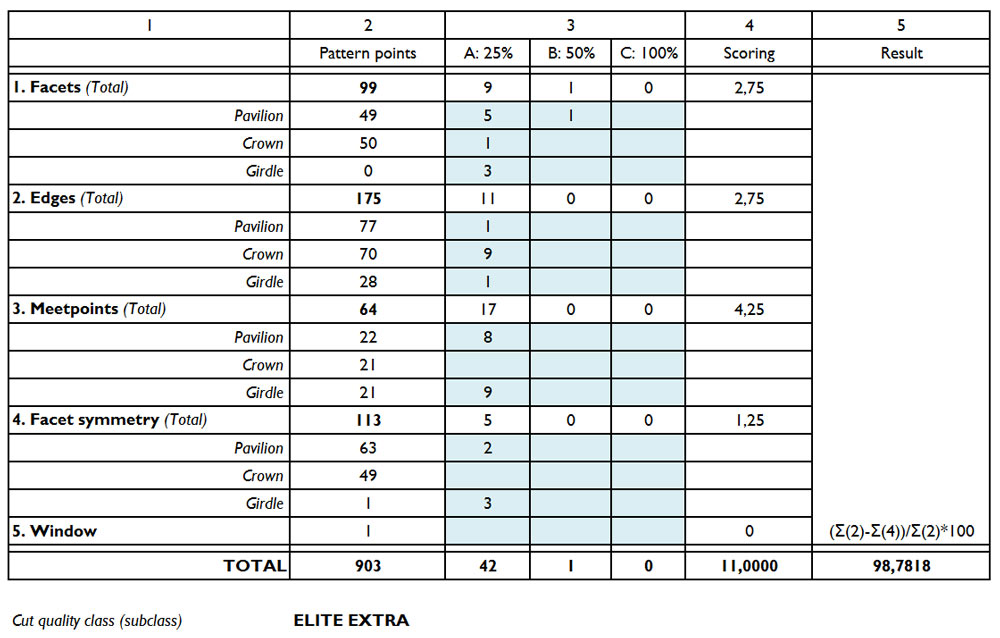
When counting final score, these groups of defects have different weight – 25%, 50% and 100% accordingly. “Window” (if exists) appointed as separate criterion as well as its size in percentage of total face area of gemstone. After filling all fields the spreadsheet calculates total score and expresses it within 100-points scale with 4 digits after comma.
Classes and subclasses
I excluded such criterion as proportion of gemstone. In difference with diamonds, specially crammed into a few standard shapes, the world of colored stones is so wide, that expression “Ideal proportion” becomes quite conditional. As for symmetry – if facets, symmetrical according to design, have the same shape and size, the whole gemstone is also symmetrical.
I use this system, when my customers ask me to make the author’s certificate for gemstones cut by me. I always include cut evaluation into this document. But I do not limit just digits – it is clear, but not so convenient. As addition I use simple classification, based on above-mentioned cut grading system. Depending mostly on final score, I divide all stones on three classes: Commercial, Quality and Elite. Each of them, in its turn, has three subclasses. And, if subclasses of first two have numeric marks: Commercial-I, Quality-III, – subclasses of the Elite class have its own names: Elite Premium, Elite Extra and Elite Ideal. There are the highest requirements for stones, which pretend on Elite Ideal subclass. Besides the total score not less than 99 of 100, there are some limitations. For example, if there is at least one defect of category B, the gemstone cannot be classified as Elite Ideal, and presence of “window” excludes gem from Elite class at all.
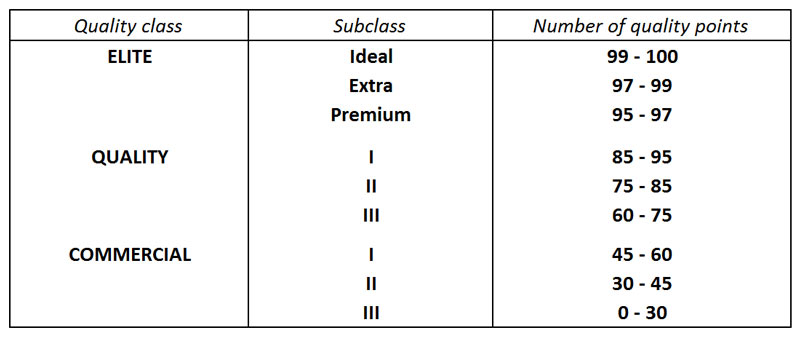
Of course, this system is still far from perfection and does not pretend to be the market standard as it is. For example, I am not sure in the name of second class – it could be changed, say, from “Quality” to “Improved” or something else. Probably, score intervals could be changed for different classes, some evaluation criteria could be added or defects classification could be modified. Any system is alive while it tends to change and develop. But the most important – it could be such base, the main principle, which could be used for creating your own approach to cut grading.
I still have not told about one very important advantage of this system – it could be easily computerized. Today there are quite precise 3D-scanners used for analyzing rough and choosing optimal shape as well as final stone proportion estimating. I think it is not so difficult to adapt software for cut testing. As a former programmer, I realize how to do it. And, having some statistic how rare are gemstones of highest subclasses on the market and how difficult to cut them, we get the understanding how to prove their high price.
How to evaluate gemstones when they are art objects?
And one more factor should be taken into consideration when evaluating gemstone. I mean cutting of gemstones that could be called “an art objects”.
What is the distinguishing feature of art? It is the ability to raise in human mind the row of associations, which bring some emotions. Gemstones themselves sometimes also could bring emotions: you see and like. This is also mastership – to be able to disclose charm and beauty of gemstone. But the real artist can do more: to create images in our consciousness, using the beauty of gemstone. Let me remind the shortest story of great Hemingway: “For sale: baby shoes, never worn…” Just six words, but – sorrow of somebody experienced with terrible tragedy – lost his baby – plunged into our mind. And, as a reply, the wave of compassion is arising, wish to help and support. The genius writer forced us to the storm of emotions – by six words only.
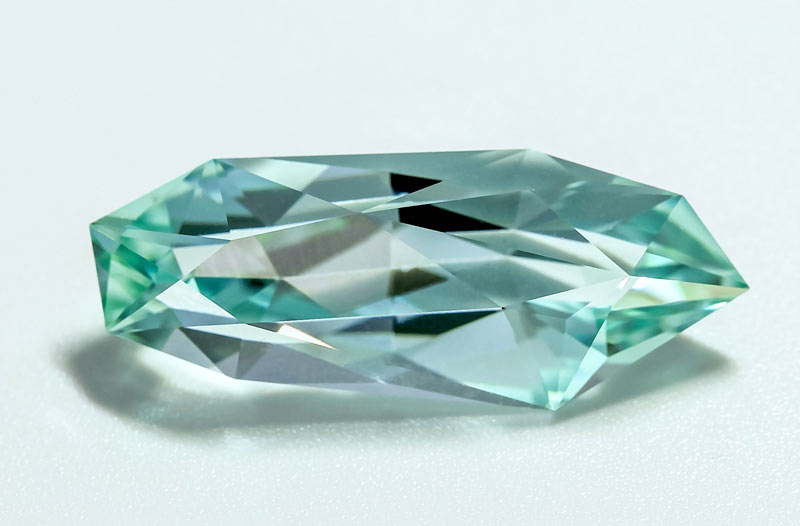
Of course, WORD – is one of the most powerful features of artistic expression. But faceted stone also could be such feature of expression. And WORD could help to the gem artist. I explain. A few years ago I cut Aquamarine in absolutely irregular shape. There were no symmetrical facets at all. (Nevertheless it had no window, when we look at correct direction). The name of this stone is “Sprout of the Universe”. One time I’ve read the hypothesis that our Universe is the Crystal, every facet of which is 3-dimensional space. How to show multi-dimensional object? Just as projection to 3D. Picture is 2D-projection of 3D-object. I tried to imagine (and cut!) 3D-projection of the Great Universe, where many Cosmoses crossed in some lines and points. Of course, gemstone is so small, but it is just sprout – imagine, how can it raise and get more complex… This is not a craft. This is the art.
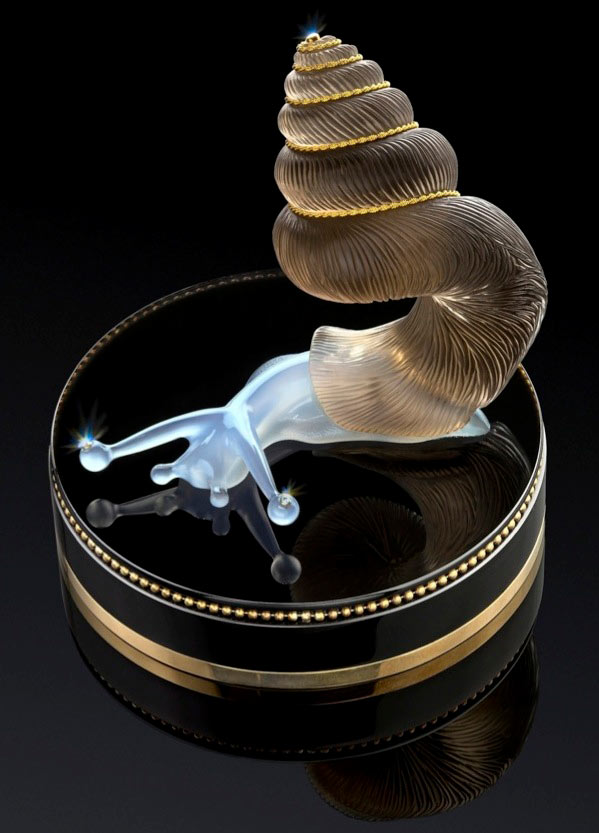
I will give another example. This is “The Balance” (Figure 5), miniature made by the Russian carver, who has worked in New York for a long time. A snail from the Mohave chalcedony and smoke quartz, decorated with gold and diamonds, is set on the round mirror-like polished basement from black obsidian also with the golden edging. Or, better to say, it is soaring above the basement as if balancing in two or three tenths of millimeter above the surface. According to the vision of the master, it should be rotating making its spiral shell screw in the space, thus giving the idea of spiral evolution of life. At the same time its plane reflection in the black obsidian (above which it is soaring peacefully) reminds that this world and this life is only a reflection of more complex and multidimensional images and processes. This is also an art.
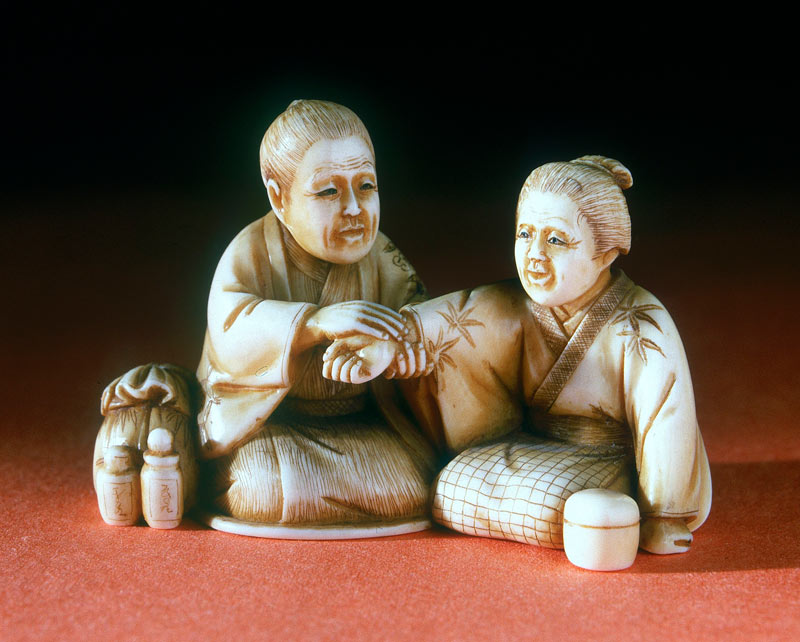
There are many examples in history. Let me remind netsuke – an old Japanese art. These are small sculptures, showing humans and animals during some moments of their life. Sometimes sculpture accompanied by short poem expressing the idea of composition or connected with it conceptually. In this case sculpture is a key, opening the chain of associations in our mind, the fundamental base for constructing a building of feelings and emotions. To continue this analogy, the poem here is like rough material, and beauty or complexity of the building fully depends on deepness of spectator’s inner world, his consciousness. It is very important moment. The main specialty of the real art is transformation of passive spectator into active creator.
In these cases we have to use another criteria of evaluating, absolutely different from, say, GIA grading system. How much are these images clear for the people? What associations do they excite? If some emotions go through the audience, how strong are they? How exactly did master disclose the idea? Of course it depends on the talent of artist and – strictly connected with value of masterpiece.
I am sure, these art objects have its own niche on the market. Whatever we touch – wearing, shoes, accessories, watches or jewelry – we can find four big groups of goods, different in quality, marketing and price accordingly. The first group includes craftworks, usually made with commercial quality. The second one covers well-made goods of factory production. The third one is brand name, high quality items. And the last group contains art-objects, unique masterpieces, as a rule, made exclusively by the real artists. Prices differ not in percent’s, but – in times. I don’t think that gemstones should be an exclusion. It is just question of time.
Well, what I have to say in conclusion?
The common scheme of gemological work needs some correction. It is impossible to ignore directions of evolution. If it presents on the market objectively, it must be taken into consideration in our activity. Today customers already ask about cut quality. Tomorrow they will come to appraisers with this question, and appraisers will come to us. If we are not ready to answer, they will come not to us, but to other market players – more flexible. One time a very wise man told me: “If you can not prevent something, you have to lead it”. We cannot stop evolution. But we can create an instrument, which direct it to the best way for us.
Article by Victor Tuzlukov, published on Rivista Italiana di Gemmologia – Italian Gemological Review #2, September 2017.