This content was first published on IGR – Italian Gemological Review no. 15 in 2022. The information provided here is therefore current as of the original publication date.

The “IV National Conference Diamond and Coloured Gems: Identification, Tracing and Ethic Aspects” was held in Ferrara, Italy, on July 7-8, 2022 at Palazzo Tassoni Estense. As was the case for last edition in 2021 held in Bari, IGR promoted the event, which was well attended, contributing as Media Partner to its dissemination, at both national and international level.
Piero Alberto Manuelli (Istituto Gemmologico Ligure – ATC Gem-A Italy), described the refractometer operating on the principle of Brewster’s Angle and allowing the determination of the refractive index in the range from 1.4 to 4.0 IR. It does not require the use of contact liquid which has a restricted reading range to 1.8. It allows a higher measurement range than traditional refractometers based on the TIR principle and avoids any harmful contamination of the gemologist with the environment as it currently happens with the use of sulfide liquids.
In his position as a spectroscopy expert from the Institute of Mineralogy and Crystallography at the University of Vienna, Lutz Nasdala offered an overview of the basics of spectroscopic investigation as a whole, then lingering on the applications of Raman and photoluminescence spectroscopy in gemology. The physical characteristics of the two techniques were explained, noting that in many cases a confusion exists in the use of the right terminology, even among papers released from scientific publications. Both techniques are widely exploited in the gemological field for both phase recognition and characterization of treatments and synthetics.
A few examples indicate their appropriate use: in one of his works on a 0.90-carat blue tourmaline, Raman spectroscopy allowed the identification as dravite, obtained of course without damaging the specimen, thanks to the spectral fingerprint given by the hydroxyl group.
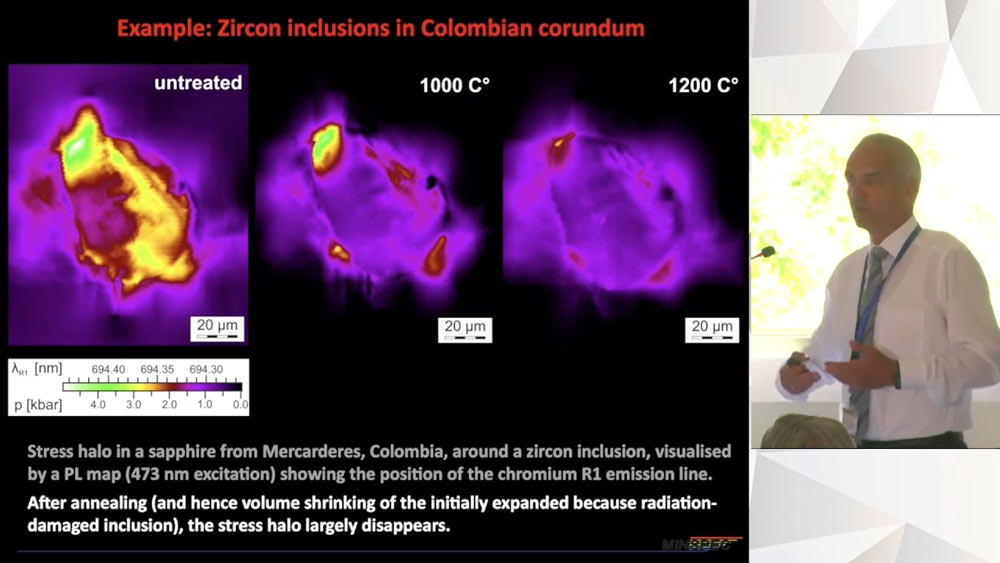
In many cases the combination of the two techniques is what gives greater accuracy to the studies. Three examples are given. a spectroscopic study of inclusions in corundum sapphires from Colombia, radio-staining of some rough diamonds and a study of the degree of spinel inversion. Especially in the first work, the analyses proved to be an excellent means for inclusion detections. In some cases, when the Raman signal was not sufficient, identification was obtained according to the spectral characteristics of the PL emission. In addition, for zircon inclusions, the widening of the spectral band further helped by highlighting the presence of structural damage caused by radiation occurring at low temperatures.

Anglo American, a giant mining company with more than US$25 billion in sales in 2021 and a market leader in diamond mining, owns 85 percent of De Beers Group, which produces one-third of diamonds by value. What are the technical geophysical techniques used for the exploration of potentially diamond rich areas? The question answered by Obone Sepato’s (Anglo American geophysicist) presentation unfolds the frontiers of Diamond prospection, a very interesting field but one that nevertheless often eludes gemmological scrutiny. Pipes of kimberlite, the rock that host diamonds, usually exhibit physical properties different from the surrounding rocks and thus easily identified; the data provide hints as to where to place drilling holes. Among the various geophysical methods listed, including gravity and electromagnetic techniques, aeromagnetic survey is the main geophysical exploration tool. Measurement results are presented in the form of maps and profiles showing magnetic field anomalies.
Article by Paolo Minieri and Stefania Coppola, published on IGR – Italian Gemological Review #15, Autumn 2022.