




This content was first published on IGR – Italian Gemological Review no. 22 in 2026. The information provided here is therefore current as of the original publication date.

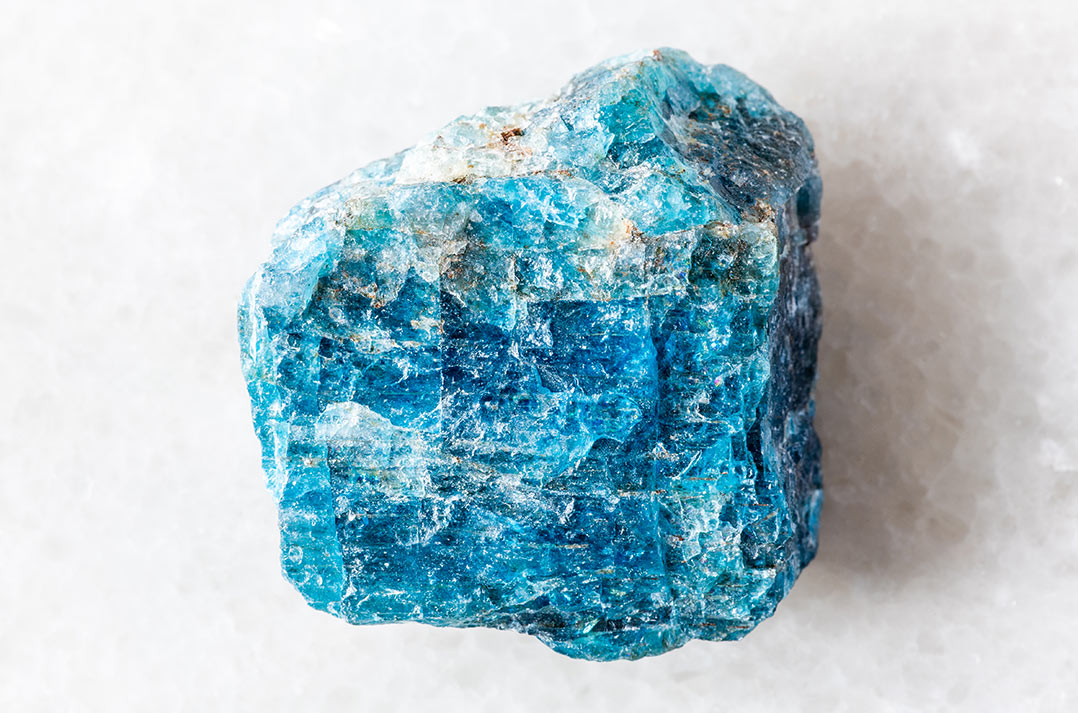
The study “Mineralogical characterization and fluorescence properties of blue, yellow, and green apatite”, conducted by Wenkai Liang, Nai Wang, and Yingrui Gan and published on RSC Advances in 2025, analyzes in detail the crystal structure, chemical composition, and spectroscopic properties of raw samples of blue, yellow, and green apatite commonly found on the market.
The results indicate that all samples belong to the fluorapatite group; in blue and green crystals, an isomorphic substitution between carbonate and phosphate ions was observed, which was less evident in yellow apatite. Chemical analyses showed an anomalous decrease in Eu and Ce, especially in blue and green samples, suggesting different modes of incorporation of these elements into the crystal structure depending on the color. The study highlights that the yellow color is mainly attributable to Nd3+ ions, the green color to a combination of Nd3+ and transition metals, while the blue color is associated with Mn2+ and sulfite.
When excited by UV light, the samples emit strong violet fluorescence around 400 nm, due to Ce3+ and Eu2+ ions. Yellow apatite, on the other hand, exhibits orange and pink emissions at around 585 nm and 600 nm, related to a higher content of Sm3+ and Pr3+. Finally, in terms of thermal stability of fluorescence, the yellow samples show slightly higher resistance than the blue ones.
This research makes a significant contribution to the understanding of the chromogenic mechanisms and luminescent properties of apatite, highlighting the crucial role of isomorphous substitutions, rare earth chemistry, and transition metals in determining the color and fluorescent behavior of these materials.
The study is available at this address: https://pubs.rsc.org/en/content/articlelanding/2025/ra/d5ra03299g
Gem news published on IGR – Italian Gemological Review #22 – Spring 2026.


