This content was first published on IGR – Italian Gemological Review no. 8 in 2019. The information provided here is therefore current as of the original publication date.

Richard Liddicoat, one of the founders of modern gemmology, declared: «If there was a scale of difficulty in the appraisal and understanding of gemstones, diamond would rank #1, the easiest, and opal would be #10, the most complex…» (In Color Summer 2018).
According to Andrew Cody, a leading Australian opal producer, opal is probably the gemstone understood the least…
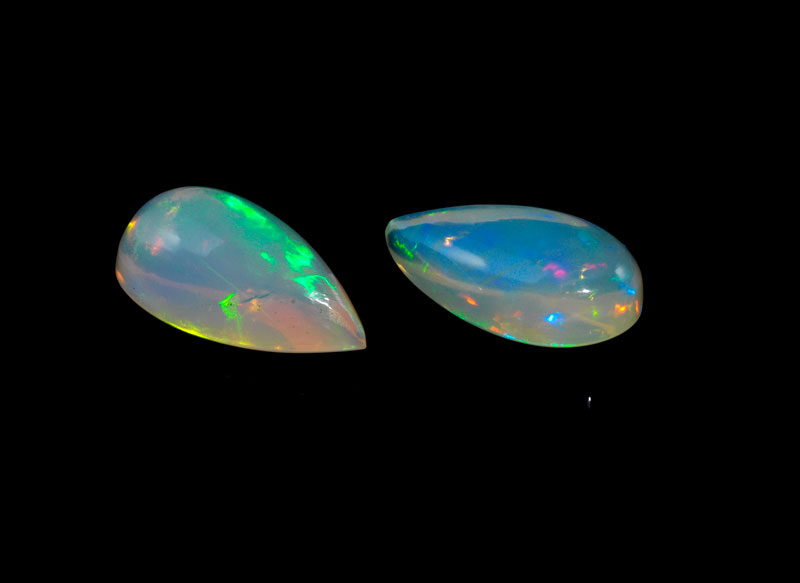
A master reference set up starting from 200,000 stones
Captivating by their colours, play of colours and shapes, opals are one of the most important gemstones in the trade.
In this context, it was important to create a specific and scientific tool that meets the demands of professionals of the gem trade and gemmological institutions.
Andrew and Damien Cody, from Cody Opals company, have spent more than two years of research and development to set up the Opal Master Reference Sets for the gem trade. This master sets were created following the need of a tool for education, identification, classification and grading.
Due to the enormous amount of work involved in this project, especially the search and classification of representative samples, only 50 sets were manufactured first. Most of them were already sold before their availability. Given this success, 10 additional sets were produced.
Around 13,000 stones, from over 200,000 stones, have been selected, cut and graded for the sets (Unninayar C., 2019). Each set consists of 9 trays containing 216 samples of naturals opals from various deposits around the world, synthetic opals, composite opals and even opalized fossils. Opals are displayed in the trays to represent the important aspects of identification, classification, locality, type, grading and morphology.
The set is as follows:
- Trays 1 and 2: Natural precious solid opal;
- Trays 3 and 4: Natural precious opal on host rock;
- Tray 5: Natural precious hydrophane opal;
- Tray 6: Natural common opal;
- Tray 7: Composite opal;
- Tray 8: Artificial opal;
- Tray 9: Opal specimens.
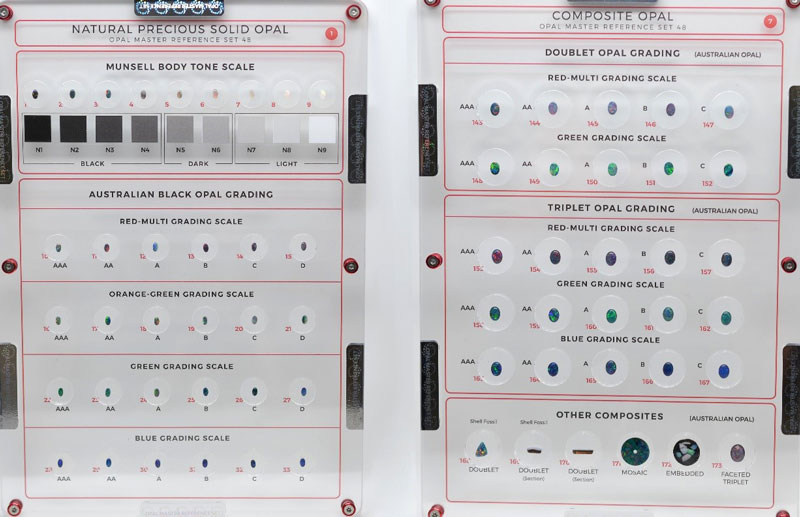
Each set is individually numbered and secured. A handbook will soon complete each set which will bring additional information on each opal sample.
Investigation on opal at the Laboratoire Français de Gemmologie (LFG). In addition to the master reference set a new specific procedure
The Opal Master Reference Sets are an educational and technical tool developed by opal specialists and unmatched in the gem trade today. It will provide incomparable assistance to all players in the opal market, as buyers, sellers and consumers, but also to gemmological institutions.
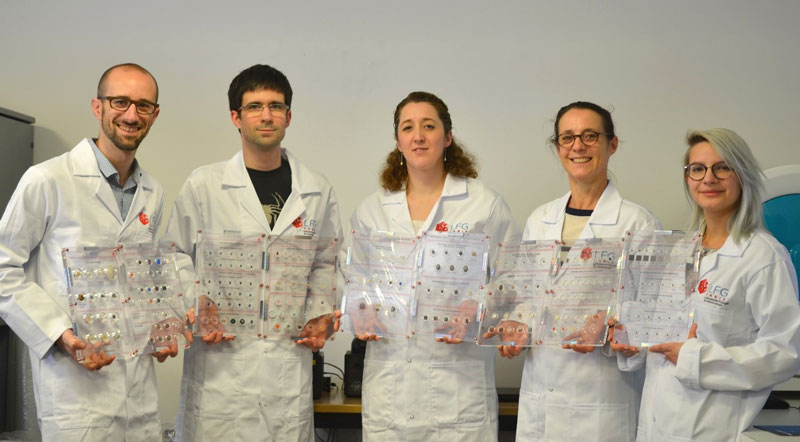
The Laboratoire Français de Gemmologie (LFG), French gemmological laboratory in Paris, has acquired one of this opal reference set, the set n°48. It will serve different purposes within the laboratory:
- for the LFG education division: future gemmologists will be able to observe and appreciate the opal gradation criteria;
- for the laboratory as a reference tool for gemmologists during analysis of opals for identification, classification and origin.
The LFG, created in 1929, is the oldest laboratory in the world still in activity. As a scientific laboratory, its first mission is the analysis of gems and jewellery for luxury professionals and individuals. Their gemmological analysis reports are internationally recognized.
Opals are frequently analysed in the laboratory to determine their authenticity. The presence of synthetic opals and imitations on the gem trade strengthened the need for professionals to control the nature of their stones (Renfro and Shigley, 2018).
A specific analysis report for opals was reviewed in 2012 to highlight these gems. It is more descriptive and precise. Indeed, the LFG has also developed a specific gradation procedure for opals base on the body colour and description of the play of colour patterns. Other characteristics are studied, such as the hydrophane character, related to the porosity of the stone and its water content, or the number of colours per diffracting pattern.
The Opal Master Reference Set will be useful for the LFG during different steps of the opal analysis procedure. It will be used to classify opals notably through a diaphaneity scale (tray n°2), a boulder opal grading scale (tray n°3) or even a fire opal grading scale (tray n°6).
At the laboratory, opals are first weighed then observed with the eye in normalized light and under a binocular microscope to observe and describe the stone. This step will already allow us to separate the opals such as: opals with or without host rock, precious opals or common opals. Also, hydrophane opals can be identified. Australian opals, in particular black opals, are exceptionally hydrophane.
Description, gradation, spectrometric and chemical analysis
Classical gemmological data are carried out as measurements, observation of the luminescence under ultraviolet light, description and duration of the phosphorescence if there is one. Description of diffraction patterns, named “play of colours”, is an important information for the classification of opals. They give rise of many trade names the Laboratory can’t describe as “variety”. Therefore, we describe in a simple way the shapes and arrangements of these patterns.
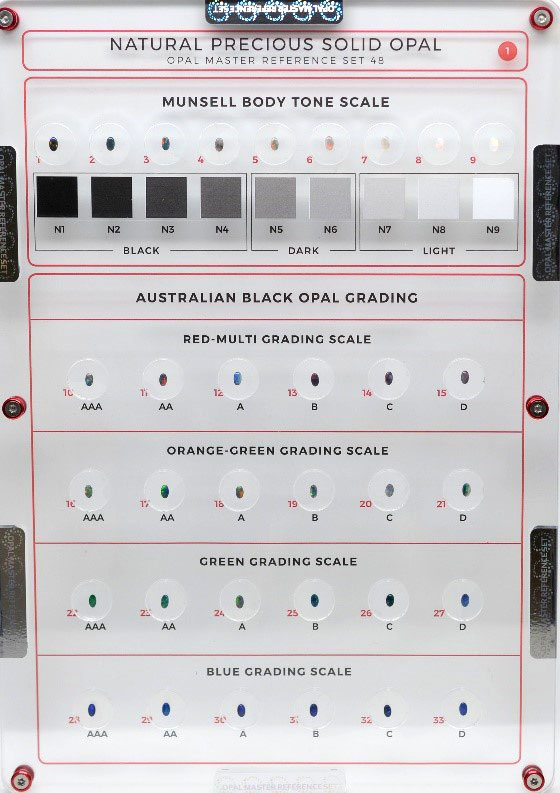
The body colour is also graded. Their colour depends on the iron content and due to very small crystalline inclusions. It will be graded according to a scale of clarity from white to black. Thus, the laboratory relies on the “Rock Color Book” of the Munsell Colour company used in geology to grade the colour of rocks.
This scale of clarity is also present on the board n°1 of the master set.
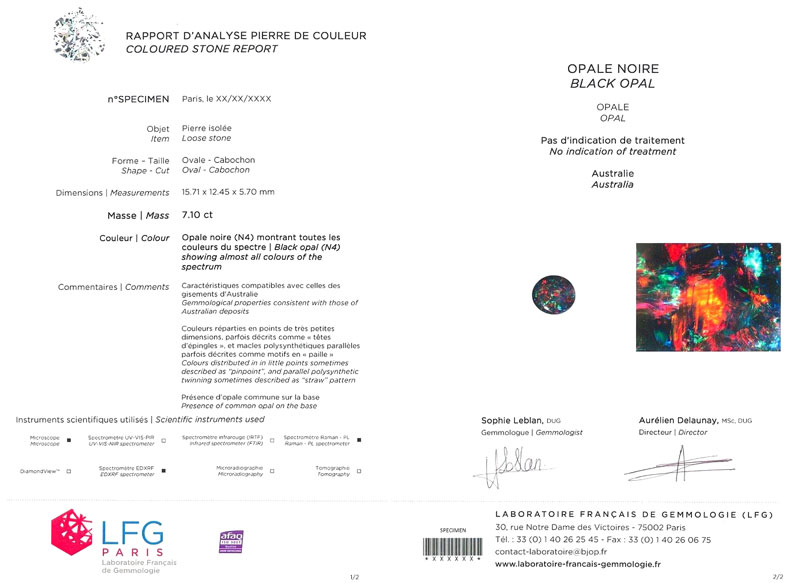
The scale goes from N1 for the blackest colour to N9 for the whitest colour. In order to apply a colour term, we used the Smallwood publication. The following classification is proposed: from N1 to N4: black opal; N5 and N6: dark opal; N7 to N9: light opal with N9 category is referred to “white opal” (Smallwood, 1997).
After the description and classification of the stone, several spectrometric measurements are acquired. A Raman spectrometry analysis, based on the molecular structure of the stone, is realized. This measurement relies on the vibrations of the atomic bonds (vibrational spectrometry) and their reactions when subjected to a laser-like excitation. The result provides a spectrum with a unique profile, characteristic for each mineral. It’s after compared to an internal database and research published and recognized in the scientific community (Lafuente et al., 2015).
A complementary chemical analysis will ensure us being in presence of natural opal and not synthetic. Some elements, such as zirconium, are characteristic of synthetic opals. This chemical analysis is also important for the determination of the geographical origin of the stone.
Geographic origin determination
Gemmological laboratories are more and more solicited to research geographical origin of opals. Several deposits in the world produce high quality opals such as Australia, Brazil, Ethiopia, Honduras, Indonesia, Mexico, U.S.A., etc. The LFG refers to published work on this subject (Gaillou et al., 2008) and have useful tools to determine a probable origin:
- Chemical analysis: the content of certain elements as barium or calcium varies considerably from one type of deposit to another.
- The determination of the opal type [amorphous (A) or composed of cristobalite-tridymite (CT)] by Raman spectrometry (Smallwood, 1997 and Fritsch et al., 1999). Following the deposits, we have a specific type as Australian opals are type A, while Ethiopian opals are type CT (Rondeau et al., 2016).
- Luminescence (light emissions resulting from excitation of electrically charged particles) can be an indicator of an origin: Australian black opals have often a strong blue-green luminescence, as well as a phosphorescence in a relatively long duration (up to 10 seconds). At the opposite, Ethiopian black opals are usually almost inert.
- Other rarer details will guide us for an origin such as faunal opalized fossils in Australia (Smith, 1999) or floristic opalized fossils in Ethiopia.
- At last, the LFG will be able to compare opals submitted for analysis with the various samples from worldwide of the Opals Master Reference Sets.
Conclusion
The Opal Master Reference Sets is a valuable tool for education, identification, classification and gradation. The considerable work done by opal specialists has resulted in a quality tool to respond not only of a demand from the gem trade but also from consumers.
For the laboratory, the master set is a complement of the existing opal identification and evaluation procedures. It will become an essential reference tool.
References
Fritsch E., Rondeau B., Ostrooumov M., Lasnier B., Marie A.M., Barreau A., Wery J., Connoué J., Lefrant S., 1999, Découvertes récentes sur l’opale. Revue de gemmologie a.f.g., vol. 138/139, pp. 34-40
Fritsch E., Wery J., Ostrooumov M., 1999, Classification of gem opals using Raman spectroscopy, Gems & Gemmology, vol. 35, p. 145
Gaillou E., Delaunay A., Rondeau B., Bouhnik-Le Coz M., Fritsch E., Cornen G., Monnier C., 2008, The geochemistry of opals as evidence of their origin, Ore Geology Review, vol. 34, pp. 113-126
Lafuente B., Downs R. T., Yang H., Stone N., 2015, The power of databases: the RRUFF project. In: Highlights in Mineralogical Crystallography, T. Armbruster and R. M. Danisi, eds. Berlin, Germany, W. De Gruyter, pp. 1-30
Renfro N., Shigley J. E., 2018, New Plastic imitation opal From Kyocera, Gems & Gemmology, vol. 54, n°1, pp. 60-61
Rondeau B., Fritsch E., Mazzero F., Gauthier J.-P., Cenka-Tok B., Bekele E., Gaillou E., 2016, Play of colour opal from Wegel Tena, Wollo Province, Ethiopia, Gems & Gemmology, vol. 46, n°2, pp. 90-105
Smallwood A., 1997, A new era for opal nomenclature, The Australian Gemmologist, vol. 19, pp. 486-496
Smith E., 1999, Black opal fossils of Lighting Ridge: treasures from the Rainbow Billabong. Kangaroo Press, 112 p.
The ICA Report, 2018, All about opal: launch of opal master reference sets, In Color, Summer 2018, issue 38, pp. 10-11
Unninayar Cynthia, 2019, Mastering Opal with the innovative reference sets, In Color, Winter 2019, Issue 41, pp. 82-84
Article by Annabelle Herreweghe1 and Aurélien Delaunay2, published on IGR – Italian Gemological Review #8 – Winter 2019.
1 Annabelle Herreweghe is gemmologist at the Laboratoire Français de Gemmologie. E-mail: a.herreweghe@lfg.paris
2 Aurélien Delaunay is director at the Laboratoire Français de Gemmologie. E-mail: a.delaunay@lfg.paris