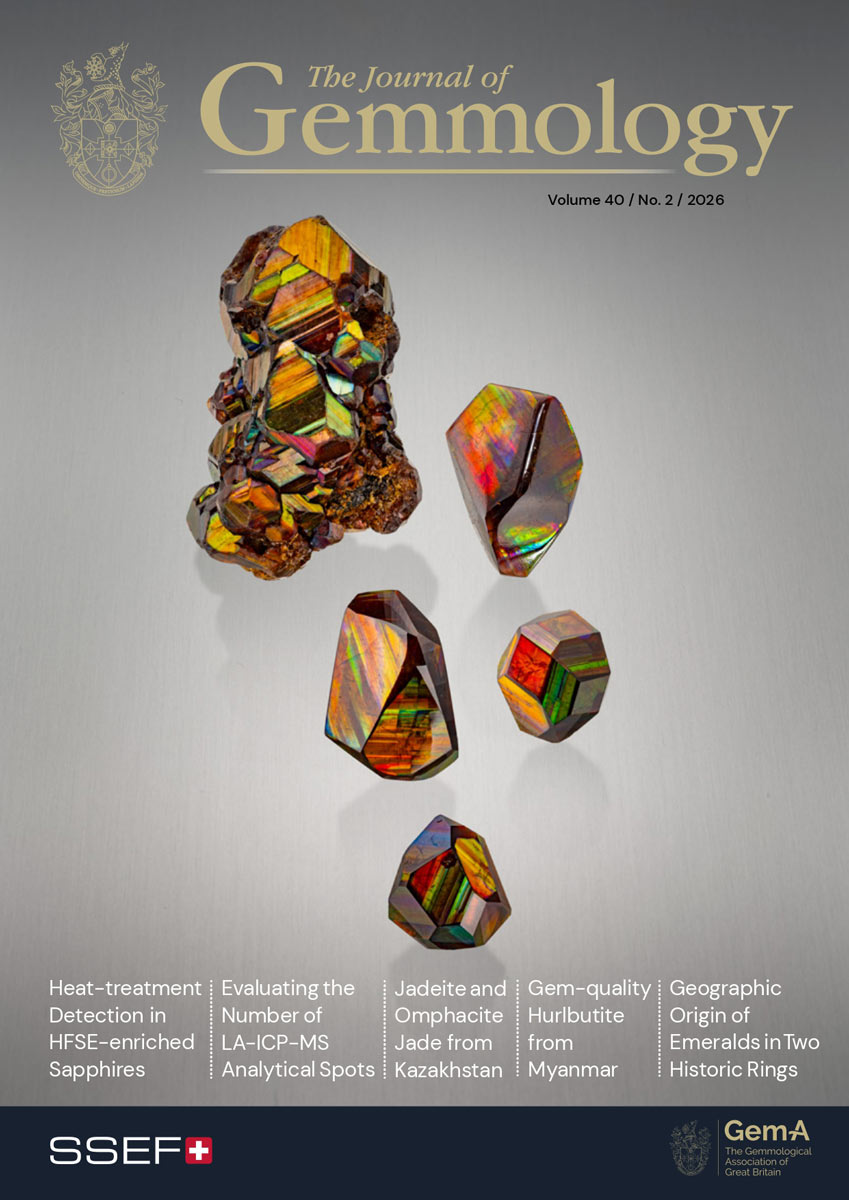
Volume 40, Issue 2 (2026) of The Journal of Gemmology stands out for a collection of contributions that reflect the most current challenges in gemmological research, balancing analytical innovation with a critical reassessment of established paradigms. From the complex identification of treatments in blue sapphires enriched in high field strength elements to new perspectives on gemstone geographic origin and emerging mineralogical discoveries, this issue offers an in-depth look at advanced methodologies and highly relevant scientific and applied case studies.
The opening article by Michael S. Krzemnicki, Laurent E. Cartier, Wei Zhou, Pierre Lefèvre, Markus Wälle, Hao A. O. Wang, and Judith Braun, “HFSE-enriched Metamorphic Blue Sapphires: FTIR and Trace-element Study, and Implications for Heat-Treatment Detection”, addresses a crucial challenge for gemmological laboratories: distinguishing between heated and unheated sapphires. The study examines metamorphic sapphires from Sri Lanka and Madagascar that are naturally enriched in high field strength elements (HFSE), such as zirconium, niobium, and tin. The research demonstrates that indicators traditionally considered reliable for detecting heat treatment — such as the FTIR peak at 3309 cm⁻¹ and the “chalky” bluish-white fluorescence under short-wave UV — can also occur in unheated stones enriched in HFSE. The authors emphasize the need for a combined approach integrating microscopic examination, advanced trace-element analysis, and Raman microspectroscopy of inclusions.
From a statistical perspective, Matthew F. Hardman, James E. Shigley, Ziyin Sun, and Aaron C. Palke, in “Statistically Quantifying the Trace-Element Composition of Coloured Gemstones: How Does the Number of LA-ICP-MS Analytical Spots Affect Evaluation of Their Composition?”, assess the effectiveness of LA-ICP-MS in determining geographic origin. By analyzing a single Madagascar sapphire using as many as 3,000 analytical spots, the researchers tested whether the three spots typically used by laboratories are representative. The results suggest that three spots provide a good balance between accuracy and minimal damage to the stone, and further indicate that the median composition may be more reliable than the mean when characterizing chemically heterogeneous samples.
The issue also explores new deposits through the work of Tiantian Huang, Yujie Gao, Lihong Liu, Andrew Christopher Lucas, Lisheng Wang, and Yilei Feng in “Characteristics of Jadeite Jade and Omphacite Jade from Kazakhstan”. The study examines jade samples from the Itmurundy deposit, distinguishing bright green, dark green, and black varieties. Bright green stones are predominantly composed of jadeite, whereas dark green varieties consist mainly of omphacite. The coloration is linked to chromium, with iron contributing to darker tones, while black jade owes its color to graphite particles.
Stefanos Karampelas, Ugo Hennebois, Aurélien Delaunay, Annabelle Herreweghe, and Marie-Laure Cassius-Duranton, in “Evidence for an ‘Uncommon’ Geographic Origin (Pakistan) of Emeralds in Two Rings of Historic Significance”, apply non-destructive techniques to emeralds set in two ancient rings — one from the Hellenistic/Roman period and the other late medieval. Spectroscopic and chemical analyses indicate an origin in the Swat Valley, Pakistan. This finding suggests that Pakistani emeralds may have been far more common in ancient jewelry than previously assumed, highlighting the value of collaboration between gemmology and archaeology.
The Gem Notes section reports several noteworthy findings, including:
- Iridescent andradite from Niger, representing a new source of garnets with pronounced multicolored striated iridescence.
- New fillers for rubies, consisting of lead-free silicate glasses (containing Ba–Zr–Y and erbium) developed for heat treatment in response to environmental and health concerns.
- HPHT-treated ruby, officially documented for the first time and identified through specific spectroscopic and microscopic features.