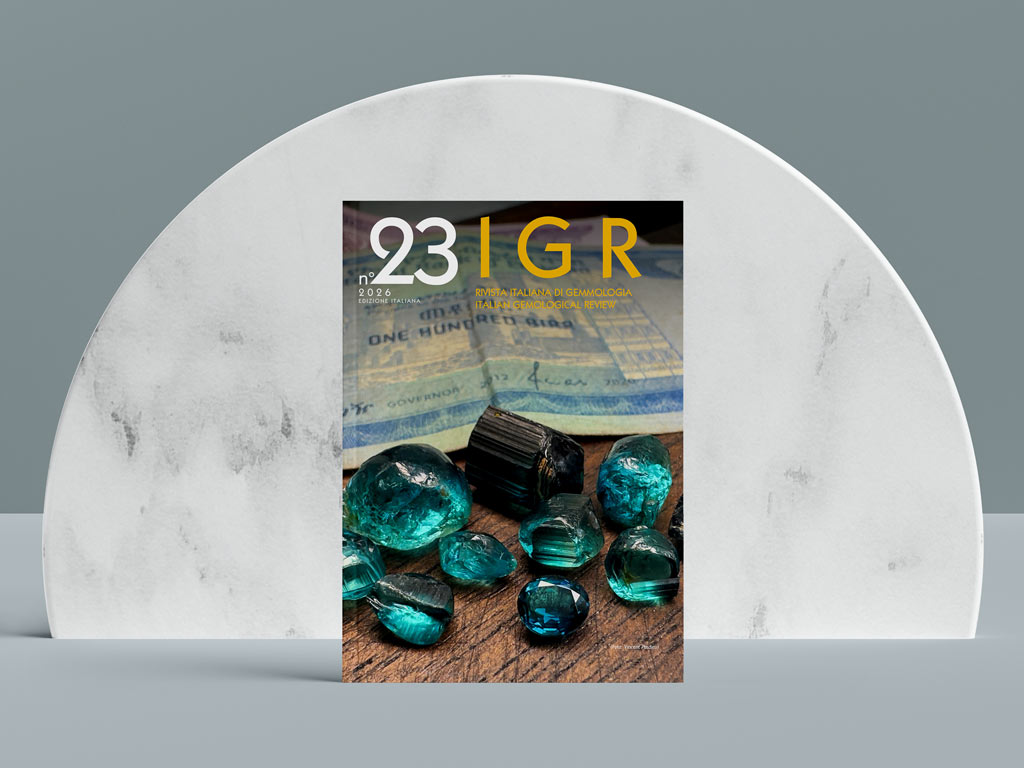
This content was first published on IGR – Italian Gemological Review no. 5 in 2018. The information provided here is therefore current as of the original publication date.

According to Forbes, one of the world most read magazines, it ranks third among the most expensive gemstones in the world, following red diamond and taaffeite and quoting US$20.000 per carat. The discovery of new deposit in southern Madagascar, near the village of Tranomaro attracted the attention of gemologists, GIA released a couple of extensive studies.
But what is making headlines is the appearance of grandidierites on the market at remarkably decreasing prices so that a new demand is growing and consumers seem to become more and more interested in them. Are we talking of unforgettable pieces?
Certainly not. Blue often turns to greenish and fractures are evident. Is the production supposed to keep on? Will the current sourced replaced by new deposits? Well, developments can’t be predicted. Being this material available and affordable now, it is worth closing up on this unique blue-shaded gem.
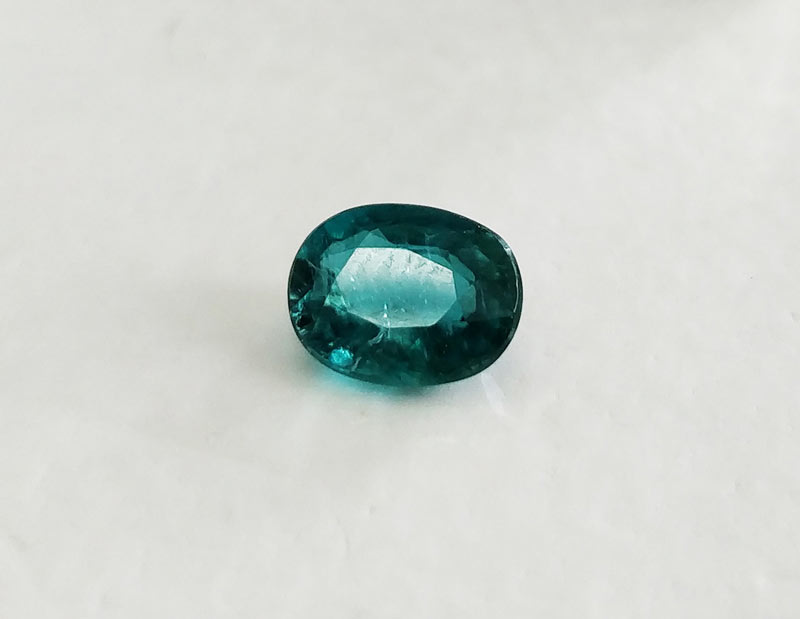
Grandidierite (Mg, Fe2+)(Al, Fe3+)3(SiO4)(BO3)O2 is an aluminum and magnesium borosilicate belonging to orthorhombic crystal system. It’s a biaxial gem with I.R. ranging from 1.575 to 1.635, density between 2.88 and 3.00 g/cm3, an appreciable hardness, 7.5 on Mohs scale. These features allow grandidierites to be used in jewelry in spite of their evident cleavage plans making cutting operations a difficult work, frequently affecting the beauty, the sizes and shapes of resulting stones.
Apparently this gem shows a blu/greenish color (blue due to its iron content), translucent to transparent having a vitreous luster and medium to strong trichroism, light blue-grayish/green, blue-greenish/colorless-light yellow. Even the most clean gems often present inclusions and surface fractures. It is UV inert at both 365 and 253 nm.
Its metamorphic nature along with the exposure of rocks at high temperature and low pressure makes grandidierite available in halogen rocks rich of boron in association with quartz, diopsides, sinhalites and tourmalines. It was just the Paraiba search fever to attract the attention towards grandidierite rough of similar color to these highly valued tourmalines.
Gem News published on IGR – Italian Gemological Review #5, Autumn 2018