This content was first published on IGR – Italian Gemological Review no. 5 in 2018. The information provided here is therefore current as of the original publication date.

No doubt demantoid is the most famous and sought after garnet variety in Italy. Its green color is due to chrome. It can be found in Valmalenco in crystals of rhombic dodecahedral habit, over 2 cm large, occasionally clean and suitable for faceting (Figure 60). The colors of stones range from yellowish green to chromium intense green, being the latter the rarest and most appreciated one.
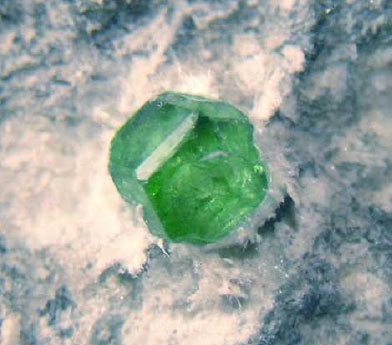
Demantoid is a typical garnet of the asbestos fissures of serpentinites. Extraordinary olive green crystals have been found in the Sferlum mine in Valmalenco as well as in Acquanegra quarries, at Ristoro di Campo Franscia and in Ross quarry.
Cossa in 1880 was the first scientist to study this mineral. He analysed the samples collected by T. Taramelli and recognized them as green andradite. At that time a French company was exploiting the asbestos available in those mines and the garnets, dipped in asbestos, were rejected. In facts garnets were present in the serpentinous matrix as well as in the asbestos scattered in very tiny millimetric crystals, the so called asbestos’ seeds and in nodules some centimeters large called acorns.
Probably the best demantoid samples ever mined are those fetched in 1947 by Luigi Magistretti who opened again the quarries of Sferlum for collectors’ use. These samples made this deposit very well known around the world and contributed to the main Italian and foreign museums. In between 1966 and 1972 Renzo Bagioli di Lanzada opened again the mine and unearthed fine samples, now showcased in the collection F. Berdognè in Sondrio. In 2005 an over 3 carat demantoid gemstone from Sferlum was donated to the Madonna of Tirano to celebrate the filth centenary of her appearance.
Another important Italian garnet is hessonite, the orange variety of grossular, which is well represented by the spectacular samples associated with the alpine rodingites. Hessonites occur in several locations, the most famous being Bellecombe, in Val d’Aosta, Ala Valley, Susa Valley, Viú Valley in Piedmont and Passo del Faiallo in Liguria (Figure 61).
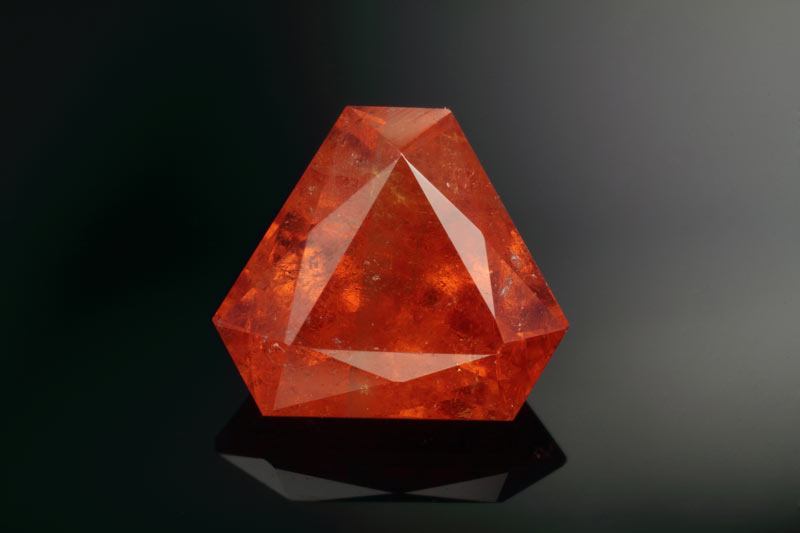
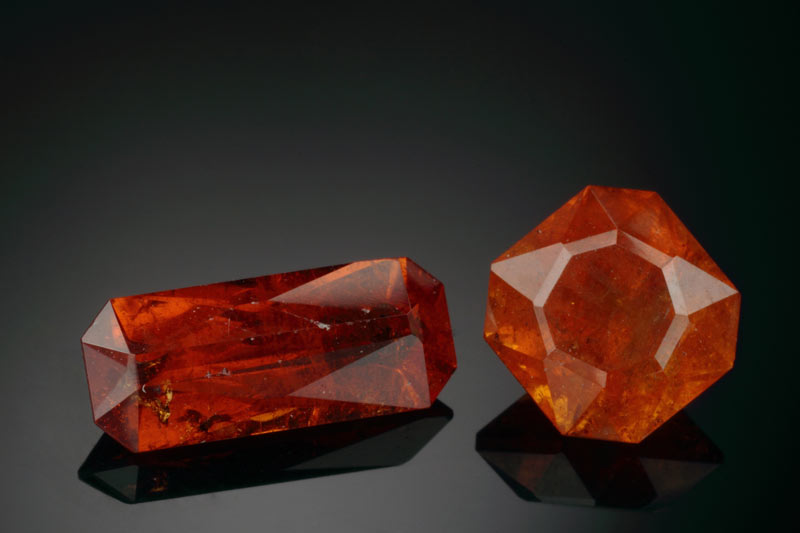
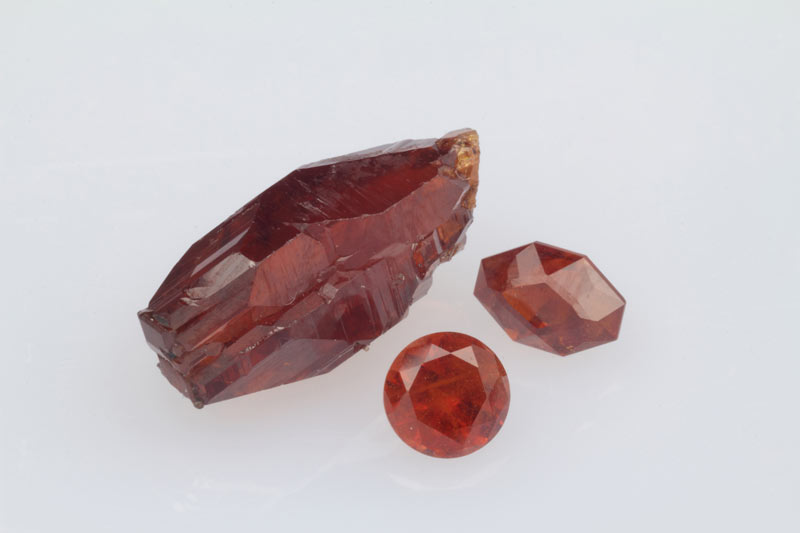
Although the collection samples encountered in the Italian locations are top quality, gem grade hessonite is rather rare and usually smaller in size when compared to those coming from other places in the world. In fact hessonite is among the cheapest cut grade garnets. This is why the Italian ones are faceted just for systematic concerns.
Stones of some carats weight have been cut from rough from Testa Ciarva, in Ala Valley, a location famous for many minerals and mostly for associations of hessonite and diopside. Weird elongated crystals have been found in Fontana del Preive.
Garnets of Passo del Faiallo in Liguria generally are dark red and associated with clinochlore. Some years ago Pio Mariani, a well known collector and trader of minerals from Milano held a concession there, mining a number of samples.
Another entirely Italian and rare garnet is the pink pyrope, available in quartzitic rocks in two locations of Cuneo province, in the surroundings of Martiniana Po in Po Valley and Brossasco in Varaita Valley. The best stones come from Brossasco and exhibit a slightly darker color (Figure 62). From these places the obtainable stones usually don’t exceed one carat, the record is a 4 carat gem. The production of this material has been estimated in 50 to 100 carats.

A yellow garnet named topazolite is also existing in Italy and can be found in Susa Valley (Figure 63), Torino province, in a copper mine in Libiola, Genoa province and in the Monte Ferrato quarries near Prato. Small size crystal measuring a few millimeters are generally very clean and lie over a black matrix, associated with magnetite. No mention of cut stones from these crystals has been reported.
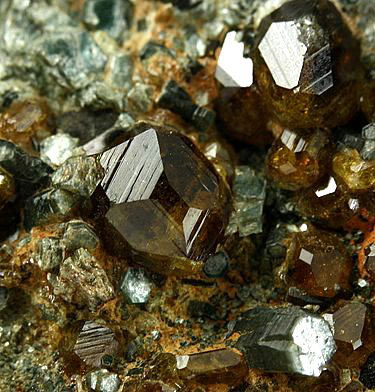
Photo by Fernando Metelli, courtesy of www.cfm-minerals.it

Visit the Gems of Italy section!
Curated by the qualified group of expert of the section Gems of Italy, published on IGR – Italian Gemological Review #5, Autumn 2018.