This content was first published on IGR – Italian Gemological Review no. 8 in 2019. The information provided here is therefore current as of the original publication date.

The main gemstone and Jewellery trade Associations have come to terms with some provisions of the new guidelines released by FTC in July 2019 including a definition of diamond considered controversial. In fact, in the US federal document removed the attribute “natural” from the definition of a diamond, a move that takes a distance from the consolidated European standard by which: “… the use of the word “diamond” alone without qualification states that it is natural”.
While incorporating most of the new FTC guidelines, CIBJO and other groups representing the industry (AWDC, CIBJO, DPA, GJEPC, IDI, IDMA, WDC and WFDB) strongly distance themselves from the possible use of the word diamond to indicate a synthetic diamond, recalling the “Diamond Terminology Guidelines”, released at the beginning of 2018, where the following definition of diamond is provided: “… a mineral created by nature; diamond always means that it is natural”.
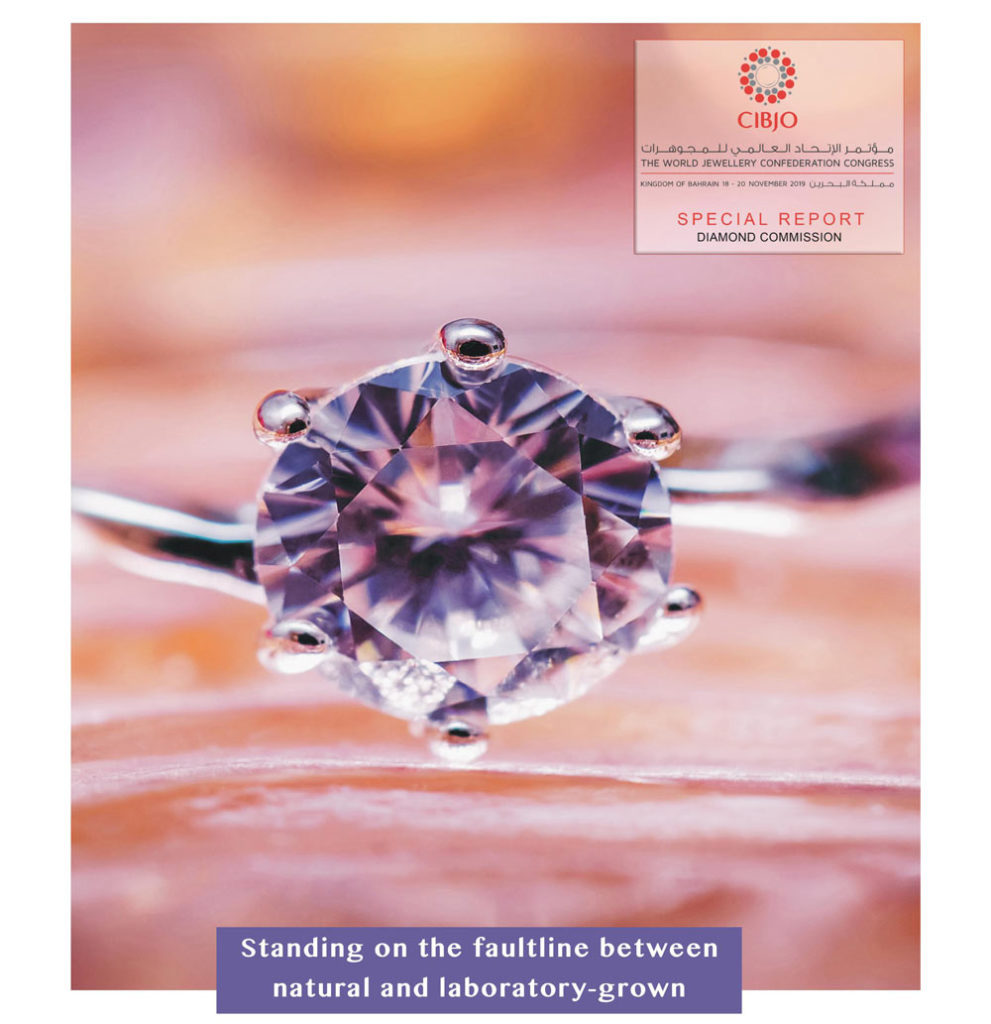
In October 2019 CIBJO’s Chairman of the Diamond Commission, Udi Sheintal, released a document, titled “Standing on the fault line between natural and laboratory-grown”, reiterating the recommendation to restrict the possible use of the term only to natural diamonds. But other interesting insights and clarifications on this thorny regulatory debate are also offered.
First of all, it should be remembered that as early as last year the CIBJO established the Laboratory-Grown Diamond Working Group, charged with formulating the operating principles and the terminological standards of this category of products which are not to be considered a transitory but a permanent industry, scientifically and economically separated from the industry of natural diamonds. Following FTC’s inclusive attitude Sheintal acknowledges this new category but insists on “the task of disconnecting the natural diamond sector and the laboratory-grown diamond [… not only from the professional perspective, but from the perspective of the consumer as well”.
Confusion must be avoided and for this purpose a new distinctive international six-digit code was ratified, qualifying “synthetic diamond, unworked or simply sawn or roughly shaped”. The new FTC guidelines have also strongly restricted the use of ecological qualifications such as “eco-friendly” diamonds. In this regards Sheintal points out: “… a stone, which is precious, but still a lifeless object, is neither ethical nor environmentally friendly… The onus of responsible behavior always falls upon the individuals and companies mining or synthesizing, processing and marketing these products”. Instead of “synthetic” (according to FTC a proper but not recommended term) “laboratory-grown diamond” or “laboratory-created diamond” (in the extended and never abbreviated form) are used in the document in deference with FTC’s position even though – as Sheintal honestly admits, “synthetic” has popped up from time to time.
Gem News published on IGR – Italian Gemological Review #8, Winter 2019