




This content was first published on IGR – Italian Gemological Review no. 11 in 2021. The information provided here is therefore current as of the original publication date.

Truly understanding who W.William Hanneman, Doctor Bill, as he was known in the gemological sector, was is not an easy task. And I am not sure I am the most adequate person to celebrate his figure. We met mainly during discussions on the “gemologyonline” forum to which he took part for many years and during short and however intense events in Tucson. He was a generous and controversial person, driven by an independent and some time polemic spirit. He didn’t follow the logic of the gemological establishment, he was certainly a freelancer, though sufficiently authoritative for not being ignored.
A “self made gemologist” who thought out of the box
In case, in our small gem village, the youngest are looking for a unique person thinking totally out of the box, viscerally removed from any kind of categorisation and openly, sometimes harshly controversial, here he is. You found him in “Doctor Bill”, just now that he serenely passed away on 17th December 2020, aged 93. He was always fond of stones and his father was an appreciated gem cutter. Then, thanks to the experience acquired as analytical chemist at some of the most important US companies (the DuPont Research Lab in Wilmington, Delaware, the Standard Oil / Chevron Refinery in Richmond and the Kaiser Center for Technology in Pleasanton, both in California), gems became to him much more than a hobby. In the sixties, thanks to his strong scientific education (he graduated at Illinois University, Urbana-Champaign, then he obtained a Phd in Organic Chemistry at the University of Nebraska) William Hanneman started to masterfully deal with the many gemological issues. Thanks to his tireless curiosity and analytic approach, he obtained results that lead him to consider himself as the first S.O.G (“Self-Ordained Gemologist” an acronym he coined for the occasion) in the world.

A provocation? Bill was aware of this, but he was filled with indignation for the fact that the access to the gemological knowledge was expensive, reserved to few and that many were cut off for economic reasons. According to him, a series of good readings and a continuous commitment could be enough to become a gemologist worth this name. Everybody must be given an opportunity. Every problem must have a simple solution and every instrument must be the most elementary and cheapest possible.
This is how the “Hanneman Gemological Instruments” were designed, a set of gemological, instrumental and information aids conceived on a common basis: they must be as affordable as possible to everybody. And here are his best-sellers, a compendium of his way of looking at things, just to mention one of them: “A guide to affordable gemology”, obviously bound with a spiral. Among the numerous inventions, many of which produced with almost always simple materials, the “Jeweler’s eye” stands out, the first “electronic” reflectometer created for gemological use. Still for sale, after more than forty years in its original “spartan soviet look”, it is obviously the original of an endless series of clones almost always coming from the East where the greater success is explained only with a most technologically advanced “look”. And also the “Air” refractometer, developed with Alan Hodgkinson, with whom he collaborated for many years, based on the “Visual Optics” methods he implemented in 1978 and that immediately attracted Doctor Bill’s attention, certainly for its incredible simplicity.
Simple instruments with a certain distrust for the complex ones
The emphasis he attributed to the “frugality” of his instruments made him undoubtedly adopt strong, non-negotiable and, in a sense, not even fully debatable positions. Here is one of the most inflexible and incomprehensible positions: “the microscope is not a gemological instrument, but an instrument meant for an appraiser”. The gemological community considered this as a blasphemy, but to Henneman it was just a mere epistemological clarification, according to which gemology simply aims at a mineralogical identification. Treatments are exclusively identified to clarify the qualitative aspect of gems and, as a consequence, according to Dr Bill, they don’t fall within the field of interest of the investigation. It is crystal clear that the gemologist idealised by Dr Bill, romantically castled on certain expertise and on the precise limits of nineteenth century experimental sciences, simply no longer exists, supposing he ever did. Hanneman was so reluctant to accept what he considered as interferences from the business world in the field of the analysis of identification data that he decided to dogmatically reject the market as a whole. We all know this, of course: although it is a radical position that proves difficult to share, does it not reveal the heart of a still unsolved question, the one concerning the continuous balance that gemology always expects, between technical application and the market requests?
Also his aversion for the technological progress in the “advanced” instruments was the result of a specific ideological belief. When the endless discussion on the forum turned towards the new spectroscopic techniques and when he visited, being insatiably curious, our stand in Tucson, we understood that, as a scientist, he perfectly acknowledged the importance of the development of technology in the spectroscopic field. He didn’t consider it as necessary, though, if it was “sold” as the umpteenth economic barrier used to the detriment of those, though driven by a true passion for the world of gems, would have never been able to buy it.
“I am the past, you are the future…”
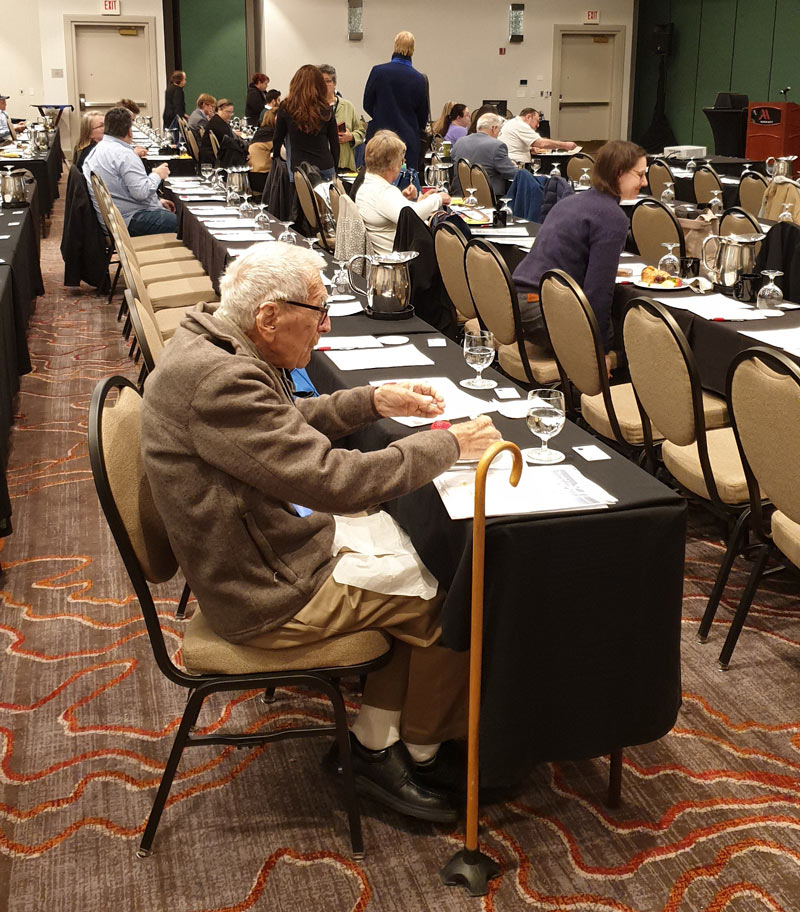
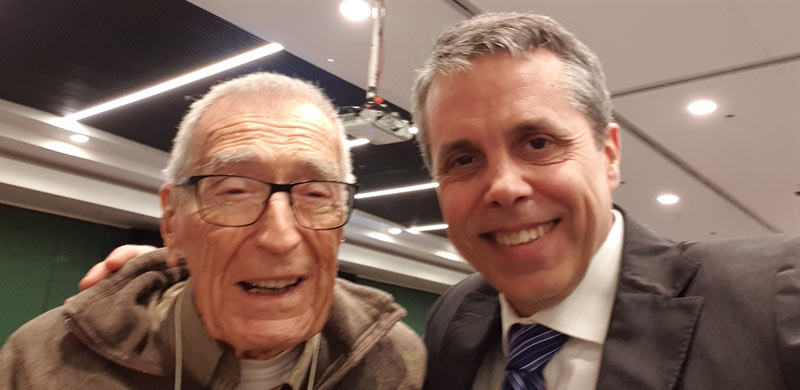
In 2018 the Accredited Gemologists Association (AGA) assigned him the Bonanno Award for his extraordinary contribution to the gemological community; his acceptance speech of the prize was a memorable compendium of Doctor Bill’s thought and I consider myself as a privileged person for having had the opportunity to be there and listen to it. We last met a year ago in Tucson for the traditional conference at AGA, the last gemological event on an international level organised before the pandemic blocked every single activity. He approached our table during the coffee break. He was amiable and friendly as usual, then he stopped for a while looking at the instruments: “I am the past, you are the future…”. No other phrase he had uttered could have surprised me more and it took me more than some moments before I recovered from the amazement, just in time for the unavoidable selfie. We greeted and, still incredulous, I watched him sitting at his place, religiously waiting for the next intervention. I don’t know what drove me to take a picture of him, just in that precise moment…but it is the last image I have of Doctor Bill and I am glad I can share it.
“His” gemology couldn’t coincide with mine, but we have always been intelligent enough to understand each other. And did not that confession of his saying that he was “the past” sound, maybe, as a sort of conscious resignation of the inevitable evolution of things? I wonder, though, if such devotion to the cause, especially in favour of the less economically fortunate, could have gathered around this passionate veteran a wider consensus and a greater encouragement. He would have deserved it and he didn’t obtain it. Maybe, this because he himself was more interested in “being” rather than “appearing”. I will surely miss Doctor Bill.
Article by Alberto Scarani, published on IGR – Italian Gemological Review #11, Winter 2020-21


