




Here is another record beaten in Zambia, a country that began emerald mining in 1928. The Kagem mine is one of the most prolific in the country, an area covering about 46 square kilometers. Here the gem is found in a schistose rock in a region rich in metasomatically altered phlogopite. Most of the mined emeralds are found within the areas of friable schists where they are easily removed by crushing and processing the embedded rock.
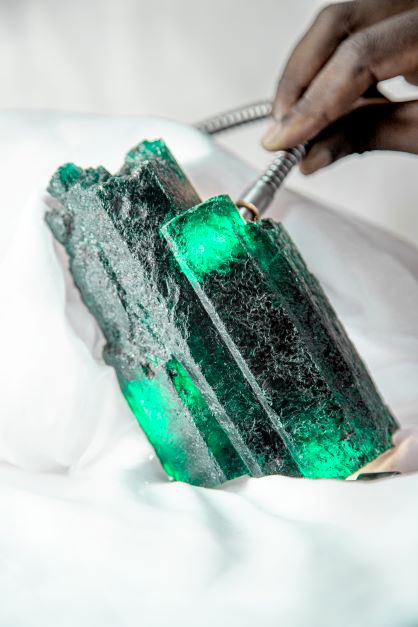
In these conditions, Manas Banerjee and Richard Kapeta, geologists of the Gemfields Group, unearthed what is currently considered as the largest emerald found in the concession (and perhaps of all those ever mined), a 7525-carat piece of rough that has been charmingly renamed “Chipembele” (rhinoceros in the Bemba language). The mineral joins “Insofu” (elephant) discovered in 2010 and “Inkalamu” (lion) in 2018 about which IGR has already provided a report.

Like its predecessors Chipembele is an extremely pure rough featuring a golden green hue and it will be offered for sale in Gemfields’ upcoming auction this November 2021. Important news: this material will be introduced for sale under an increasingly ethical and eco-conservation inspired label. As already made before, a part of the revenue will be donated by Gemfields to the North Luangwa Conservation Programme in Zambia, an organization working to safeguard the North Luangwa ecosystem, specifically devoted to black rhino protection programs. The rough gemstone will then undergo the “Emerald Paternity Test” by the Gübelin Gem Lab’s. This laboratory will apply nano-particles with information including traceability, the mine origin as well as the extraction date, a package of data that will enhance the remarkable value resulting from the exceptional weight and the responsible use of the mineral.


