




From September 2th to 5th, 2024, the joint conference entitled “Geology for a Sustainable Management of Our Planet”, organised by the Italian Geological Society (SGI) and the Italian Society of Mineralogy and Petrology (SIMP), will take place in Bari, Italy. The conference will address the crucial role that geosciences play in achieving the sustainability goals set forth by the United Nations’ 2030 Agenda.
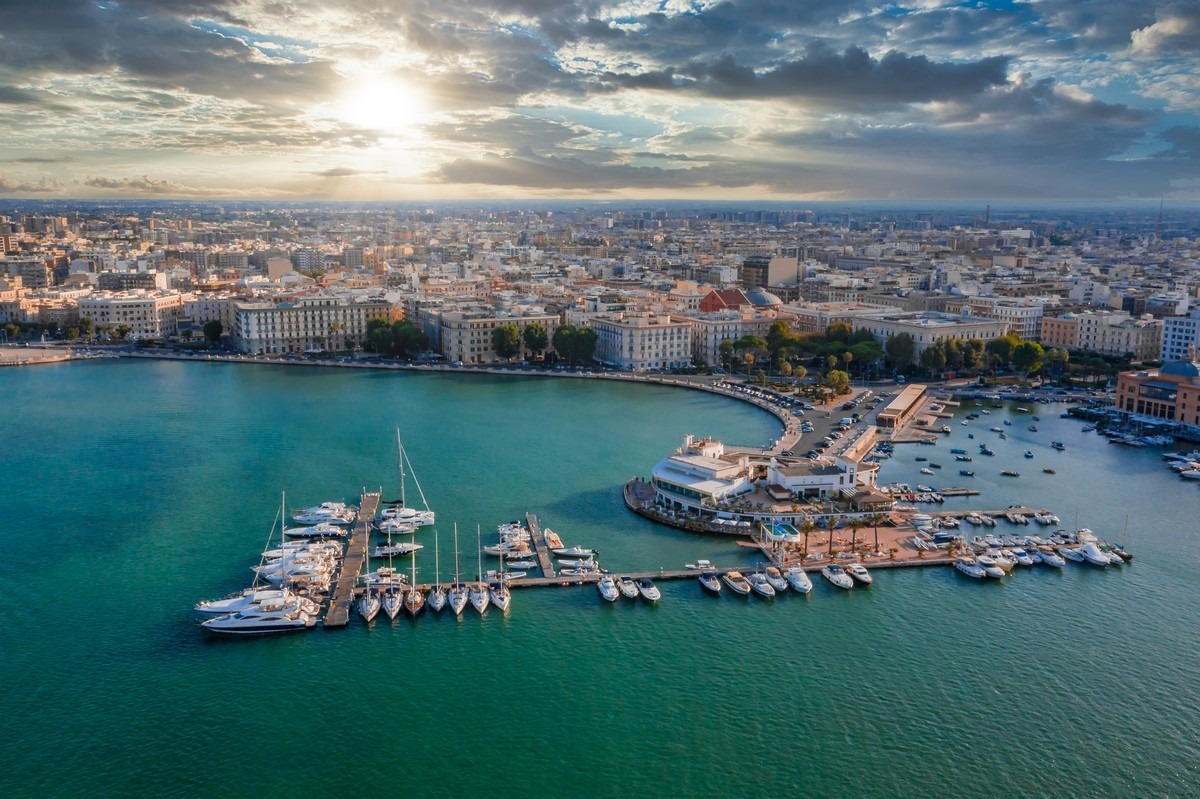
This significant event will be held in the Apulian city beginning with the opening ceremony in the afternoon of September 2, followed by conference sessions from September 3 to 5th at the University Campus of Bari.
The opening ceremony will be a special occasion dedicated to the dissemination of geosciences, open to the public and enriched by the participation of four distinguished international guests. During this day, there will also be a morning city tour, allowing participants to discover the geological and cultural wonders of Bari.
The following three days of the conference will offer a comprehensive and diverse programme, including parallel scientific sessions, plenary lectures by internationally renowned scholars, round tables, and workshops. The sessions will concentrate on pivotal topics in the geosciences and their impact on substantial geological and social concerns.
The conference will emphasize scientific dissemination, with a particular focus on the role of geosciences in educating citizens and promoting a sustainable future for our planet.
The conference will place particular emphasis on the dissemination of scientific knowledge, with a specific focus on the role of geosciences in the education of citizens and the promotion of a sustainable future for our planet.
Furthermore, the programme comprises seven post-conference excursions, with durations ranging from one to three days, which offer additional opportunities for field exploration and learning. The excursions will encompass a variety of locations in Puglia, including Gargano, Murge, and Salento, in addition to areas in Basilicata and Calabria.

Among the many talks, we mention those scheduled for September 4th during Session 7 and Session 21. Each session will include a specific “Poster” which will address a range of interesting topics.
Session 7 on September 4th, 2024: Vibrational spectroscopy studies of geomaterials: case studies and new perspectives
This session will examine the application of molecular vibrational spectroscopies, particularly Raman and infrared, to the analysis of materials that constitute our cultural and geological heritage. These innovative techniques have gained increasing relevance in the scientific community of applied mineralogy and petrography, proving to be fundamental tools for addressing a wide range of archaeometric issues.
The session is open to researchers from all fields of heritage sciences and will highlight the extraordinary progress that has been made in methodologies and applications of these spectroscopies. The session will include studies illustrating how these techniques contribute to the interpretation, conservation, and deepening of knowledge of cultural heritage. The applications of these techniques are diverse, encompassing exploratory investigations, authentication and provenance issues, and the analysis of alteration and degradation of materials.
In recent decades, the development of miniaturised components has enabled the design of increasingly compact and portable Raman and infrared instruments, leading to the development of portable and handheld solutions. This evolution has facilitated the transition from laboratory-based investigations to fieldwork at sites of interest, including museums, archaeological sites, and geosites. The advantage of performing non-invasive on-site analyses is particularly significant in the field of cultural heritage, where the preservation of the original material is of paramount importance.
This session will provide a valuable opportunity to discuss and present updates on the latest applications of Raman and infrared spectroscopies.
The session will feature a number of experts, including Martiniello S., Capitanio A., Legnaioli S., & Raneri S., with “Gemstone, treatments and imitations in medieval goldworking: a gemmological and spectroscopic combined approach” (from 10:00 to 10:15); Capriotti S., Di Fazio M., Miele F., Mattia V., & Annoscia G.M., with “Archaeometric Investigation to analyze some medieval rings from Cencelle (Tarquinia, VT)” (from 10:15 to 10:30); Porcaro M., Cognigni F., La Penna G., Proietti A., Regoli C., Casi C., Carosi S., Rossi M., Brunetti A., & De Vito C., with “Analyzing the Structure and Chemical Composition of an Etruscan Bronze Fibula from Tomb Number 129 at Vulci (VT, Italy) through a Non-Destructive Multi-Analytical Approach” (from 12:00 to 12:15).
Session 7 – Poster
In relation to the Poster of Session 7, we would like to draw attention to the following contributions: Rea C., Calzolari L., Capriotti S., De Vito C., Aurisicchio C., Mignardi S., & Medeghini L. with “Application of infrared external reflection spectroscopy in the identification of emerald provenance” (Booth 17); Spironello M.Y., Barone G., Mazzoleni P., Caggiani M.C., & Fugazzotto M. with “Precious votive offerings in 17th- and 18th-century Sicilian production: non-invasive gemmological analyses” (Booth 18).
Session 21 on September 4th, 2024: Mineralogy behind Earth processes: insights from the atomic to the macroscopic scale
The objective of this session is to undertake an exhaustive examination of the function of minerals as chroniclers of geochemical, geological, and formation processes. Minerals reflect the geological evolution of the rocks that host them and represent the primary source of metals and raw materials essential for our society. The development of sophisticated analytical techniques has enabled the investigation of the crystalline chemistry of minerals at the nano- and micro-scale with unparalleled spatial resolution, sensitivity, and precision.
Mineralogical crystallography plays a pivotal role in elucidating the intricacies of crystalline structures, elucidating the interrelationships between structure and properties of minerals and their synthetic analogs. This field of study enables the description of mineral evolution under non-ambient conditions, the discovery of new mineral species, and the improvement of existing taxonomy.
The session welcomes both experimental and theoretical contributions related to these topics, including studies on mineral nomenclature and classification. The presentations will examine the diverse array of advanced techniques and their impact on our understanding of crystalline structures, offering a comprehensive insight into the mineral resources that support our society.
We highlight some noteworthy contributions: Cotellucci A., Garcia-Ruiz J.M., Otálora F., Bruno M., & Pastero L. with “Gypsum crystals experimentally grown near the equilibrium conditions: the laboratory counterpart of large gypsum crystals discovered in Pulpi cave” (from 11:45 to 12:00); Monico S., Marinoni N., Gatta G.D., Adamo I., Prosperi L., Mácová P., & Ševčík R. with “Partially crystalline silica varieties in gemmology: The case study of the blue Andean opal” (from 12:00 to 12:15).
Session 21 – Poster
Among the “Posters” of session no. 21 will be the contribution of Rizzo F., Bosi F., Tempesta G., Skogby H., Bernardini S., Vadrucci M., & Agrosì G. with “Causes of color changes in tourmalines after thermal and irradiation treatments” (Booth 83).


