




This content was first published on IGR – Italian Gemological Review no. 9 in 2020. The information provided here is therefore current as of the original publication date.

Among all colored stones, ruby is always the top of Thailand’s main export products, generating over a hundred million US dollars of income per year. Approximately over 80% of the world’s productions of rough ruby has been refined and finished in Thailand being exported towards the international market. Generally speaking, almost all high-quality rubies being traded in the global market must have once circulated through Thailand. Thus, the Gem and Jewelry Institute of Thailand, aka GIT as a national authority to support the gem and jewelry sectors in Thailand has the major mission to uphold the ruby color standards for the industry.

The search for a reliable measure
Since 1999, the Institute has conducted many in-depth researches on the “Colored Stone Quality Standards”, specifically on gem corundum varieties. The grading systems on qualities of the ruby, blue sapphire and sapphires of other colors have been carried out in terms of “Color”, “Clarity” and “Cut”, respectively. The objective in creating these standards was to have an accurate, reliable measure for colored stones’ quality evaluation; in particular to assess the communication between traders and consumers on “color quality” of ruby and sapphire for their trading and for the price structure determination.

As a result, the original master sets of natural ruby and sapphire (Figures 2 and 3) were created with the well-defined color names referable to the Munsell codes. The locally-used, common color names were converted into the Munsell system, which was then modified so that they could be better understood by relying on the color code charts of the ISCC-NBS (Inter-Society Color Council-National Bureau of Standards) system.
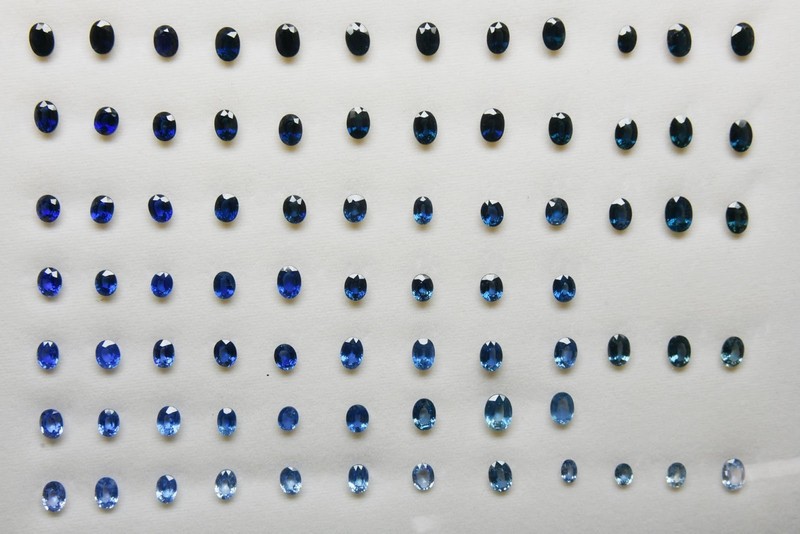
The series of research were carried out and continually refined through opinions and inputs from gem traders and experienced gemologists (Janthayot et al., 2001, 2003a, 2003b, 2003c, 2004, 2007; Siripant, 1999; ; Siripant et al., 2001, 2003). Eventually in 2009, the GIT has established the complete colored stone master standards on eight varieties of gem corundum, i.e., ruby, blue sapphire, padparadscha, yellow sapphire, pink sapphire, purple sapphire, orange sapphire, and green sapphire. During that time, GIT has also put forward with its own “Pigeon’s Blood”, “Royal Blue” and “Cornflower Blue” master sets, all of which, made of genuine natural stones (Janthayot et al., 2001, 2003a, 2007).
The Ultimate Color: “Pigeon’s Blood”
It is well understood that color is the most impactful factor influencing the consumer’s decision to purchase colored gemstones, especially for the stone having exquisite quality like ruby. Among those 4 Cs factors, color is also the primary factor influencing the price of the stone. The legendary color “Pigeon’s Blood” is the most famous trade name and the highest desirable ruby color used in the market. Therefore, the ruby dealers worldwide used this color term for their trading in different definitions and color boundaries.
Through many years of our comprehensive researches on the standard “Color” master sets of ruby and sapphire as mentioned above, GIT has finally come up with its own “Pigeon’s Blood” ruby master set made of authentic stones. Again, with a similar approach to develop the master sets of gem corundum, the stones have been passed to many gem experts and traders for their opinions on an agreeable color range.

As a result, the master set of ruby’s “Pigeon’s Blood” color has been established. It comprises 6 master stones in a range of vivid red with intense color and medium tone (Figure 4). Since 2001, GIT has started offering to the trade, for this highly demanded ruby color trade term, a color term which is based on our color standards.
Just to define the term, the “Pigeon’s Blood”, of either Chinese or Arab origin, is a historical term by which Burmese used to refer to the unique hue of the ruby. Some compared it with the color of the center of a live pigeon’s eye. Halford-Watkins described it as a rich crimson without a trace of blue overtone (Hughes, 1997). To qualify as “Pigeon’s Blood” according to GIT standard a ruby has to possess the following criteria:
- the stone’s color must fall within the designated boundary of the master stones under a standard lighting condition;
- the stone weight must not be less than a half of one carat;
- the stone must be unheated or conventionally heat-treated;
- the stone must have a homogeneous color from face-up view with at least 20% brilliancy.
To ensure the consistency of the given result, GIT gemologists perform grading under a strictly controlled environment. For example, the stones must be placed at 15-25 cm from the standard light source (Gretag Macbeth 5000°K) that has proved to be equivalent to average sunlight’s temperature in this region and then visually graded facing-up at a distance of 30 cm and viewed perpendicularly to the table surface.
Continuous development of the Ruby Color Standards to fulfill the market
Over the last two decades, the colored stone market significantly has shifted from the Western to the Asian countries with China as the world’s top consumer. As a trade culture of ruby in the Chinese market, Chinese consumers are not just impressed by the stone’s exquisite color, but they are also influenced by the legendary color name, its story and the increasing popularity of its proper meaning.
In the ruby market today, however, only the “Pigeon’s Blood” color is a well-known historical connotation for ruby, thus many dealers have faced difficulties in trying to sell a good quality ruby that is not qualified for such color.
In order to facilitate the ruby market worldwide, in December 2019, GIT has launched two brand new ruby color standards, namely, “Rabbit’s Eye Red” and “Golden Red” (Leelawatanasuk et al., 2019).
The names of these two colors have been created with the aim of fulfilling the gap of the ruby color standard. This can also help celebrate Chanthaburi as the “City of Gems”, and show respect to their great ability in gemstone enhancement and to their exceptional craftsmanship skills that were the deep roots of Thailand gemstone industry. These two new color names are defined as follows.

The “Rabbit’s Eye Red” is designated as a pinkish-red color of faceted gem-quality natural ruby regardless of its origin (Figures 1 and 5). A rabbit in the full moon glow is the symbol of the province of Chanthaburi. The rabbit, in many cultures, is related to good fortune. It is the symbol of peace and tranquillity in Buddhism, Christianity, and Judaism. In China and Japan, the rabbit is a symbol representing love and happiness.
The “Golden Red” (aka Daeng-Tong in Thai) is a traditional ruby color term being used in the Thai market for decades and referred to a slightly orangy tinted ruby with intense red color (Figure 5). In the Thai market, this is also considered one of the fine colors, among others. In addition, to be qualified for grading the stone must pass the same criteria as those required for the “Pigeon’s Blood”.
Conclusions
By creating new ruby standards our ultimate goals are to use them as communication tools to promote ruby trade, build consumers’ confidence, and also increase competitive advantages for the global gem and jewelry industry. Eventually, standardization should create unity in developing the gem and jewelry industry more effectively. GIT believes that the gem and jewelry industry is actively growing with new emerging markets in Asia. The new challenges require special communication, rationalized tools and contents to meet consumer expectations.
References:
Hughes R. W. H., 1997. Ruby and Sapphire. RWH Publishing, 512 p.
Janthayot P , Yongyut K. and Singbamroong S., 2001. Color Grading System of Ruby. The Gem and Jewelry Institute of Thailand (Public Organization), Bangkok, Thailand, 58 p (In Thai)
Janthayot P., Saejoo S., Siraprapha K. and Singbamroong S., 2003a. Color Grading System of Blue sapphire and other sapphires. The Gem and Jewelry Institute of Thailand (Public Organization) Bangkok, Thailand, 200 p. (In Thai)
Janthayot P., Saejoo S., Siraprapha K. and Singbamroong S., 2003b. Clarity Grading System of Corundum. The Gem and Jewelry Institute of Thailand (Public Organization), Bangkok, Thailand, 67 p. (In Thai)
Janthayot P., Saejoo S., Siraprapha K. and Singbamroong S., 2003c. Cut Grading System of Corundum. The Gem and Jewelry Institute of Thailand (Public Organization). Bangkok, Thailand, 101 p. (In Thai)
Janthayot P., Chotima K., Saejoo S. and Singbamroong S., 2004. Quality Assessment Standard of Gem Corundum. The Gem and Jewelry Institute of Thailand (Public Organization), Bangkok, Thailand, 96 p. (In Thai)
Janthayot P., Atichat W., Chamjuree S., Saejoo S. and Saengbuangamlam S., 2007. The Improvement of Gem Corundum Color Communication System. The Gem and Jewelry Institute of Thailand (Public Organization), Bangkok, Thailand, 105 p. (In Thai)
Leelawatanasuk T., Atichat W., Pisutha-Arnond V., Sutthirat C., and Jakkawanvibul J.,2019. Two Decades of GIT Ruby and Sapphire Color Standards. InColor Magazine, winter 2020, Issue 45, 96-93 p.
Siripant S., 1999. A Gem Color Communication System. The Thailand Research Fund. 86 p. (In Thai)
Siripant S., Janthayot P., Yongyut K. and Singbamroong S., 2001. A Gem Color Communication System (Ruby). The Gem and Jewelry Institute of Thailand (Public Organization) Bangkok, Thai-land, 58 p. (In Thai)
Siripant S., Janthayot P., Saejoo S., Siraprapha K. and Singbamroong S., 2003. Quality Standard of Blue and Other Sapphire. The Gem and Jewelry Institute of Thailand (Public Organization), Bangkok, Thailand, 200 p. (In Thai)
Article by Thanong Leelawatanasuk, Wilawan Atichat, Visut Pisutha-Arnond, Chakkaphan Sutthirat, Jirapit Jakkawanvibul* , published on IGR – Italian Gemological Review #9 – Spring 2020.
* GIT, The Gem and Jewelry Institute of Thailand (Public Organization).


