The latest issue of Gems & Gemology (Volume 61, Number 3, Fall 2025) offers an overview of some contemporary gemology topics. The edition is structured around three lead articles on diamonds with a 480 nm absorption band, the morphology of macle diamonds, and the surface microstructure of Russian white nephrite, complemented by sections on lab cases, spectacular inclusions, and new gem discoveries.
In the contribution “A Guide to Diamonds with the 480 nm Absorption Band”, Dr. Mei Yan Lai examines a narrow but gemologically crucial lot of diamonds showing an absorption band around 480 nm in the visible spectrum. These stones represent less than 5% of the yellow diamonds analyzed by the GIA over the past decade, including pure orange diamonds and “chameleon” specimens that temporarily change color in response to heat or darkness, necessitating accurate optical characterization.
The study identifies key diagnostic criteria: moderate to strong fluorescence under long-wave UV (in yellow, orange, or mixed yellow-blue hues) and the presence of micrometric dark inclusion clusters, often aligned along defined crystallographic directions. The key point is that the 480 nm band is documented only in natural diamonds and is not reproducible with currently known commercial treatments, making it a reliable indicator of natural origin versus synthetic or treated materials.
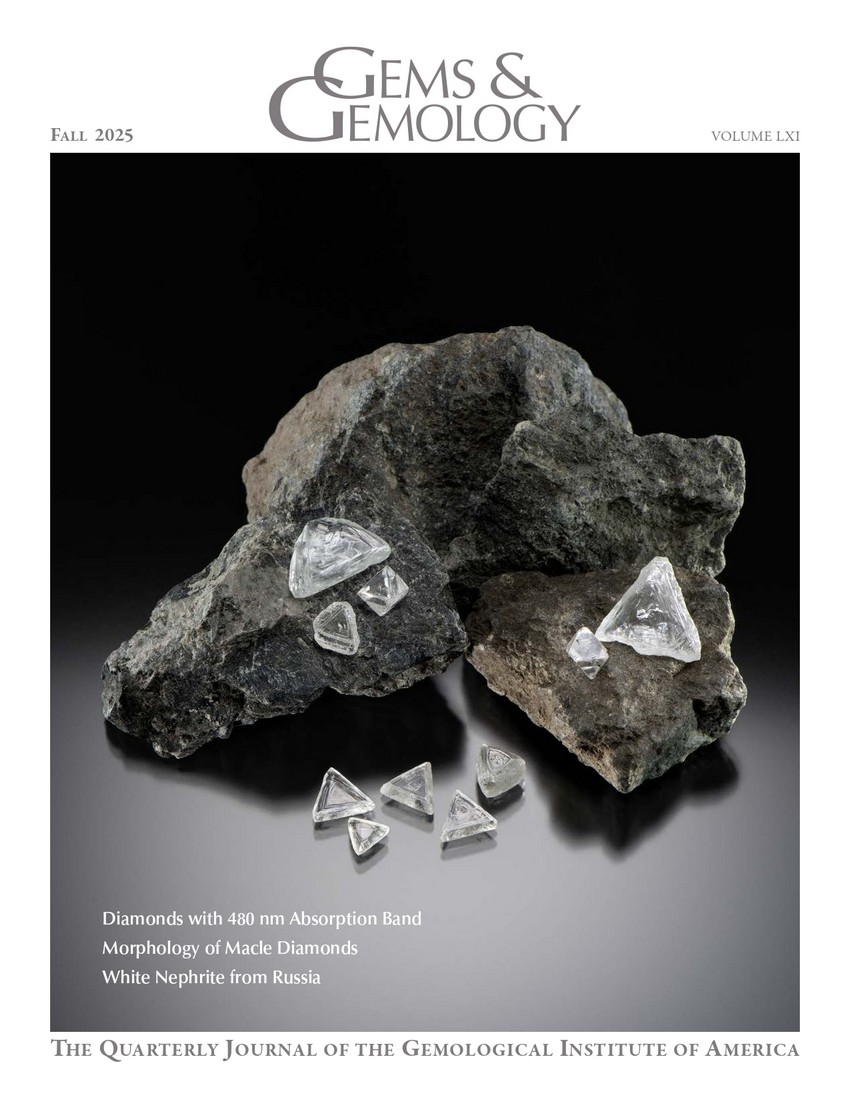
The article “External Morphology and Internal Zonal Structure of Macle Diamond”, by Ahmadjan Abduriyim and Masao Kitamura, shifts focus to the crystal growth of macle diamonds, which are contact-twinned crystals. Using scanning electron microscopy with cathodoluminescence (SEM-CL), the authors reconstruct the three-dimensional internal zoning of these crystals, reading the growth alternations to reveal the history of physicochemical conditions in the Earth’s mantle where they formed. Morphological variations correlate directly with fluctuations in carbon supersaturation in the growth medium, providing new interpretive keys to link the diamond’s external habit to the deep processes that guided its crystallization.
In the third key article, “Characterization of ‘Orange Peel’ Surface Microstructure of White Nephrite from Russia: A Unique Pseudomorph Pattern”, Meiyu Shih, Guanghai Shi, and Biqian Xing tackle a central issue in modern gemology: origin determination. The work documents a characteristic “orange peel” effect observable on the polished surface of Russian white nephrite, a feature until recently associated almost exclusively with jadeite jade, and explores its causes at the microstructural scale. Through microscopic and spectroscopic investigations, the authors show that this texture arises from a pseudomorphosis where tremolite replaces rhombic carbonate crystals, preserving their architecture in a lattice of “pseudo-rhombs” traversed by veins: since this microstructure has not been detected in white nephrites from other origins (such as China or South Korea), the “orange peel” effect becomes a robust diagnostic criterion for certifying Russian origin, with significant implications for traceability and market value.
The Lab Notes, Micro-World, and Gem News International sections enrich the picture with emblematic cases blending lab science and practice. Highlights include a 37.41-carat rough bicolor pink-colorless diamond from Botswana, a rare bicolor dumortierite crystal over 63 carats, and pearls artfully assembled to mimic natural growth; all examples that refine gemologists’ diagnostic tools. Gem News International reports the discovery of Palaeoclavaria burmitis fungal fossils in Burmese amber, confirming the role of these organic gems as exceptional paleontological archives and showing how integrating classical gemological observation with advanced analytical techniques is now essential for understanding the genesis, origin, and nature of contemporary gems.
The full issue of Gems & Gemology is available on the GIA website.