In recent years, artificial intelligence has progressively gained ground within the field of gemology, working alongside traditional analytical methodologies. Among the most established pioneers of this approach is the Gübelin Gem Lab, which has developed machine learning-based systems to identify inclusions and support geographic origin determination. These systems are built upon proprietary databases and a robust scientific validation framework. It is no coincidence that such developments have emerged within the Swiss landscape, a region characterized by close interaction between applied research and academic institutions — most notably ETH Zurich (Eidgenössische Technische Hochschule), one of Europe’s leading hubs for materials science and data analytics.
Today, numerous international laboratories and research centers are following this trajectory, exploring the use of predictive models for the automated analysis of gemstones’ internal and external characteristics. However, the industry must recognize that transitioning toward AI-based operational protocols requires an exceptionally solid scientific foundation. Both the quality and representativeness of the reference samples used for model training, as well as the rigorous validation of deductive procedures, are crucial. This ensures that results are reproducible and consistent with established gemological standards.
Within this framework, alongside well-established developments, more exploratory initiatives continue to emerge. These reflect a rapidly evolving field that is still in a phase of progressive consolidation, and such initiatives must be carefully scrutinized.
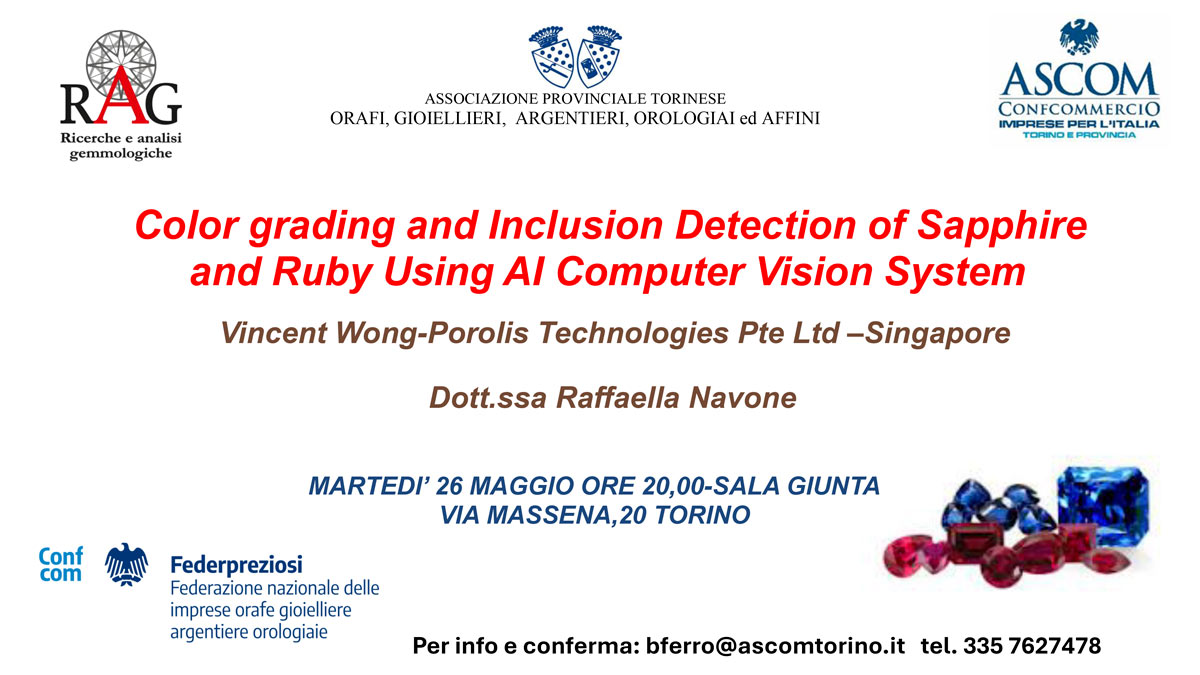
It is within this context that the Associazione Orafi Torinese (Turin Goldsmiths’ Association), with the contribution of Dr. Raffaella Navone, is hosting an event titled “Color grading and inclusion detection of sapphire and ruby using AI computer vision system”, featuring speaker Vincent Wong. The information currently available does not yet allow for a complete outline of the methodological and practical framework of the presented solutions, which sit within an emerging and evolving research landscape.
The event will focus on the potential of computer vision systems applied to the color grading and inclusion detection of sapphires and rubies — areas that represent some of the most complex challenges in gemological analysis.
The meeting will take place in Turin, Italy, on Tuesday, May 26, 2026, at 8:00 PM, with a remote viewing option also available. Participation requires prior registration, and a simultaneous English-to-Italian translation service will be provided.