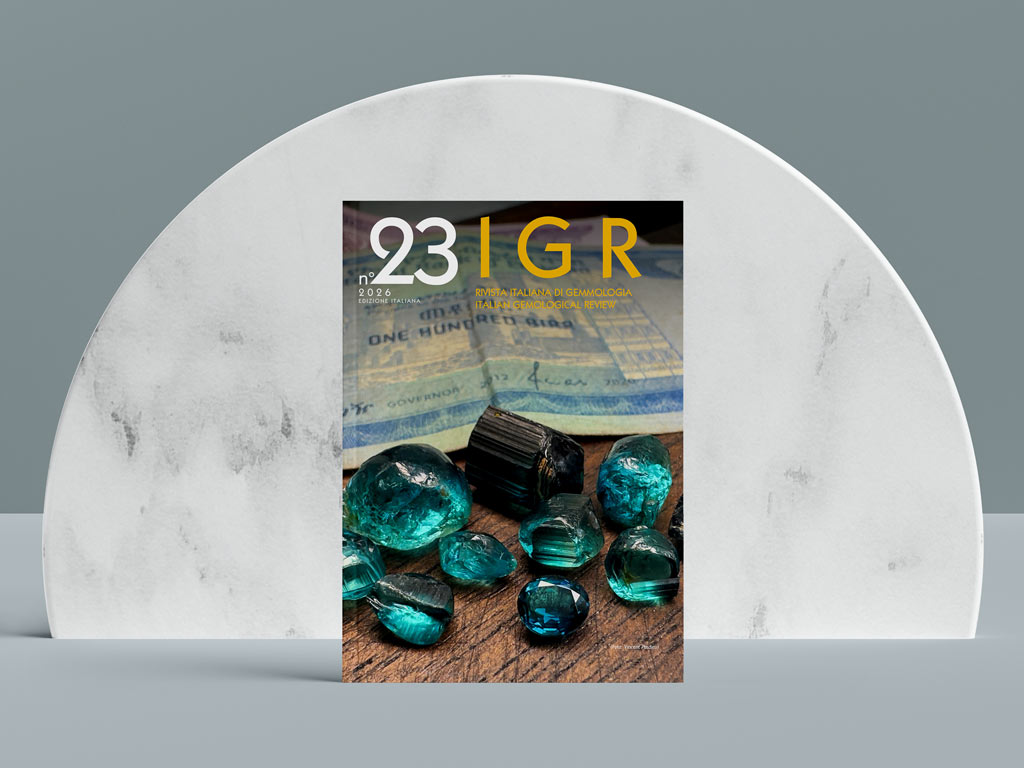
The 2026 edition of Facette, the annual publication of the Swiss Gemmological Institute (SSEF), brings together some of the year’s most significant research in the field of scientific gemmology. At a time when the distinction between natural and synthetic becomes increasingly complex, the work of the Basel-based institute focuses on the application of cutting-edge technologies to ensure market transparency.
The opening article, “A hot issue then and now: the history and future of synthetic coloured stones”, authored by Laurent E. Cartier and Michael S. Krzemnicki, addresses the subject of chemical synthesis from both a historical and technical perspective. The quest for “perfect” man-made gemstones dates back centuries of speculative theory, but it was in 1902 that chemist Auguste Verneuil marked a turning point with the synthesis of ruby via flame fusion. Sources indicate that the production of synthetic rubies had already reached 5 million carats per year by 1907. Today, the market is flooded with synthetic diamonds produced by HPHT (high pressure, high temperature) and CVD (chemical vapour deposition), but the challenge is once again shifting towards coloured stones. The authors emphasise the importance of CIBJO nomenclature, which rigorously defines synthetic stones. One of the most demanding modern challenges is the so-called mêlée challenge — the identification of tiny synthetic rubies or sapphires (often between 1 and 4 mm) mixed into parcels of natural stones. In such cases, traditional microscopy is often insufficient, making advanced analytical protocols such as Raman spectroscopy or ICP-MS necessary.

In the gemmology section, the study “Gemmological characterisation of emeralds from Musakashi, Zambia” by M.S. Krzemnicki and L.E. Cartier analyses an emerald deposit discovered in 2002. These emeralds differ from the classic Zambian material from the Kafubu district due to their formation in chromium-enriched metasediments intersected by hydrothermal veins, making them visually and chemically similar to Colombian or Afghan emeralds. To resolve this ambiguity, the SSEF employs trace element analysis via GemTOF and machine learning algorithms such as t-SNE, which allow data clusters to be clearly separated according to geographic origin.
The theme of artificial intelligence is further explored in “Paraiba tourmaline origin determination using machine learning” by Hao Wang and Michael S. Krzemnicki. Determining the origin of Paraìba tourmalines is critical due to the significant price difference between Brazilian stones and their African counterparts (Nigeria and Mozambique). The SSEF has adopted an unsupervised machine learning approach, using algorithms such as t-SNE and UMAP to simultaneously analyse over 57 chemical elements. This method allows computers to identify hidden patterns in data without being influenced by predefined labels, ensuring superior scientific objectivity in mapping the chemical signatures of boron, copper, manganese, gallium, and strontium.
Another notable discovery is documented in “Väyrynenite of exceptional quality and size, reportedly from Nigeria” by Michael S. Krzemnicki and Laurent E. Cartier. Väyrynenite is a rare phosphate mineral usually found in small crystals, but the SSEF has recently analysed Nigerian specimens of exceptional transparency weighing up to 16 carats. Chemical analyses revealed that the Nigerian material contains significantly higher concentrations of iron and zinc compared to Pakistani material, providing a reliable method for distinguishing between the two sources.
In the field of organic materials, the article “DNA testing: A new era of identification” by Laurent E. Cartier illustrates advances in genetic analysis applied to gemstones. Using near-non-destructive techniques requiring only 2.3 milligrams of material, the SSEF is able to identify precious coral species, ensuring compliance with CITES regulations. This research has led to the discovery of new species in trade, such as Pleurocorallium niveum, and has enabled the correction of historical misidentifications, as in the case of “angel skin” necklaces that belonged to different species than previously assumed.
Also in Brazil, the article “Emeralds from the Mina Canaã, Minas Gerais, Brazil” by Isabelle Beney describes emeralds extracted from phlogopite schist rocks that display unusual clarity for this type of deposit, with sparse mineral inclusions and growth channels parallel to the optical axis.
The SSEF Research section presents a series of technical case studies that demonstrate the complexity of laboratory work. In “Winza ruby with hollow tube as a helix”, Michael S. Krzemnicki describes a 10-carat Tanzanian ruby containing a spectacular helix-shaped inclusion, a natural feature that confirms the stone’s origin. In “Rare encounter: sapphire with grandidierite needle inclusion”, the same author documents the discovery of grandidierite needles in a Sri Lankan sapphire — an extremely rare inclusion confirmed by Raman microspectroscopy.
A case of sophisticated manipulation is illustrated in “Purple substance in hollow tubes to mimic unheated paraiba tourmaline” by Michael S. Krzemnicki, in which a purple substance was artificially inserted into hollow tubes of a heated tourmaline to simulate the effect of a natural radiation halo, in an attempt to deceive gemmologists as to the nature of the heat treatment. Similarly, in “An uncommon artificial resin feature in a brazilian Paraiba tourmaline” by Wei Zhou, an artificial resin is described that assumed a sharp-edged geometric form within a cavity, perfectly imitating a natural inclusion.
Diamond research is represented by two significant articles. “Eclogitic orange-yellow diamonds coloured by the 480 nm band” by Michael Mintrone analyses rare diamonds coloured by a crystal defect generating an absorption band at 480 nm, linking their origin to eclogitic rocks formed during tectonic plate subduction. In “Cvd synthetic diamond with colour shift”, Michael Mintrone and Julia Griffith study a synthetic diamond that changes colour from greyish to bluish following exposure to deep UV light — a photochromatic effect linked to the charging of SiV defects.
The journal also devotes space to radiometric dating in “Age dating of Burmese jadeite” by Michael S. Krzemnicki, where the analysis of zircon inclusions allowed a jadeite to be dated to approximately 170 million years ago. On the technological front, the article “Spectrofluorometer – New instrument at SSEF” by Markus Wälle presents the new JASCO FP-8550, an instrument capable of mapping fluorescence in three dimensions, essential for the analysis of crystal defects and fillings. The use of this instrument to measure phosphorescence decay times in diamonds is addressed in “Phosphorescence spectrometry of diamonds” by Jean-Pierre Chalain.
The section dedicated to fraud, “Fake it ‘til you break it: oddities and fraud cases submitted to SSEF” by Michael S. Krzemnicki, reports emblematic cases such as purple glass sold as tanzanite, blue glass passed off as Paraiba tourmaline complete with a forged certificate, and topaz crystals cut into octahedral shapes to simulate rough diamonds.
In a fascinating fusion of history and science, “Renaissance point cut diamond and gold ring” by Akitsugu Sato analyses a sixteenth-century ring, explaining the point cut technique, which preserved the diamond’s natural octahedral shape, sacrificing internal light reflection in favour of the symbolic value of the stone’s hardness.