This content was first published on IGR – Italian Gemological Review no. 4 in 2018. The information provided here is therefore current as of the original publication date.

When, at the end of 2015, John Pombe Magufuli unexpectedly won the presidential elections in Tanzania, few people would have predicted that the new leader would have literally revolutionised the mining branch of the country. Son of a peasant, deeply catholic, teacher and then industrial chemist, Magufuli had previously been President of the CCM Party (Chama Cha Mapinduz). His activity in the field of public works could, though, have given reasons to the most careful observers to think that this active man – his determination in providing Tanzania with road infrastructure had already won him the nickname of Bulldozer – wouldn’t have hesitated to start the reorganization of the mining branch. In fact, it is a clear fact that the country does not obtain suitable benefits from the wealth of its earth: in 2005 the extraction industry contributed to the GDP only for a poor 3.36%, despite being the fourth African producer of gold and rich in uranium, natural gas, diamonds and Tanzanite.
The researchers of Tanzanian economy agree on the fact that the country has, over time, developed well-organised forms of mining smuggling able to involve private companies and public managers. A recent parliamentary investigation quantifies the annual value of illegal mining export in 90 billion US$. Of the about 8000 trillion Tanzanian pounds resulting from the tanzanite business, only a poor 0.05% was collected by the inland revenue of Dar es Salam. Magufuli punches the first blows in March 2017 with the bid for the export of not-worked minerals. Whole containers of concentrates of copper/gold, which accumulated in the port of Dar es Salam, are inspected and found to contain 14 times the stated quantities. This is the episode that makes the case explode of an extraction sector virtually subject to the interests of investing private companies to which privileges and fiscal exemptions have been granted since 1998. Thanks to its fame as enemy of corruption, Magufuli imposes a new and more restrictive mining legislation that wipes out the season of bilateral agreements and enforces the public control over the whole sector.
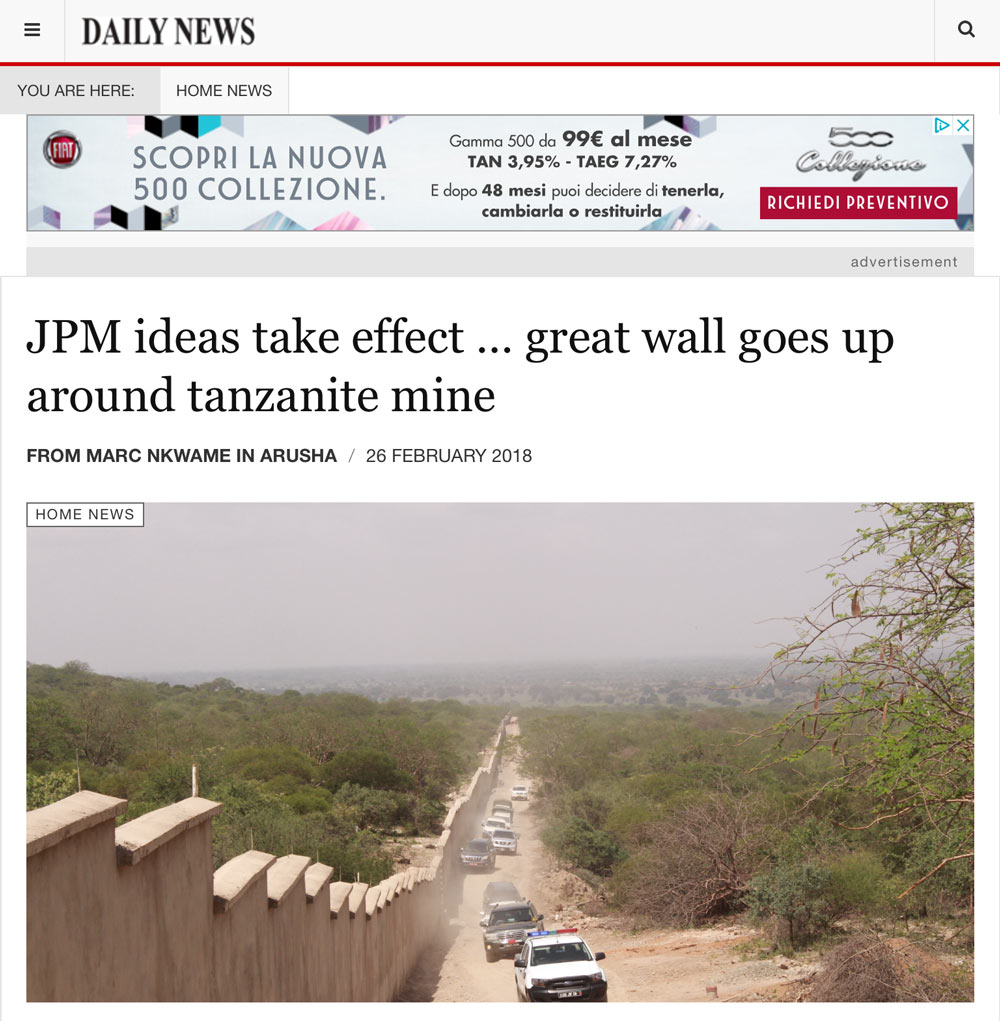
The wind of change had already reached Tanzanite at the beginning of 2017 with the imposition of auctions for trading the gem within domestic borders in order to oppose the haemorrhage caused by the underdeclaration of value and smuggling. In September 2017, Faisal Juma Shahbhai and Hussein Gong, two officers of Sky Assiociates Ltd, a Virgin Island-based company controlling the most famous Tanzanite One Mining Ltd, are arrested for fraud following the outcomes of a parliamentary investigation ordered in July by Magufuli that involved famous people also among the government officers. The reaction against the illegal exploitation of Tanzanite exacerbates in February 2018. This time it directly involves Tanzanite One and seven people are arrested, less than a month after the government had started negotiations with the company hoping for a new dialogue based on the primary acknowledgement of the priority of domestic interests. Clearly not everyone had taken seriously the start and opening, on 6th April 2018, of a 24.5 km wall meant to surround the extraction areas of the blue gem that can be only found in Tanzania. And even that wall was wanted by President Magufuli: now crossing its borders carrying not declared tanzanite is a crime.
The new mining course implies some changes for the small artisan diggers of Tanzanite. Some funds are envisaged to improve their safety conditions while the practice of reimbursing miners with rewards in raw material is being discouraged. Starting from now salaries will have to be paid.
Gem News by Trasparenze News, published on IGR – Italian Gemological Review #4, Summer 2018.