




This content was first published on IGR – Italian Gemological Review no. 7 in 2019. The information provided here is therefore current as of the original publication date.

There are significant differences worldwide among legislations on gemstones. The FTC (Federal Trade Commission) in the US is a Federal Agency whose comprehensive trade guides, by its own admission, are “administrative interpretations of the law, without force of law and are not independently enforceable”. This apparent lack of imposing power does not diminish the authoritativeness of the FTC in the US. Its guidelines usually become strict and influential federal indications enforced by the single States, but nevertheless can also significantly diverge from other international gemological regulations.

The updated FTC Guidelines. New rules on lab-grown diamonds
On July 24, 2018, the FTC replaced, after 22 years, the standards for marketing jewelry items as well as gems, concluding a six year revision process in which suggestions, from traders and Associations involved in the business, have been discussed and considered in order to achieve updated rules.
The recent Guides’ explanations on how to avoid making deceptive claims, focus on the elimination of thresholds for calling an alloy gold or silver, the correct description of metal coatings, the prohibition of incorrect gem variety names and the disclosure of pearl treatments.
But by far the most significant statement concerns changes in how synthetic diamonds can be marketed. To many non-American commentators FTC’s approach, based on indications coming from an industry consensus-building process, might sound strange. And even stranger must have been regarded the warning letters that the FTC subsequently addressed on April 2, 2019 to eight lab grown diamond producing companies, some of which have even been actively involved, for that matter, in the revision process and had the opportunity to put forward their own views. What happened?
What did and what did not change. Three recommended terms
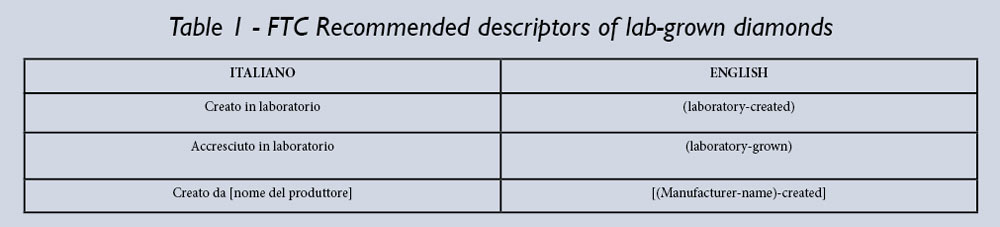
Some preliminary considerations are necessary to get the new FTC regulatory context explained and fully understand the reasons behind their letters. It must be noted that, according to FTC, in order not to get consumers confused by further changes in the basic definitions, the new FTC Guidelines did not modify the terminology to be used for “man-made diamonds”,“laboratory-created”, “laboratory-grown”, “[manufacturer-name]-created” remain for the American Agency the fairest and most adequate descriptions to indicate not mined diamonds. “Cultured”, as maintained by FTC, is an admissible attribute only if explicitly related to the three above mentioned specifications.
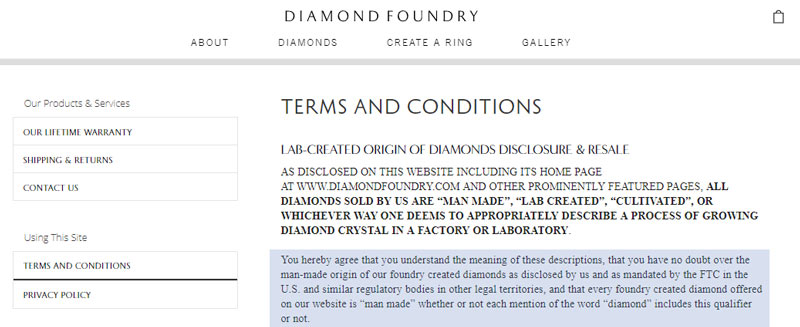
While for the European standards for Diamonds, Gemstones and Related Products (ISO 2018/TC174/WG 2) the term “synthetic” is a sufficient and exhaustive definition for man-made diamonds, the FTC now makes a distinction. This word is never considered, by the Agency, deceptive and therefore is not ruled out, though it is not listed among the recommended specifications. In fact the FTC agreed on the indications coming from some lab grown diamond producers and based on the acknowledgement that consumers may equate the term “synthetic” with “simulant” and consequently tend to make confusion between “lab grown diamonds” from one side and CZ and moissanite on the other side.
The Guides, while deciding to continue on the prohibition of the use of the terms “natural, genuine and real” as apt to describe “lab-grown diamonds”, do not exclude to take in due consideration further consumer perception studies concerning the term “real”. It is worth reminding that as early as in 2012 GIA’s Mumbai lab director declared in a Rapaport conference: “Synthetic diamonds are real diamonds. They have the same optical, chemical, thermal, and physical features”. Statements like this have been echoed by many, especially among synthetic diamond producers, this probably resulting in influencing the FTC’s consultations.
In gemology the issue on how much the resemblances between natural and synthetic diamonds make their identification more and more difficult and depending on increasingly sophisticated equipment is still open, while, contrary to what someone might believe, there is no question that they are not the same thing. Natural and synthetic diamonds actually share most chemical and physical properties (Figures 1 and 2) but are different in their structure, their inclusions and their luminescence (phosphorescence in particular) reactions.
Therefore there is no gemological ground for a future reconsideration of the attribute “real”, once these distinctive features are properly considered regardless of the difficulties that can be encountered in the identification process.
The confirmed prohibition of the use of “real” as a descriptor of synthetic diamonds also depends on FTC’s evaluation of the results of a poll commissioned by DPA (Diamond Producers Association) to Harris Poll in May 2018, to assess the extent to which consumers associate the term “real diamonds” with “natural diamonds”. The study shows that a large majority of adults do not consider lab grown diamonds to be real.
It can therefore be concluded that the decision to continue the prohibition of the word “real” to indicate lab-grown diamonds has been currently influenced by statistical data based on interviews rather than assuming that the gemological evidences are conclusive.
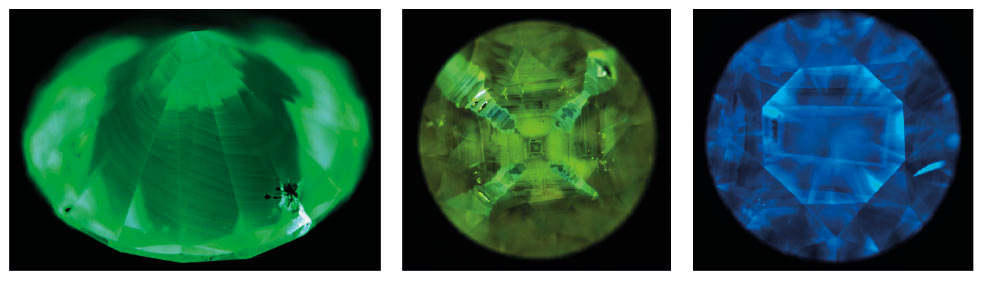
From left to right:
a) CVD synthetic diamond: curved, parallel bands can be seen;
b) HPHT synthetic diamond: typical cubo-octahedral growth, diagnostic for the identification;
c) natural diamond: one of the many growth patterns observed in natural diamonds.
(Photo courtesy: Egor Gavrilenko, IGE Gem Testing Laboratory)
The unexpected move by the FTC. By definition diamonds are not exclusively natural
However, the most controversial decision perhaps is the removal of the word “natural” from the previous definition used by FTC for diamonds. Before a diamond was described as “a natural mineral consisting essentially of pure carbon crystallized in the isometric system”. The new definition moves away from the European ISO standards according to which “it is unnecessary to note the genesis of a diamond, as the use of the word “diamond” alone without qualification states that it is natural. The word “diamond” alone shall not be used to describe synthetic diamonds no matter which basic material or methods are used. Products made in this way shall be clearly referred to as “synthetic diamonds” and shall not be graded”.
In other words, despite the obligation to duly reveal whether diamonds are mined or man-made, the semantic area allowing the use of the word “diamond”, according to the new Guidelines released by the FTC, must include both natural and synthetic stones. As Reenah Kim, staff attorney for FTC’s Bureau of Consumer Protection, Division of Enforcement, puts the question in an interview to JCK: “Marketers [of synthetic diamonds] still need to make those disclosures that it’s not a mined diamond. That guidance just happens to be in a separate section”.
The provision, however, intends to legitimate the interests of the synthetic diamonds manufacturers, much stronger in the US than in Europe: “if anyone is going to use real or natural to imply a lab-grown diamond isn’t an actual diamond, that would likely be deceptive”. To European commentators, breaking the consolidated reference of the word “diamond” to solely indicate natural ones, probably is a risky and illogical step. In this perspective, in fact, for example, synthetic emeralds too could legitimately aspire to the title of “emeralds” and therefore an emerald, by the word itself, would not be implicitly natural.
The warning letters
On April 2, 2019 eight companies received a warning letter by the FTC . Three of the letters were sent to companies that exclusively market lab-grown diamonds, Ada Diamonds, Diamond Foundry and Pure Grown Diamonds. The other five were sent to companies that sell diamond simulants, Agape Diamonds, Timepieces International, Diamond Nexus, MiaDonna & Co. and Stauer. The last two companies sell both lab-grown diamonds and simulants.
Reuters and JCK had the chance to see a version addressed to Diamond Foundry. JCK reports a statement in it: “The term aboveground real diamonds does not clearly and conspicuously disclose that the diamonds are laboratory-created… Neither the company name Diamond Foundry, the hashtag #labgrowndiamonds, nor the statement ‘real diamonds created in America’ appearing in some of this advertising clearly and conspicuously discloses that the diamonds are laboratory-created”.
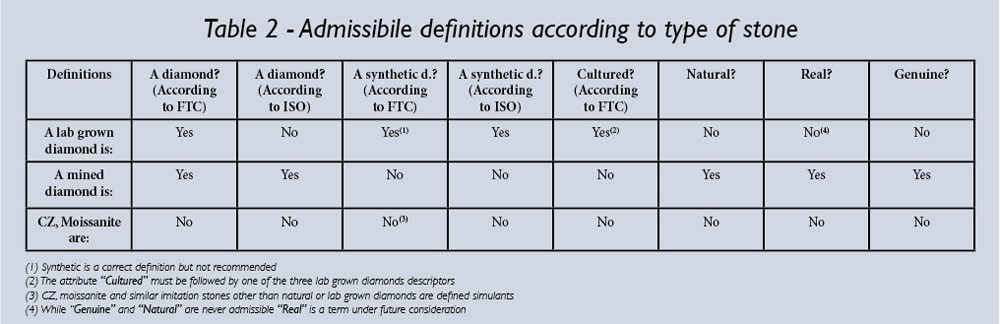
The company responded positively: “We pride ourselves on our transparent marketing of non-mined diamonds”. Diamond Foundry CEO Martin Roscheisen released an accommodative statement: “We have received an inquiry from the FTC that we intend to respond to in thorough detail”. A statement visible in Diamond Foundry‘s website in May 23, 2019 shows an immediate effect of FTC’s recommendation: “as disclosed on this website including its home page at www.diamondfoundry.com and other prominently featured pages, all diamonds sold by us are ‘man made‘, ‘lab created’, ‘cultivated’, or whichever way one deems to appropriately describe of growing diamond crystal in a factory or laboratory”.
The cautious approach in its terms and conditions section (Figure 3) confirms that the company took very seriously these recommendations. Jason Payne of Ada Diamonds proved to be as much cooperative. He commented: “I think it’s fantastic that the FTC has clarified their position. FTC has taken an issue with three ads… of Ada Diamonds that featured ‘#labdiamond’ but was not deemed to be a significant enough disclosure, by considering that FTC has not approved the terms in the non-hashtag portion”. It seems that the FTC intends to show that even hashtags count and using terms other than the suggested ones to describe lab-grown diamonds is a risky challenge. The letters are a strict invitation to stick to the three recommended terms.
How much “eco-friendly” are lab-grown diamonds? It cannot be measured
The letters sent by the FTC also reprimand the companies for the improper use of “eco-friendly” or similar terms to describe diamonds made in a laboratory: “…your advertising also touts the environmental benefits of your jewelry compared to mined diamonds. We note that marketers must have a reasonable basis for any environmental benefit claims they make for their products, and qualify any such claims adequately to avoid deception”.
As early as in 1992 the FTC issued the “Green Guides”, subsequently revised in 1996, 1998 and 2010, providing a guidance on making environmental claims non-deceptively. Several actions in recent years have been brought in relation to misleading recyclability, biodegradability and environmental certification claims. The fact is that these kind of claims, including the alleged better environmental impact of non-mined lab-grown diamonds, are not measurable.
“We don’t have an opinion on whether they’re good for the environment or not, they just need to be clear in their marketing” said Robert Frisby, an attorney with the FTC’s Bureau of Consumer Protection who worked on the letters. Interestingly, the FTC developed the “Green Guides” revision in 2012 through a statistical survey of consumers’ perception of environmental friendly qualifications, the same approach used in 2018 leading to continue the restriction of the use of the term “real” referring to mined diamonds.
When these crucial terms do not result by themselves in clear definitions and therefore the industry cannot refer to an accurate benchmark, specific studies, conducted to examine consumers’ perceptions, can be helpful to fix a fair standard. This is a methodology that European regulatory organizations should take in due consideration.
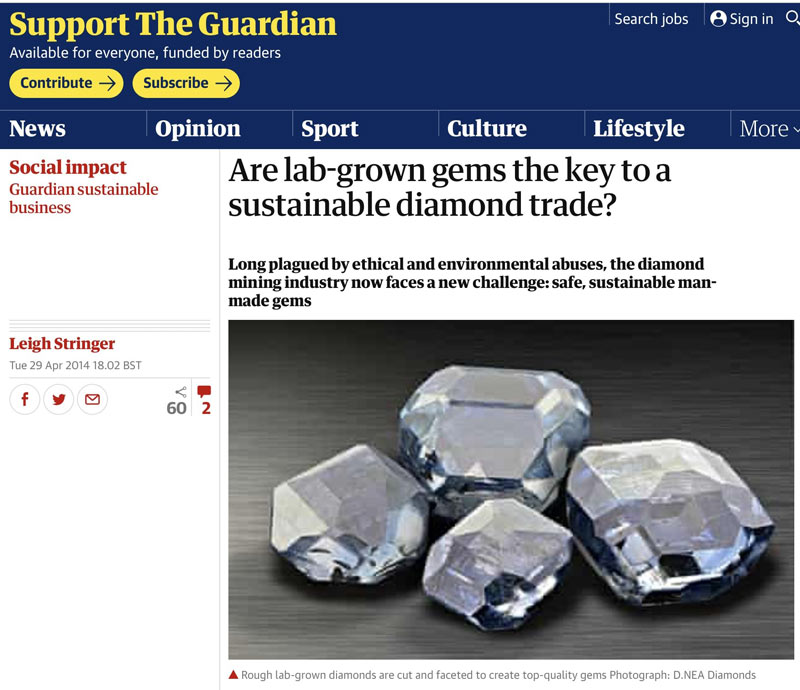
Gem labs draw the consequences
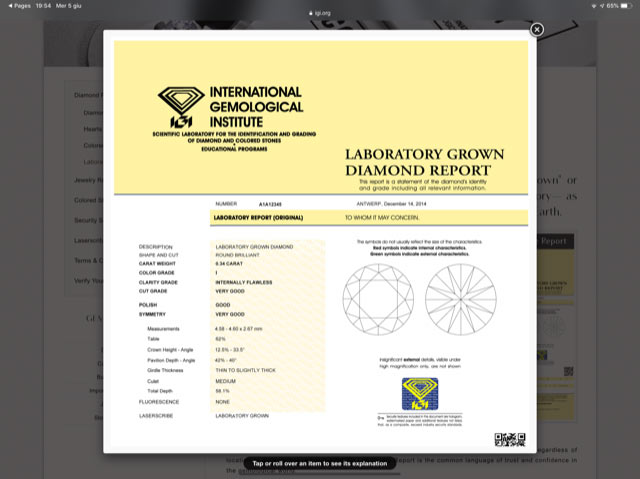
Following the FTC modifications, labs are aligning their lab-grown diamonds reports to the new rules. While HRD has changed the grades used in its lab-grown diamond reports to match mined ones, the GIA’s identification reports will no longer use the term “synthetic”, replacing it with the term “laboratory-grown diamond” followed by an explanatory statement. HRD Antwerp has changed its previous five color grades (colorless, near colorless, faint, very light and light) to the same 13 used for natural diamonds (D to M, plus N-O, P-R and S-Z). Additionally the former five clarity grades (from free of inclusions FI, to included I) have been replaced by the same 10 applied to mined diamonds.
On the contrary, the GIA will reduce the grades, using the same color and clarity boundaries for synthetic diamond reports as the grading system for natural diamonds and showing “the same visual representation of the scales for color, clarity and cut as GIA’s grading reports for natural diamonds”. No significant change is scheduled for the IGI Laboratory-Grown Reports which will bear the same information as the IGI Diamond Report, except for the yellow color which will be given as a distinctive feature.
Conclusions
The new FTC standards partly confirm the consolidated rules and partly open controversial issues in substantial discrepancy with ISO European provisions. While accepting some indications coming from the synthetic diamond industry, that now can legitimately qualify its products as diamonds, to enforce the new guidelines the FTC is calling for a strict compliance to three defined specifications, at the same time making clear that hazardous neologisms to represent synthetic diamonds are not welcome, as the warning letters show. Understandably the new rules are provoking adverse reactions among traders and gemologists fearing that they will introduce more confusion and ambiguity rather than transparency. Ernie Blom complains that the lines do not comply with the terminology approved by the World Federation of Diamond Bourses (WFDB), of which he is the President. Martin Rapaport notes that consumers are not duly receiving two basic pieces of information: firstly, on an historical basis, synthetic diamonds are not able to retain their value and secondly while the disclosure of post treatments is compulsory for mined diamonds, for frequently post treated (HPHT) synthetic diamonds it is not.
Article by Paolo Minieri, published on IGR – Italian Gemological Review #7, Summer 2019


