This content was first published on IGR – Italian Gemological Review no. 13 in 2021. The information provided here is therefore current as of the original publication date.

I’ve never called for it and I’m unlikely to call for it again. But, if you agree, then pass this message along. Gemologists and jewelers, let’s wake up, please! Unknowingly, you have ended up in a gated community, in the protected green zone of Baghdad while chaos is just a few hundred feet away. With our gemstones and jewels safely secured in the comfort zone of a graceful wunderkammer, we’re forgetting to spot what’s going on outside.
One quiet day this past July we nearly had a heart attack. One of the leading national newspapers was indeed reporting the astonishing words from a spokesman of the Italian jewelry brand Morellato about the synthetic diamond the company is starting to use for one of its collections: «it’s a diamond for all intents and purposes, but democratic… it’s not synthetic, if anything it’s an ecological diamond».
Can you guys possibly imagine anything more disturbing? Yes, I can. The fact that NO ONE has reacted. This is to me even more disturbing. But Morellato’s disconcerting statement is but the very tip of the iceberg. When it comes to jewelry and precious stones, Italy, the same country that is strictly regulating the level of decibels produced by lawnmowers and is punctiliously protecting seagulls’ nests in the city center, allows an outrageous Wild Far West. Those who write that a synthetic diamond (as explicitly stated in a report that presents it as such) is not synthetic are not challenged at all. One can issue so-called “certificates” saying or not saying anything. Values can be attributed at will («you know what? We type “rubino” in Italian in a big font and glass filled in English tiny print, in the end it is still a ruby and many do not pay attention to English words»). In our country, natural and synthetic gems are being mixed up, and the most invasive treatments are being silenced or passed over. In such a climate, buying is nothing more than pulling down a slot machine lever and this leads to the degradation of the primary asset, i.e. the consumer confidence.
Theoretically, when it comes to facing this barbarian practice, IGR (Italian Gemological Review) is not alone. However, the many expressions of appreciation are voiceless and do not result in a critical mass capable of publicly denouncing it. The outrage of the small-sized artisan manufacturers is diminished by their weakness. Major companies consider a soaring turnover to be worth more than fair disclosure. The silent majority is self-absolving, they know but close their eyes. After all, wasn’t it always done this way? And what about the associations? You to act? Do I move? If it’s a matter of watching, no doubt they watch. But they just stay quiet by their windows.

«We will have to repent in this generation – Martin Luther King once warned us from a Birmingham jail – not merely for the hateful words and actions of the bad people but for the appalling silence of the good people. Human progress never rolls in on wheels of inevitability». But when is this silence interrupted? The moment comes when a man (a scientist) feels that silence becomes his fault. At that point, each and every scientific discipline sets aside the golden Arcadia of self-satisfaction and is forced to turn civil and militant. Progress doesn’t come by itself.
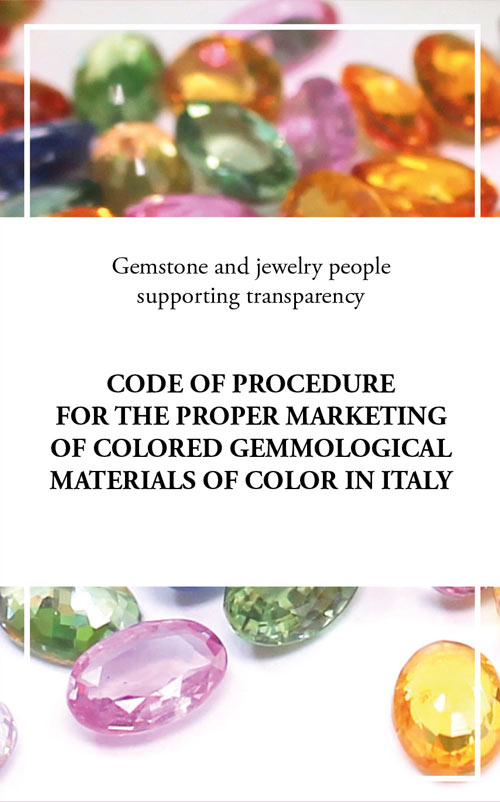
In the end, commitment and good will: here the key words can be found to take action. If gemmology is grounded in science, it must be able to responsibly oppose the non-scientific use that the less responsible make of it. This is what geographers and ethnologists did in the last century when they denounced the subordination of their studies to the interests of colonial domination. It is what Darwin and Freud did against the paralyzing ecclesiastical dogmas, it is what physicists and chemists did when the military powers began to transform their work into atomic weapons and exterminating gases. With due proportion, even the use of precious stones shows the practice of a form of hidden power, a kind of distorted marketing based on illegal definitions. Stones do not exist in abstraction but take their shape only when we see how they are shifted by the tides of the economic and social context. The definition of a stone in gemology implies a correct identification and definition of its economic value. Let’s leave the Wild West to its destiny and take sides. The rules to make this game fair are not complex and there are already authoritative sources. Why don’t all of us, good will people, sign a shared pact on a written code of conduct? The purpose is just very simple and consists in the commitment to fairly disclose what a poor fellow (who is trusting us) is buying.
By Paolo Minieri, published on IGR – Italian Gemological Review #13, Autumn 2021