This content was first published on IGR – Italian Gemological Review no. 11 in 2021. The information provided here is therefore current as of the original publication date.

The problem behind gem traceability is that digital ledgers must be based on physical markers. These markers are the connection to univocally identify each single gem to which certain properties must be assigned, whether these properties are gemological and qualitative characteristics or origin determination and responsible sourcing information. In short, are information packets secured in unchangeable digital chains? Yes, today they are, but these packets are not reliable unless they are properly associated to every single stone. The first tracker to respond to this need was Gübelin’s Provenance Proof, later evolved in a blockchain initiative with Everledger. It consists in the application of nanoparticles that can virtually sign rough and polished gemstones such as emeralds.
As for diamonds, traditionally the marker that the industry is widely using is a laser in-scripted serial number on the girdle. Over 10 million diamonds are assumed to be individually laser-written every year to store quality information and deliver it to buyers including the necessary information on provenance, so feeding the blockchain. But how secure a surface in-scripted serial number can be? Not much, it can be polished away or duplicated as long as the technology to do that is more and more accessible. Consumer confidence as well as sophisticated ethical gem programs cannot be developed and based on laser inscriptions for long.
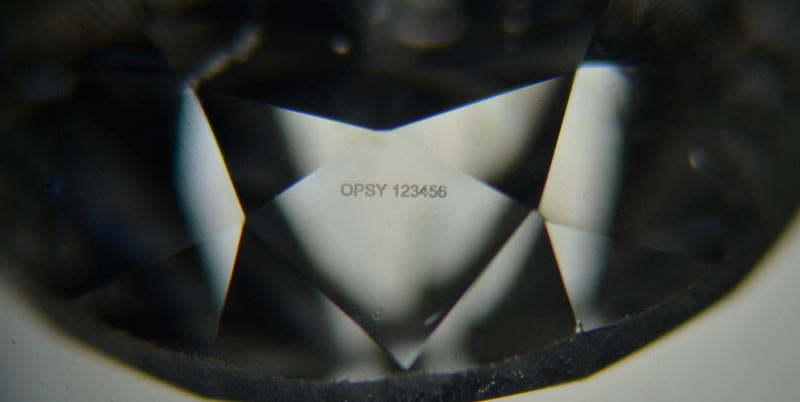
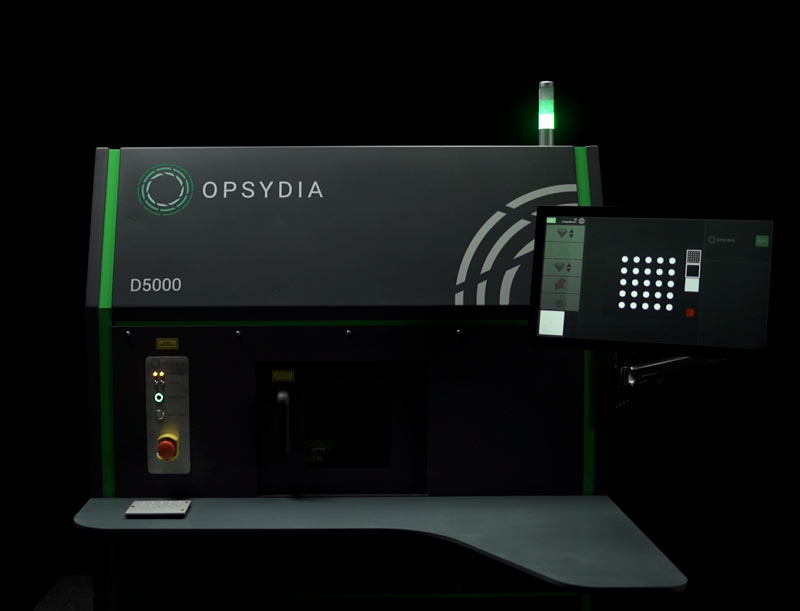
Opsydia, a spin-out company from the Department of Engineering Science at the University of Oxford, has decided to enter the market of diamond security with its innovative and proprietary marking technology apt to create practically invisible structures inside transparent materials. The technology works by applying laser pulses, shorter than one trillionth of a second in length, and shot over a million times per second, to a diamond. The markings are less than 1/50th of the size of a human hair and a microscope is required to view them. The nano-scale identifier does not affect the clarity grade of internally flawless diamonds as verified and confirmed by two leading grading houses, including the Swiss Gemmological Institute (SSEF).
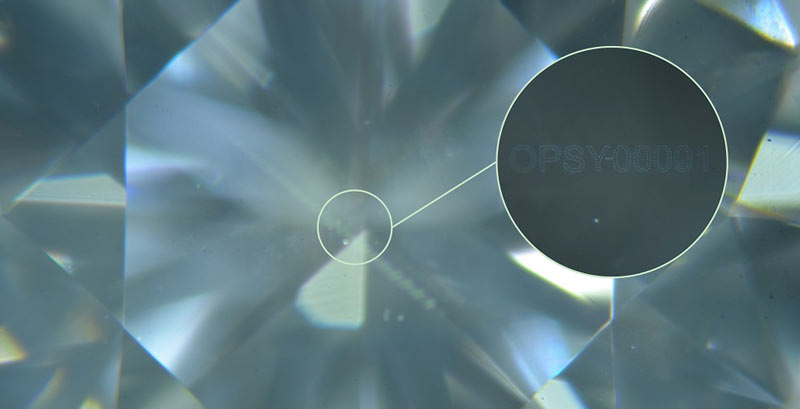
Opsydia’s markers can be used by gem labs to write their reports beneath the surface of diamonds and the industry can use them to implement the integrity of the transactions over the supply chain of polished diamonds. De Beers was the first company to apply Opsydia’s markers on its Lightbox synthetic diamonds as early as in 2018. Last test before their massive introduction?
Gem News published on IGR – Italian Gemological Review #11, Winter 2020-21