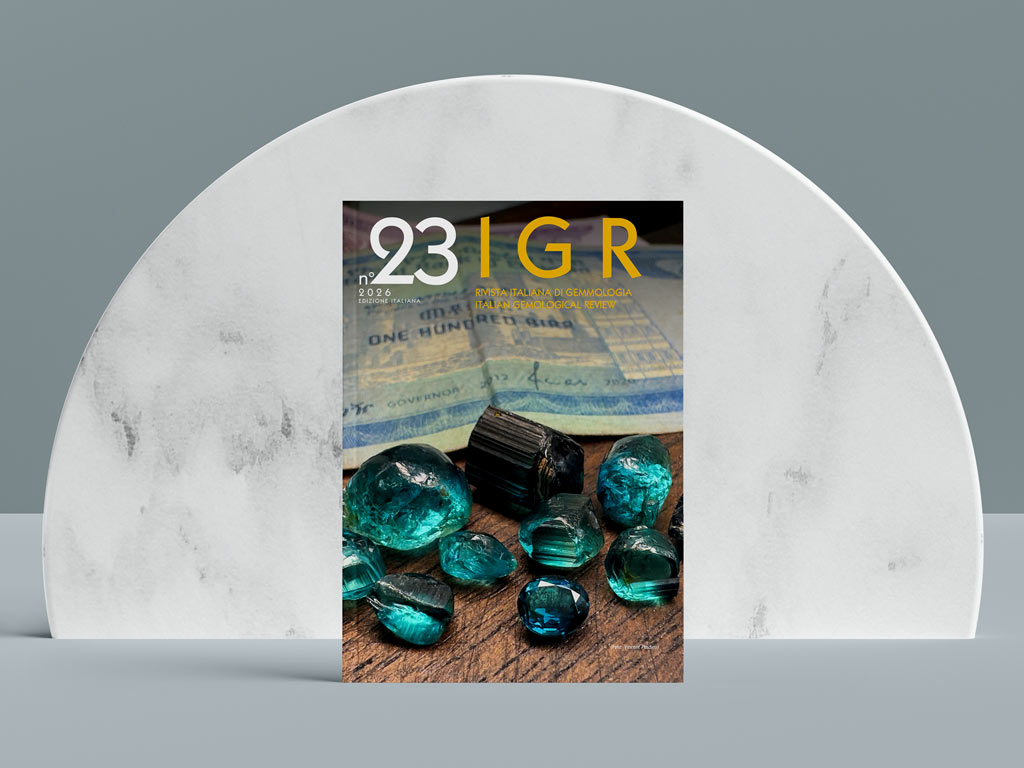
On July 3 and 12, 2021, “Corriere della Sera” and “La Repubblica”, two important Italian newspapers, published two articles on the Morellato Group, with the following titles: “Rubies, emeralds and sapphires. The case of Lab-Grown Gems” (Corriere della Sera, July 3, 2021) and “After Ferragni, Morellato introduces the Ecological Diamond” (La Repubblica, July 12, 2021).
From these articles we report and highlight some passages that soon appeared to many in the jewelry and gemstone industry to be rather questionable.
The disputed statements
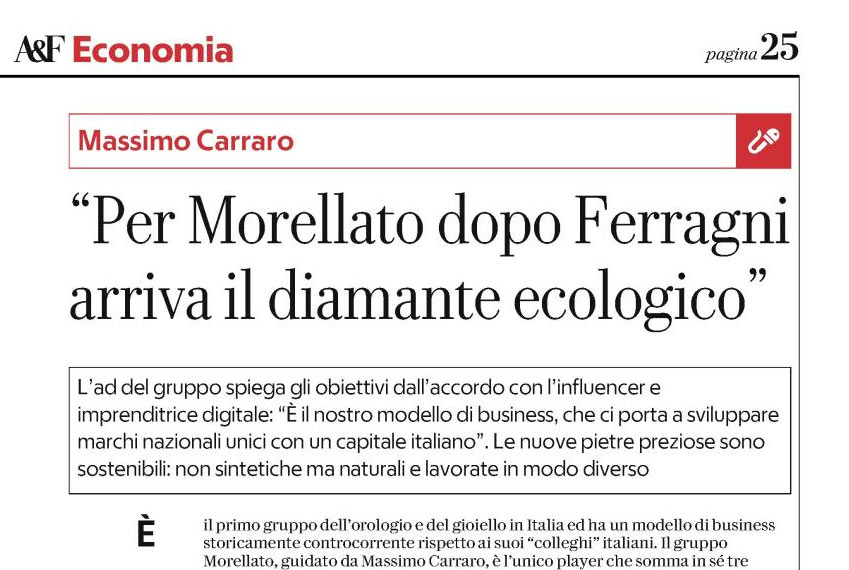
(Repubblica, interview with Massimo Carraro, CEO of Morellato Group)
“Question: «Morellato has established itself as the interpreter of the “easy to wear” jewel where the precious content is expressed by design and not by the material. An innovation that has changed the Italian jewelry model. Now you are among the first ones launching the ecological jewel».
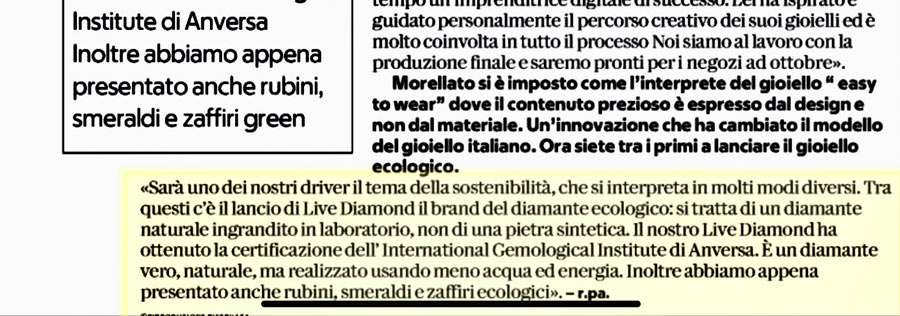
Answer: «One of our drivers will be the theme of sustainability, interpreted in many different ways. Among these is the launch of Live Diamond, the brand of the ecological diamond: it is a natural lab-grown diamond, not a synthetic stone. Our Live Diamond has been certified by the International Gemological Institute of Antwerp. It’s a real, natural diamond, but manufactured using less water and energy. We have also just introduced eco-friendly rubies, emeralds and sapphires»”.
(Corriere della Sera, interview with Francesca Ginocchio, Global Marketing Advisor at Morellato Group)
“«And the result is diamonds, emeralds, rubies and sapphires with the same characteristics of clarity, brilliance and weight as the mined gems, so much so that we have submitted them to IGI (International Gemological Institute) certification». To clear the field of possible equivocation with synthetic diamonds? «Exactly, precisely because of the very novelty of the new diamonds there is a risk of equating them with synthetic gems that have nothing to do with natural diamonds in terms of materials and production process»”.
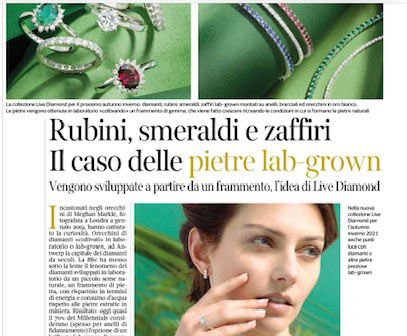
And again in “Corriere della Sera”
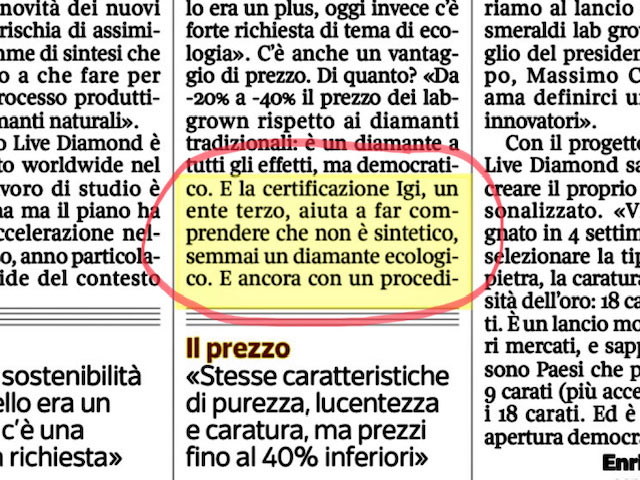
[…] “it is a diamond in every respect, but a democratic one. And the IGI certification, which is a third party, is helping to make people understand that it is not synthetic, but rather an ecological diamond” […]
No comment from people who made the statements. A collision course with UNI standards
Upon verification, the statements referred to above, do not appear in Morellato’s website communication and in Live Diamond website.
At the time we are releasing this article, no comment was given by Morellato, though the editorial staff of IGR has tried to reach the Group. These declarations fully involve the issue of the gemological terminology as well as the regulations governing its use. On this subject IGR interviewed Dr. Carlo Cumo, rightly considered one of the deans of Italy’s gemstone analysts, having worked for six years at the State Laboratory of Valenza and managed later his own laboratory in the same town.
«In such cases it is necessary to stick – says Carlo Cumo – to the UNI rules on gemological materials, specifically, to article 4.5.1 of Regulation 10245:2013 which defines a synthetic mineral as an artificial material with chemical and physical characteristics similar to those of the corresponding natural materials. Article 4.5 qualifies an artificial gemological material as an organic or inorganic substance produced by means of technological processes».
UNI is the Ente Italiano di Normazione (Italian Organization for Standardization), a highly authoritative body gathering the stakeholders and the major industry players and experts to set rules that become standards for industry as trade as well. UNI standards are generally in line with the international ones and are being continually updated. Their definition of synthetic (or lab-grown) diamonds is quite clear: “Man-made diamond that has essentially the same chemical composition, crystalline structure and physical properties as its natural equivalent – Note: It is not allowed to use the term ‘diamond’ alone to describe synthetic diamonds whose total or partial crystallization or recrystallization is due to human intervention, regardless of the starting material and the method used. A diamond manufactured in this manner must be clearly indicated as a ‘synthetic diamond’” (art. 3.15.3 of the UNI standard 9758:2021 “Diamond – Terminology, Classification, Characteristics and Test Methods”). The UNI rules also define “Diamond” (art. 3.15), “Natural gemological material” (art. 3.28.1), “Artificial gemological material” (art. 3.28.2), “Synthetic material” (art. 3.28.2.1) and “Synthetic product” (art. 3.28.2.2).
«It seems to me odd – Carlo Cumo says – that in a company like the one under consideration there is not a single person who is aware of what I have just recalled. I can also realize that, when launching a product, the most important vector is publicity, nevertheless I believe that it is always important to rely on qualified people in any specific matter because some of these statements show frequent contradictions. A fast reference to any dictionary is sufficient to realize that the terms “true” and “natural” are not applicable to this type of diamonds».
«I fully agree with the opinion expressed by Dr. Cumo – said Claudio Russo, GIA G.G. AGA S.G., geologist, long-standing gemologist and teacher at the Istituto Gemmologico della Magna Graecia – since evidently these articles put us in the presence of declarations based on mystification and misinformation». This point of view is echoed in the words of Marco Agazia, provincial vice-president of Federpreziosi, of Sommer Jewellers in Cavallino-Treporti, Venice: «I do not disapprove lab-grown diamonds trade but I do advocate the use of the right terminology…», and of Francesco Sequino, gemmologist F.G.A., AGA S.G., director of Gem-Tech Gemological Laboratory: «The UNI standards require the trade to use a proper nomenclature so as to avoid the introduction into the market of products that do not correspond to the seller’s claims». Bruno Martinez, G.G. IGI, owner of Martinez Diamanti insists on the ethical aspect: «Gemology is the science studying gems and the terminology to be used can only be scientific; a diamond can be either natural or synthetic, aside from an imitation. No room for ambiguity should be allowed. Currently, communication transparency represents a real industry need, particularly at a time when the market has yet to fully recover from the misconduct of some banks with regard to the proposed sale of diamonds. My concept of ethics is based on the full and proper disclosure of the characteristics resulting in a well-informed and therefore aware purchaser».
Many other traders wanted to have their say on the Morellato Group’s claims. We have chosen only a few of them for the limited space we have available. Alberto Malossi, an experienced and respected figure in lab-grown gems and CEO of Gemmecreate srl, a company specializing in synthetic stones: «in my opinion there is enough material to submit a detailed complaint to guarantee bodies such as the Istituto dell’Autodisciplina Pubblicitraria (Institute of Advertising Self-Discipline)». Omar Bakr of Bakr srl: «I cannot help but be outraged to read such statements». Rosita Zitoli of Gioielleria Piccarreta in Corato, Bari: «I am outraged by such a reduction in the importance of common regulations that have long governed our work and which aim to protect the final consumer!»
IGI lab-grown diamond reports feature a look and layout graphics different from the natural diamond ones
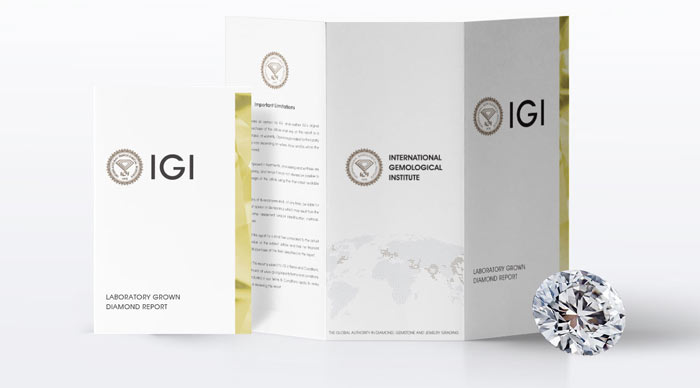
IGR reached out to the International Gemological Institute whose reports were used in the controversial Live Diamond promotional campaign. The Belgian Institute pointed out to us that it is active, like all major international laboratories, in the lab-grown report business. «Yes, we do issue reports for lab-grown diamonds» a laboratory official told IGR, «and, precisely in order to provide the market with the utmost transparency and clarity, these gemological documents are strictly issued in different and distinguishable layout and color so that they cannot be mistaken in any way with those that are issued for natural diamonds. The documents issued for lab-grown diamonds are yellow colored, and include the same criteria used for natural diamonds. The stones are laser engraved and we never claim that these diamonds are environmentally friendly or anything like that». Recently IGR has reported an additional service offered by the IGI reports on lab-grown diamonds that include post-treatments, as from January 2021.
The Italian jewelry and gemstone industry has been discussing for some time the issue of the proper disclosure of gemstone information along the supply chain. Specifically, the basic question is: are the specifications that reach the final consumer the correct ones?
The Italian legislative vacuum: concerns about market transparency and the role of trade associations
Starting from 2004, several law drafts have been brought to the attention of the Parliament to impose stricter fair disclosure obligations, without achieving the enforcement of new legal regulations.
«Unless there is a regulation enforced by State law, and without sanctions, in Italy we risk a gemological Wild West – claims Francesco Sequino – seriously damaging what is a key component of our work, i.e. consumers’ trust».
Among the many operators we have contacted, many have insisted on the fact that it should be the Italian trade Associations to make a strong commitment and apply the right pressure for promoting responsible marketing practices, also and above all, undertaking once and for all an effective action. As Marco Torelli, HRD GG, AGA S.G., Director of the Masterstones Analytical Laboratory pointed out: «The UNI standards are clear but little known. Think instead of the enormous influence that the CIBJO guidelines have at a global level. Those on synthetic diamonds consist of 18 clear and precise pages that not surprisingly begin as follows: “1.1.1 Their primary goal is to protect consumer confidence”. If such misleading statements had not appeared in such widely circulated newspapers, it would hardly be worthwhile to point out something so obvious, namely, that according to these guidelines, a synthetic diamond cannot be accompanied by attributes such as “true” or “natural”. The CIBJO prohibits even the use of ethical qualifications if not properly demonstrated».
IGR has collected the opinions of some professionals working in the field of gemology and jewellery and precious stones trade. We will be pleased to publish any replies from Morellato as soon as these will be available.
Article by Luigi Costantini, Alberto Scarani and Paolo Minieri