This content was first published on IGR – Italian Gemological Review no. 18 in 2024. The information provided here is therefore current as of the original publication date.

On September 6, 2023, the Gemological Institute of America (GIA) announced that the historical trade term “Hanadama” will be used in the comments section of its reports to distinguish a specific quality range of cultured Akoya pearls. The announcement clarifies that cultured Akoya pearls must exhibit a combination of the following GIA Pearl Value Factors classification ranges in order to be designated “Hanadama”: round to near-round shape, white body color (with or without overtone), excellent luster, clean to slightly spotted surface, excellent to very good matching, and sufficient nacre thickness and quality.
As Gary Roskin acutely points out, «Hanadama, Pigeon’s Blood, Paraiba, Chrome this, Cobalt that are commercial names and marketing tools used to convey to the consumer the remarkable high quality of a particular appearance». While the GIA’s decision aligns with this well-established trend, it is intriguing to observe that the attribution of “Hanadama”, which translates to “flower pearl”, this time does not align with the Western-oriented gemological wording, which includes attributes such as Pigeon’s Blood, Paraiba, Santa Maria Aquamarine, etc. Instead, it caters to the needs and terminology of a market traditionally influenced by Japan’s cultural experience and trade leadership fueled by the strong demand for quality Akoya pearls from China over the past decade.
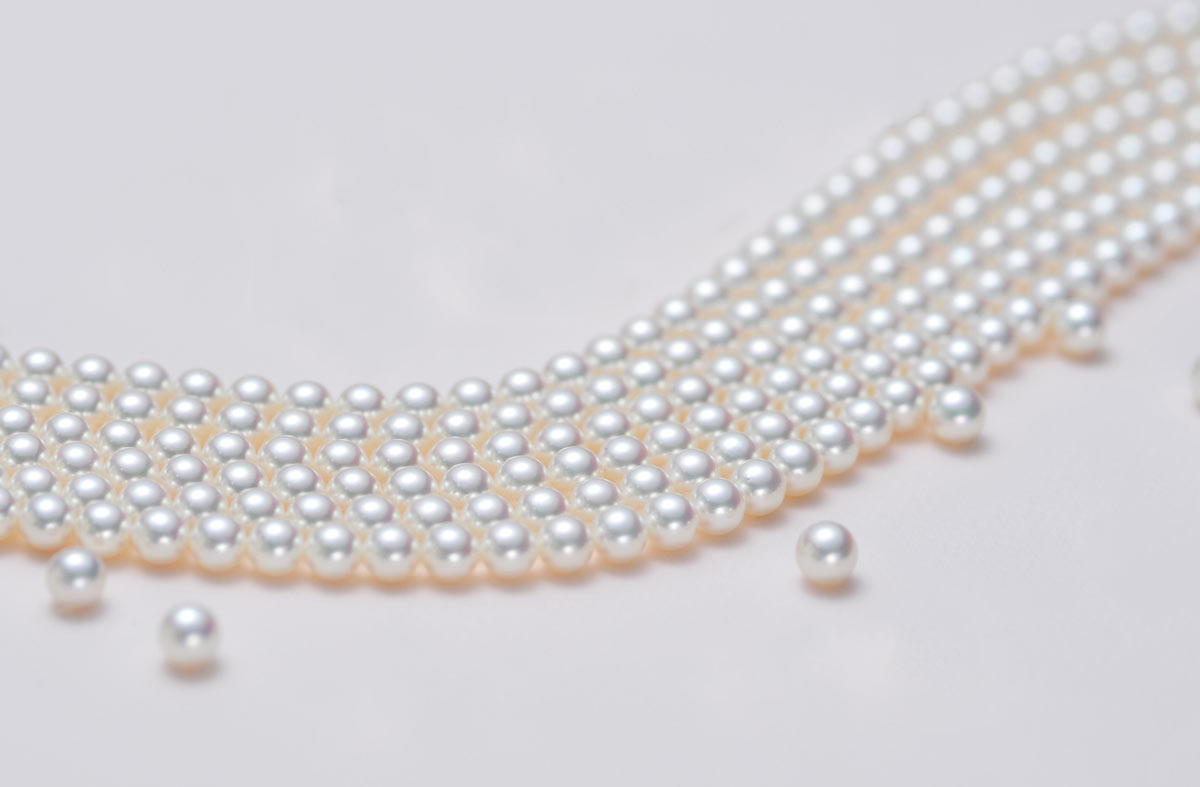
As the country of origin, producer and global marketplace for cultured Akoya pearls, Japan has its own tradition in the field of pearl nomenclature and evaluation. Japanese renowned laboratories such as PSL (Pearl Science Laboratory) and the Pearl Institute use their own specific terms based on factors such as nacre thickness, surface smoothness and luster. PSL issues certificates from bottom to top as follows: FA pearls with no grade, SJ and SK for Aurora Rosé and Aurora Peacock, SS for Aurora Hanadama, SP for Aurora Goddess, Top grade.
It seems that in Japan, traders have accepted a certain degree of ambiguity of the term, so much so that the Japan Pearl Promotion Association, founded in 1956 with the mission to provide support to the pearl industry, took action for clarification, to issue an important statement on its official website to remind to the Japanese pearl companies to use cautiously the word “Hanadama”.
Specifically, it must considered that “Hanadama” is a term that has been employed by pearl professionals in Japan since ancient times to denote a very limited and exclusive category of untreated pearls as they come out of the mollusk. Interestingly and ironically, a literal interpretation of this Japanese term in its original sense would not make it applicable to a pearl necklace simply because it has been drilled.
«However, in the market today, variable qualities of Akoya pearls are traded under the name “Hanadama” without a unified standard of quality in the industry […]» the Pearl Standard of Japan Pearl Promotion Society, admits, «[…] Thus, to say at the time of sale that a pearl is of the highest quality only by reason that it has a “Hanadama” certificate is not a sufficient justification for the consumer».
It is no coincidence that the Japanese Akoya nomenclature and standards, traditionally utilized in Asia and embedded in a different tradition, have been carefully scrutinized by the GIA. «We undertook a thorough examination of the original and contemporary uses of the term “Hanadama” and gathered extensive input from industry insiders», said Tom Moses, Executive Vice President and Chief Laboratory and Research Officer.
After all, an attribute, whether it is an indication of geographical origin or a reference with a literary suggestion, can be formalized and can work well as a brand, even if it comes from a distant culture.
Gem News published on IGR – Italian Gemological Review #18, Spring 2024