This content was first published on IGR – Italian Gemological Review no. 16 in 2023. The information provided here is therefore current as of the original publication date.

Marco Campos-Venuti’s long essay “Biominerals” was published at the end of 2022, a real manual on a little-known subject, but very topical in the academic world (526 pages and +1000 figures). With this third book Campos-Venuti completes his trilogy on agates, and we love this grand finale dedicated to the biomineralization induced by microbial faunas, not only in agates, but also in a large number of minerals.
Although this saga is aimed particularly at the study of agates, in reality the author’s attention investigates the limits of classical mineralogy. First with the analysis of the crystallization of polymers in colloidal solutions and then with the participation in the crystallization of microbial fauna present in low temperature hydrothermal solutions. So an interesting multidisciplinary effort, completely innovative, between mineralogy, microbiology and paleontology. Moreover, the author keeps us accustomed to new theories, in fact he has always turned his attention to poor and poorly studied materials, such as lapidary materials and semi-precious stones, as well as jaspers and agates, also alabaster, malachite, rhodochrosite, iron and manganese oxides. These materials are not crystalline enough for mineralogists nor gemmy enough for gemologists and therefore traditionally snubbed by researchers.
According to the in-depth comparative analysis of the structures present in numerous samples, the author finds unequivocal analogies between hundreds of mineral structures, traditionally considered just mineralogical oddities, and living bacterial colonies, both in the laboratory and in nature developed within biofilms. First of all inclusions in agates; therefore the moss and plumes agates turn out to be to all intents and purposes microbialites, i.e. colonial constructions produced by the biomineralization of microbial colonies. They are therefore more fossils than minerals. But then the author went further and found traces of a biological origin in the manganese dendrites present both in quartz and in many rocks, in concretions, in many banded minerals such as opal, the Bumble Bee, malachite, rhodochrosite or schalenblende and even in some native metals such as gold and copper.

Bacterial faunas abound in soils and therefore it is intuitive that whenever a mineralizing solution originates near the surface at temperatures below 100 °C, this is of course contaminated by microbial faunas and these must interact to a variable extent with the crystallization processes. The existence of a deep biosphere has been known for some time, but for the first time we have here a study of the traces it leaves on minerals and rocks and an indispensable means of identifying their presence in the future.
The identification of the traces left in the rocks by these extremophile faunas has numerous implications of various kinds. First of all, chalcedony in the gel state proves to be a perfect habitat for the proliferation of bacterial colonies. So much so that the suspicion arises that the origin of life on Earth occurred right inside an agate. And agates with well-structured colonies have been found within walking distance of the Dresser Formation, dated 3.48 By and considered the cradle of the first living molecules. From another point of view, the ability to recognize biogenic structures in concretions such as the Moqui Stones allows us to make interpretations in the field of astrobiology and identify structures of clear biomineral origin in photos of the Martian surface. Finally, the study of the structures present in the karst environment indicates that the caves are a perfect place for the proliferation of bacterial faunas with the most disparate metabolisms that have left us a great variety of beautiful speleothems with eccentric shapes or inflorescence-like appearance.
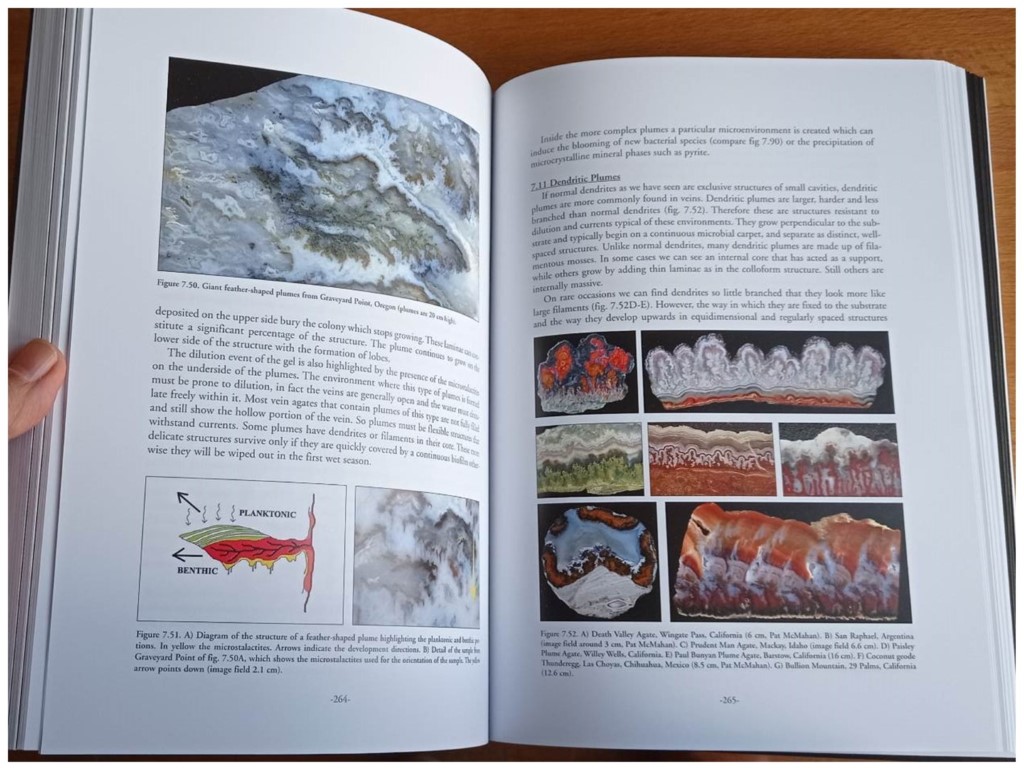
It is difficult to summarize all the ideas that this book offers the reader, but surely your view of geology will have changed after this reading. As the well-known Italian geologist Paolo Forti says in the introduction: «My personal believe is that this monograph will soon become the fundamental basis from which to start for any genetic discussion involving the form and chemical composition of any secondary deposit potentially governed by microorganisms (whether it is a rock or a mineral)».
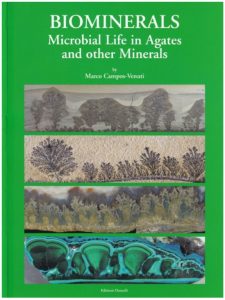 “Biominerals – Microbial Life in Agates and other Minerals”
Marco Campos-Venuti
Published in Italy by Edizioni DanzaSì in 2022.
528 pages, A4 format, +1000 figures, 78 diagrams e 55 photo cards
ISBN: 9788894582789
Available in English language on www.agatesandjaspers.com at the price of 85 € plus shipping fees.
Article by Michele Macrì, published on IGR – Italian Gemological Review #16, Summer 2023.