





This content was first published on IGR – Italian Gemological Review no. 4 in 2018. The information provided here is therefore current as of the original publication date.

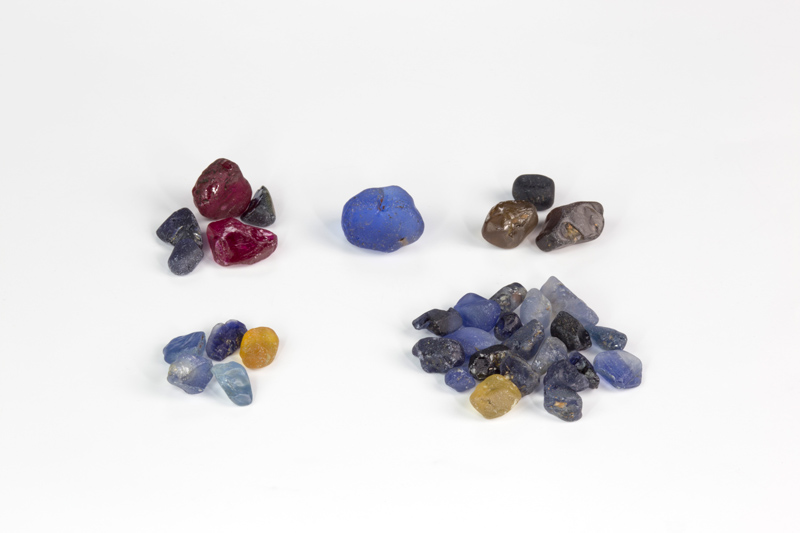
Since the discovery of fine blue sapphires in 1994, Madagascar has quietly become the world’s largest supplier of high quality sapphire. Every few years it seems that yet another strike is made.
This article provides a brief introduction to sapphire in Madagascar, and then a comprehensive review of the inclusions of fine Madagascar sapphire.

Introduction
The Island of Madagascar is an anomaly in many respects. While lying just 400 km from the coast of Africa, it was not settled until roughly 2000 years ago, and not by Africans, but by adventurous sailors from the Malayo-Indonesian Archipelago, some 6400 km to the east. Today the country’s human population is a tumultuous stew spiced with Malay, African, Arab, French, Chinese and Indian ingredients.
Madagascar has long been recognized as one of the most biologically diverse spots on the planet. The following will give you some perspective:
- While the California-sized island makes up just 0.4% of the earth’s total landmass, its plant and animal species make up roughly 4% of the planet’s total.
- 80% of Madagascar’s species are endemic, meaning they are found nowhere else on earth.
- Although Madagascar occupies only about 1.9% of the land area of the African region, it has more orchids than the entire African mainland and is home to about 25% of all African plants.
- Close to 100% of all lemur species are found only in Madagascar.
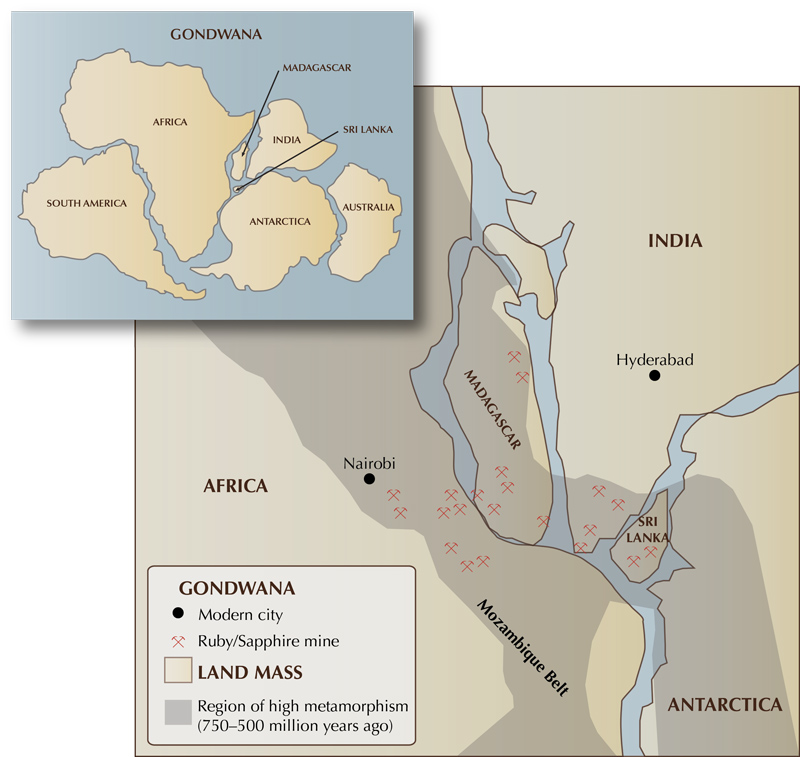
Madagascar owes its biological diversity to geology. Over 165 million years ago, the island was a land-locked plateau at the center of the supercontinent, Gondwanaland. At this time, giant reptiles roamed the earth, while flowering plants and birds were first beginning to appear. Gondwanaland subsequently broke up, leaving Madagascar like a castaway in the Indian Ocean, marooning many of these ancient species. These were further pollinated by plants, animals and humans flying, drifting, swimming, sailing or blowing onto the island, creating a magnificent menagerie unlike any other on the planet.
And what of Madagascar’s spectacular gem diversity? A quick glance at a map of Gondwanaland provides the answer. Before the breakup of that land mass, Madagascar’s nearest neighbors were East Africa, Southern India and Sri Lanka. These regions represent some of the richest gem deposits on the planet. Madagascar lies smack-dab in the middle of precious stone Nirvana.
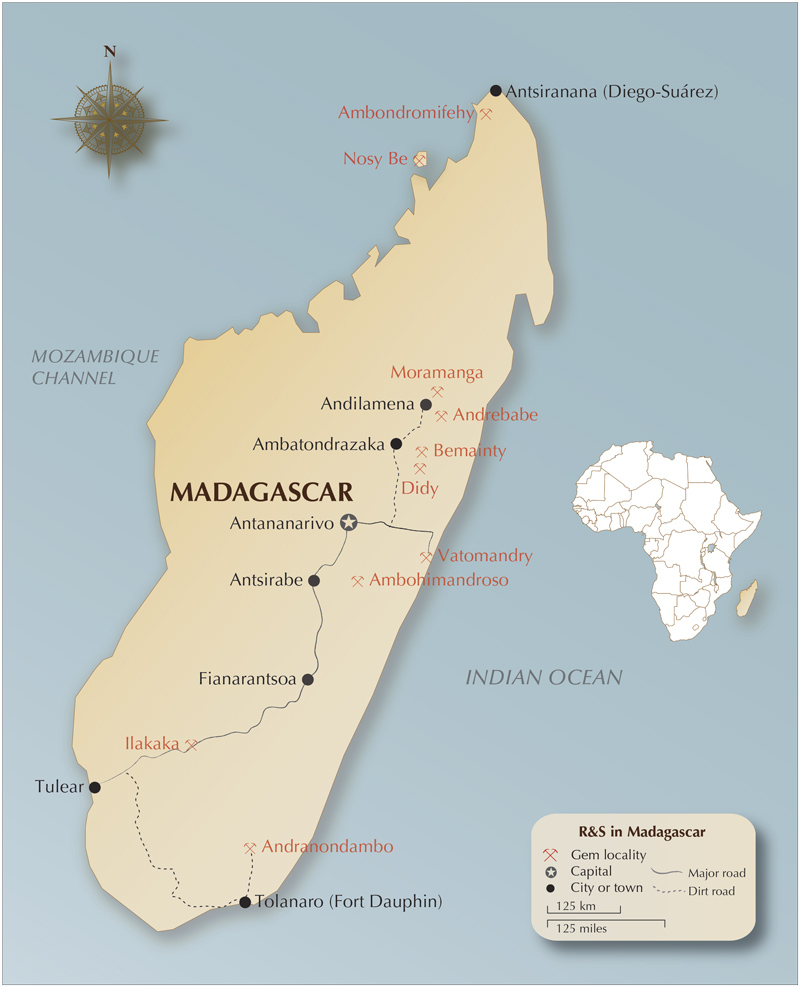
The first major find of fine blue sapphire in Madagascar took place about 1991 at Andranondambo. These were fine blue stones that initially (and still are) confused with the famous blues of Kashmir.
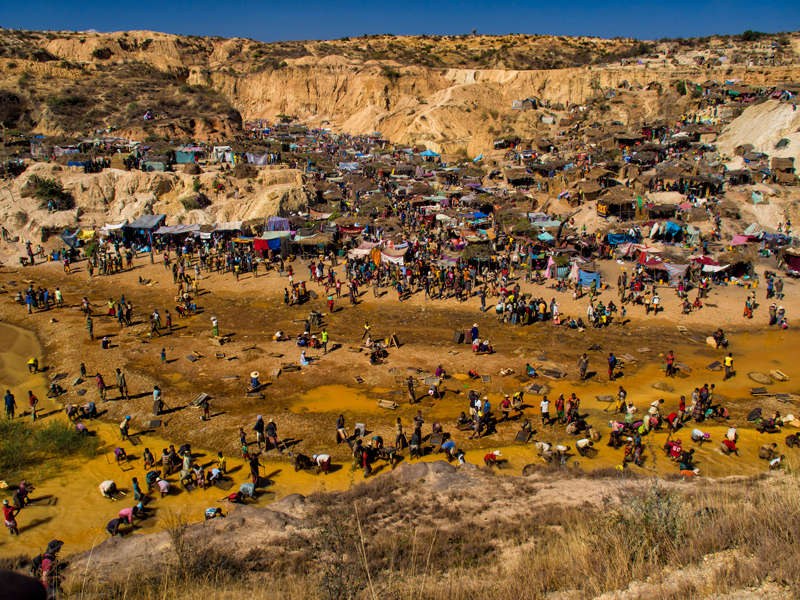
In 1995, basalt-related dark blue sapphires were unearthed at Ambondromifehy in the far north. But the discovery that really set the gem world on fire occurred in 1998, when sapphire was unearthed beside the small village of Ilakaka. Overnight the population grew from a few hundred to tens of thousands. This was the first of Madagascar’s major gem rushes, and one that continues to this day.
Following Ilakaka, corundum was found at Vatomandry (2000), Moramanga and Andrebabe (2004), Didy (2012) and Bemainty (2015). It seems that almost anywhere one puts a spade into the ground, pulling up a ruby or sapphire is a distinct possibility.

Inclusions
There are many features of Madagascar sapphire that, when taken as a whole, can help us distinguish these stones from those from other origins. Some of the most prominent features we have observed include:
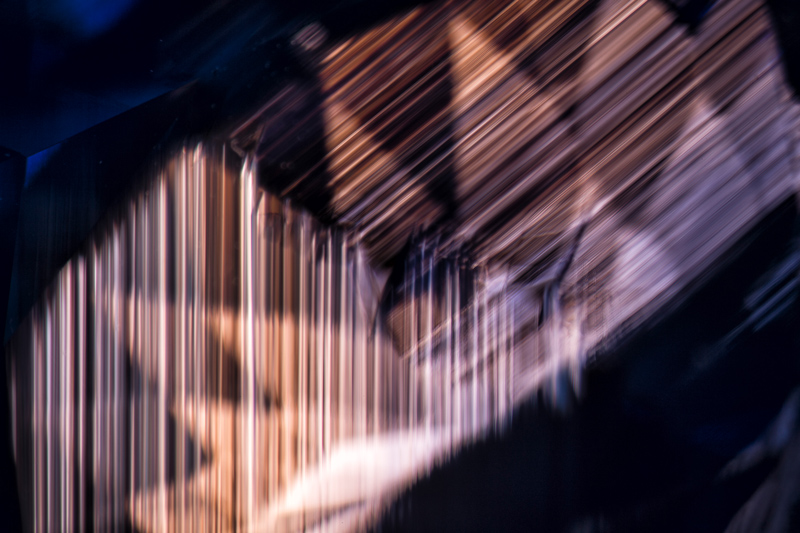
- Sharp angular growth zoning
One of the most distinctive features of Madagascar sapphire is the extremely complex angular growth zoning. These zones create sharp angular structures when viewed perpendicular to the c-axis, and are sometimes so close together that they create an iridescent effect.
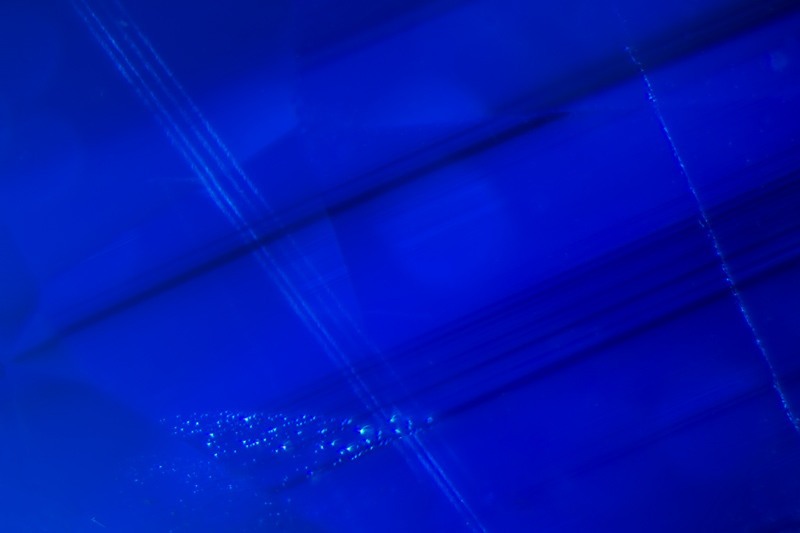
- Deep blue color zones
Color zoning can be striking, with thin, deep blue zones surrounded by lighter colored, milky texture clouds. Oftentimes we can also see streamers of fine particles going against the grain of these color zones.
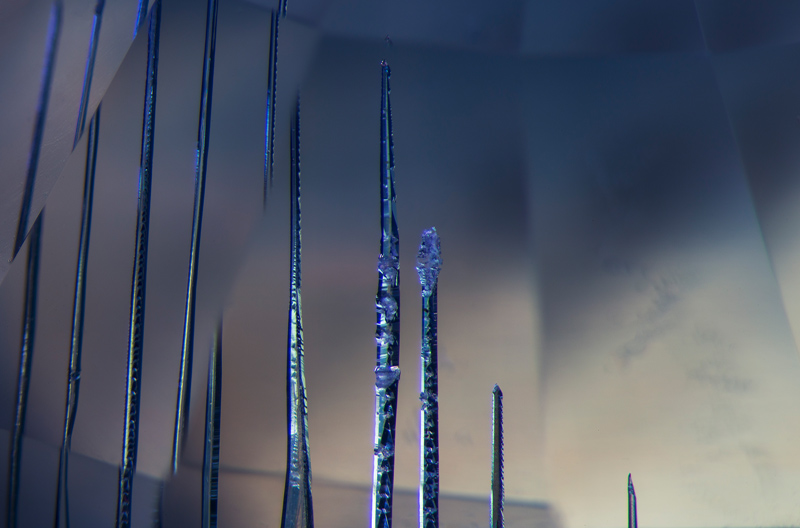
- Growth tubes
While growth tubes can be present in corundum from any origin, they are particularly prevalent in specimens from Madagascar. Sometimes small, single tubes can be seen, but often they are together in clusters.
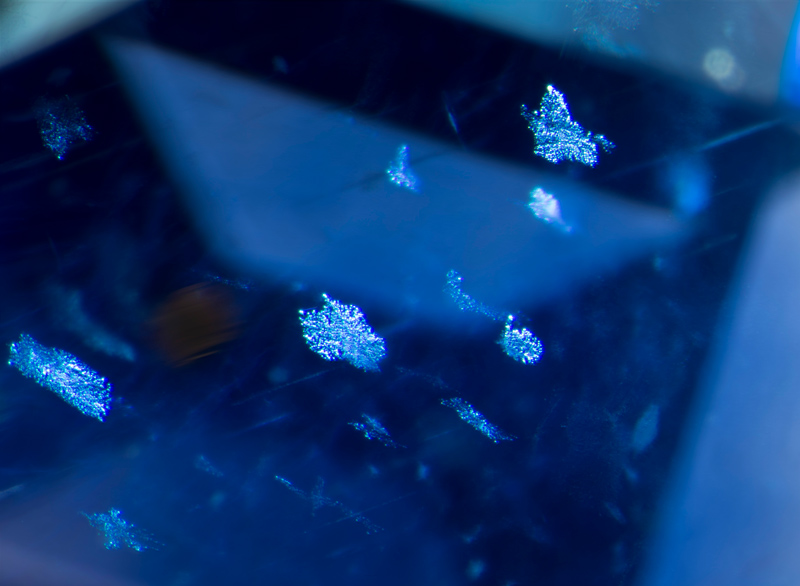
- “Doily” inclusions
“Doily-like” inclusions appear and can make these stones easily confused with Kashmir material. These look like little “lace” or “snowflake” forms, and come in small flat clusters of tiny particles or crystals.
- Solid crystals
One of the most common solid inclusions we find is zircon crystals. These can be found as small rounded crystals or sometimes even blocky crystals. At times we see just one or two, but often several, even hundreds can be found in one sapphire.

The zircon crystals are transparent and doubly refractive, so observing the specimen in crossed polars can help identify them because zircons will display interference colors, and sometimes a strain pattern.
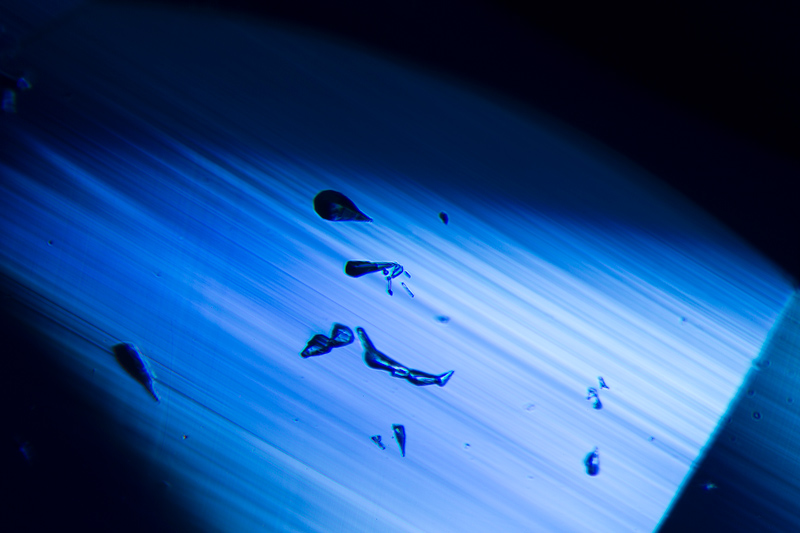
There are also many transparent crystals that are elongated to a pointed end in the Madagascar material. Other types of crystals are also present that we have not currently identified.
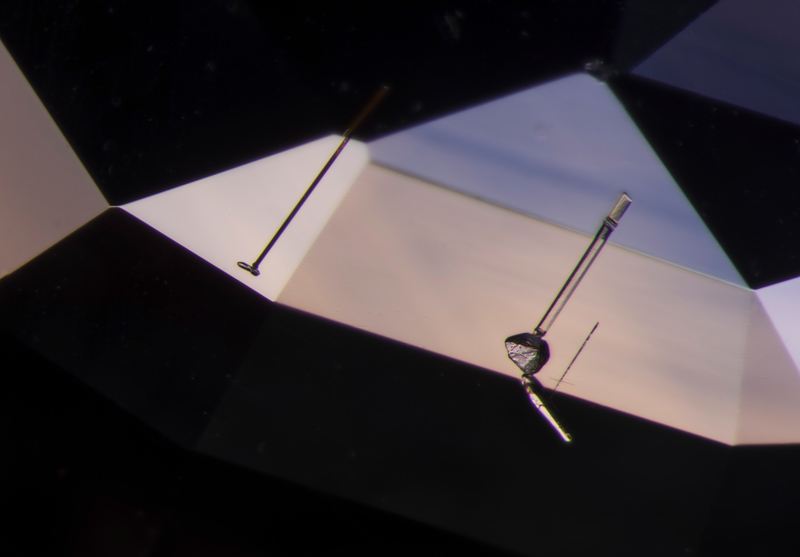
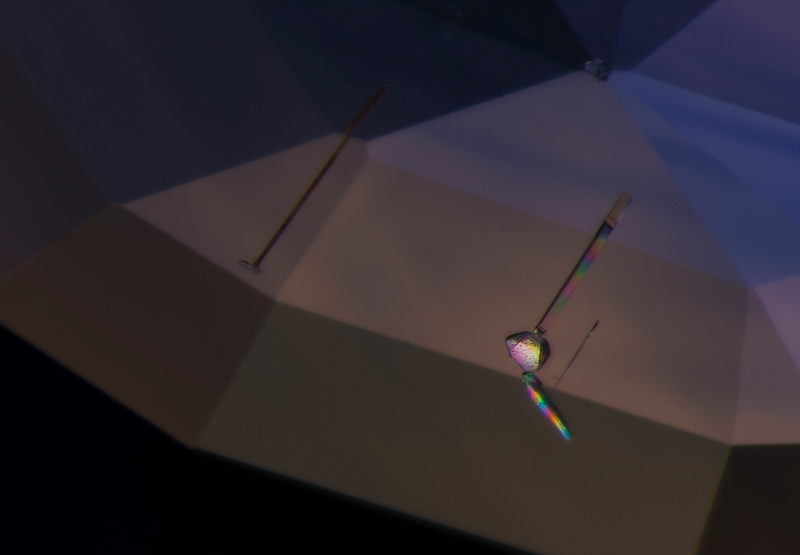
However, observation in crossed polars shows that some of these crystals show interference colors, confirming that they are solid crystals.
- “Web-like” fingerprints
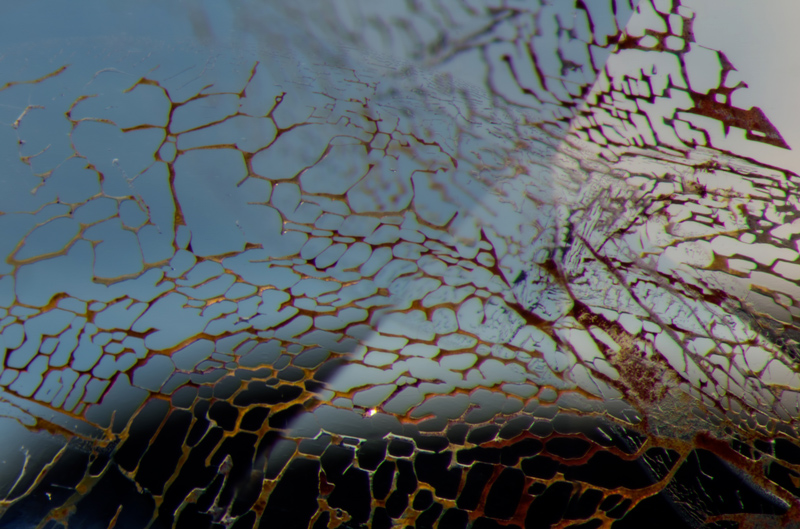
Some Madagascar stones display a series of inter-connected tubes that form web-like fingerprints.
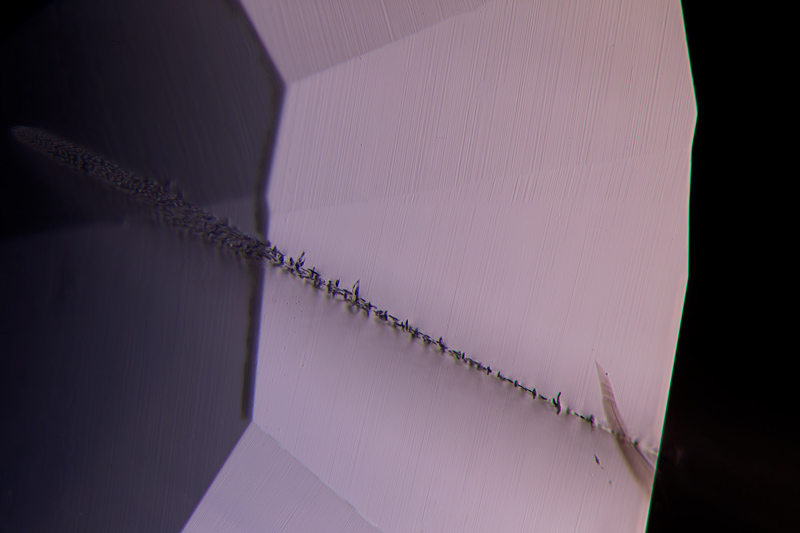
Furthermore, in some specimens the fingerprints show high relief if viewed from the side, where the small negative crystals stick up from the fingerprint plane.
- “Superficial” chalky shortwave fluorescence
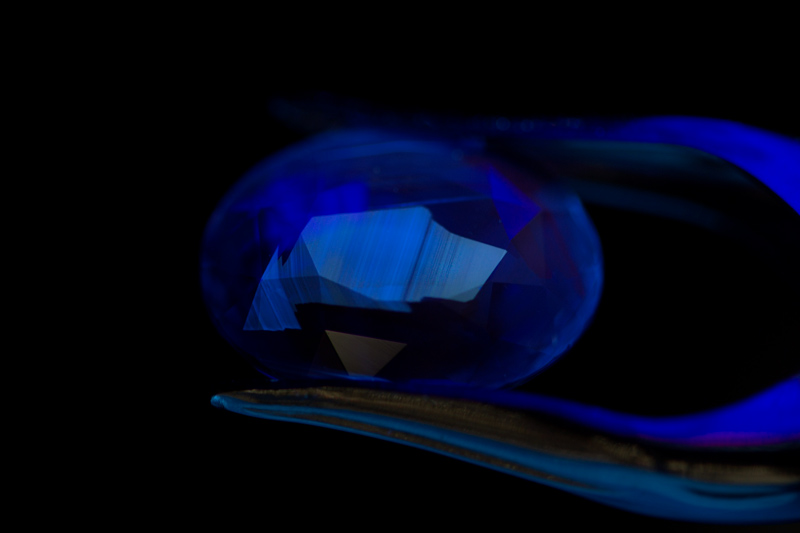
The “superficial” chalky shortwave fluorescent effect is one of the more unusual features we have noticed in Madagascar sapphire. Whereas normally chalky shortwave fluorescence can be observed in heated stones, we have seen it occasionally in untreated Madagascar material. The difference is that this “superficial” fluorescence tends to be in limited, sharply defined patches, and appears to be only on the surface of the material. In contrast, in heated stones the chalky fluorescence tends to appear to go deeper into and across the stone, without showing such strong patchy edges.
- Twinning
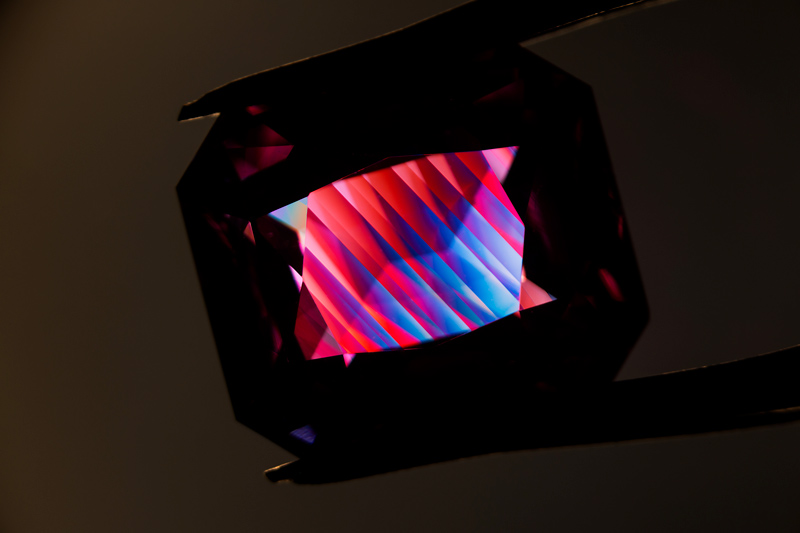
Twinning is common in this material, and often we can see polysynthetic twinning where there are multiple twin planes going in the same direction. In some specimens we even see twin planes criss-crossing each other.
Further reading:
Gübelin, E.J. and Koivula, J.I. (2005) Photoatlas of Inclusions in Gemstones, Volume 3. Basel, Switzerland, Opinio Publishers, 672 pp.
Hughes, R.W., Manorotkul, W. et al. (2017) Ruby & Sapphire: A Gemologist’s Guide. Bangkok, Lotus Publishing, 816 pp..
Hughes, R.W. and Emmett, J.L. (2005) Heat Seeker: UV fluorescence as a gemological tool. The Guide, Vol. 24, No. 5, Part 1, Sept.–Oct., pp. 1, 4–7
Article by E. Billie Hughes* and Richard W. Hughes**, published on IGR – Italian Gemological Review #4, Summer 2018.
*Gemologist and award-winning photomicrographer at Lotus Gemology laboratory in Bangkok, Thailand.
**Gemologist at Lotus Gemology laboratory in Bangkok, Thailand. He is the author of Ruby & Sapphire: A Gemologist’s Guide, considered the most complete reference ever written on the subject.


