This content was first published on IGR – Italian Gemological Review no. 1 in 2017. The information provided here is therefore current as of the original publication date.

A product that seemed to be gemologically supervised
From the 80’s of the last century, the surface diffusion heat treatment of corundum made it possible for the market to secure the availability of a steady and huge quantity of attractive blue sapphires, often offered in lots of calibrated sizes. The considerably lower prices, compared to the natural blue sapphires ones, gradually gained the increasing favor of the jewelry manufacturers, concerned as they were about the possibility of getting affordable and easily available calibrated gemstones having homogeneous color. For at least two decades since their inception in 1975, covered by a Union Carbide’s USA patent, many diffused blue sapphires entered the market in a deceitful way. A significant quantity of this material was reported to have flooded the jewelry stores, mainly on Italy, sold as natural blue sapphires, despite Golay Buchel – the first distributor – sold them as properly disclosed. Actually, it is not unreasonable to claim that diffused blue sapphires are among the less deceptive gemstones, after all, either because their identification is an almost simple job, or because a wide gemological literature has made them popular and detectable. In 2016 something unexpected happened, though.

In Thailand, the main producing country of treated corundum – including those heated with surface and/or deep diffusion – a sharp fall in sales starting from the second quarter, became apparent. Recent reports show, however, that during the last recent years a steady production level was matching a stable demand from Europe and Asia, particularly strong from the part of the numerous Indian traders operating in Bangkok as middlemen, brokers and traders. To be taken into consideration as well is the fact that diffused sapphires are mostly produced and traded in Chantaburi, a city where most specialized treaters and traders are active. There, huge quantities of material change hands, often on outdoor tables as well, via an extensive brokerage network serving the crowded week end market. Identification, in these conditions, becomes quite an awkward exercise. Additionally, there’s a serious risk of not being able to trace the broker who sold those goods, after all.
A puzzling decline in price
Some producers of diffused sapphires revealed that by the middle of 2016 several of their customers discontinued their purchases, complaining that diffused gemstones were to be found in Chantaburi at prices 30% cheaper than they were used to pay before.
In most of the cases, however, a probing test was limited to the observation of the color concentration on the facet corners, being this – in the buyers’ opinion – an unmistakable proof of authenticity for big lots of small size stones. It is the case to consider, anyway, that Thai burners might not have a true gemological training but they run in many cases reputed companies and are skilled and experienced in the acquisition of rough they have to buy regularly from Sri Lanka and Madagascar. They are good in business and used to trade remarkable quantities of rough, searching the right features to obtain deep blue tones without inclusions easy to find at naked eye.
In September 2016 some of these traders informed us that, according to their accurate calculations, low prices like the ones quoted in Chantaburi were unreal. The price discrepancy was particularly evident for stones above 4 carats since the expected returns in no way could compensate the cost of the colorless or nearly colorless large pieces of rough sapphire needed to produce polished stones of such a weight. The deficiency of adequate gemological equipment in Chantaburi could only lead to rushed investigation. Sometimes small laboratories reportedly admitted on their printed statements that the nature of the gemstones was undetectable.
During the Bangkok Gems and Jewellery Show held in Bangkok in February 2017, some doubtful foreign buyers decided to submit their purchase of large size and costly diffused sapphires to the gemological judgement of GIT (The Gem and Jewelry Institute of Thailand). Editors of Rivista Italiana di Gemmologia interviewed the director of GIT, Mrs. Pornsawat Wathanakul, who declared that “colorless natural sapphire rough, once used only for surface diffusion, today is preferably treated with beryllium and so the shortage of blue sapphire has encouraged the middlemen to introduce surface diffused blue synthetic sapphires on the market. As for the reasons why this production increased so much we must consider, beyond the deceitful intents, the fact that it responded to the requests of a specific client who want the same color for each category of stone size though fairly disclosing the features. Additionally the cost of colorless natural sapphire rough has soared in the last years. Deep diffusion treatment by beryllium allows you to achieve a wide range of attractive and requested colors other than blue. It is quite evident that this method is preferred to the surface diffusion. Synthetic blu corundum can’t be used for Be-diffusion because, instead of yellow, a brown color would come out”.
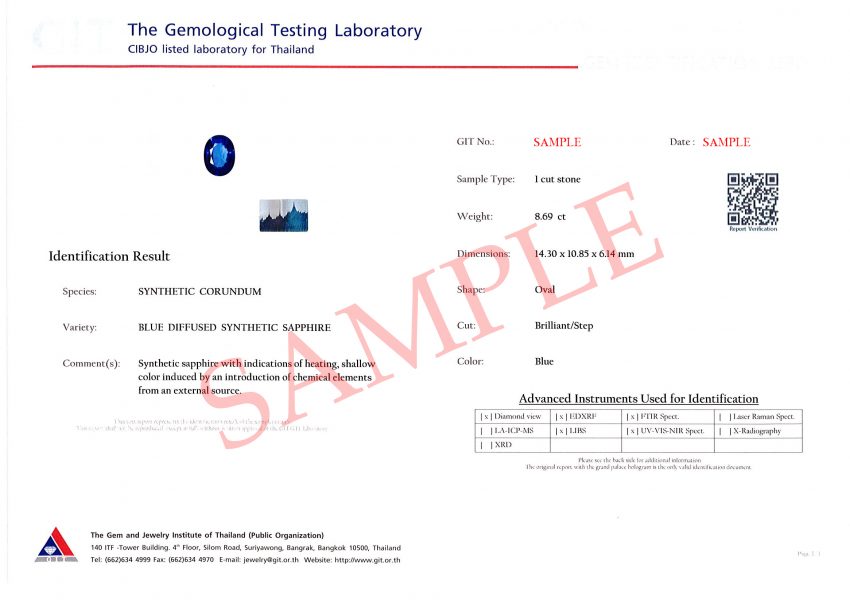
GIT witnessed the uncertainty of the market. Hereunder are our findings and remarks
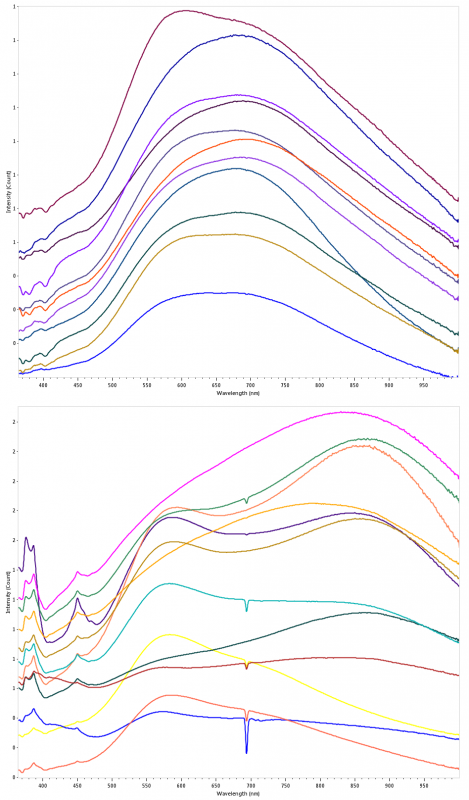
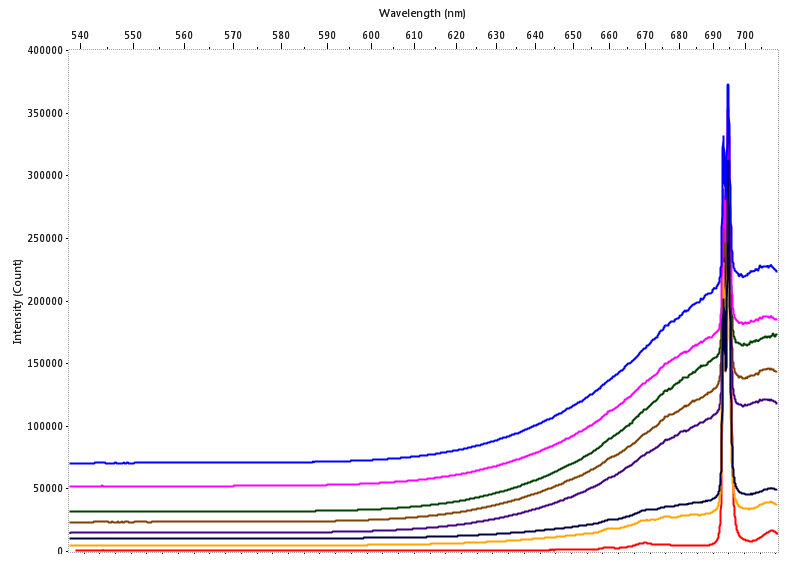
In March 2017 we have thereafter received some samples considered suspicious because of their low price and their lack of inclusions at 20x. The stones, sold as natural diffused sapphires, have been collected by a company in Bangkok and thence sent to our labs in Italy to be tested. We began our investigation by performing the specific test used when dealing with suspected surface diffused sapphires: the immersion microscope probing test. Besides the typical patterns of facet corners color concentration and different facets color saturation, we could not trace any of the usually occurring inclusions typical of the natural material. Needless to say that none of the “curved striae” commonly present in the Verneuil flame fusion synthetic could be spotted either: the surface distributed color layer obstructed any possible positive identification of the feature. We then had the UV-Vis-NIR spectroscopy test performed on all the samples (Fig. 2). All of them displayed absorption spectra overlapping the typical Verneuil flame fusion spectrum. More specifically, the test showed a complete lack of the 375 nm and the 388 nm absorption bands due to Fe3+ which are present, to a various extent, in the naturals. Photoluminescence spectroscopy (PL) revealed for both naturals and synthetics, the 693,2 nm and 694,5 nm peaks due to chromium which are associated, in synthetic samples, to a broad band between 630 nm and 710 nm (Fig. 3). Although typical of synthetic material, that feature cannot be considered diagnostic because it has been observed, rarely though, also in the natural material. FTIR spectroscopy and UV reaction have not provided more useful information.
Conclusion: immersion microscope examination, UV-Vis-NIR and PL spectroscopy techniques produced an effective identification protocol for the synthetic surface diffused blue sapphires. Verifying that a gemstone has undergone a surface diffusion treatment does not rule out that such treatment could have been applied to a synthetic corundum as well.
References
Kane E., Kammerling R.C., Koivula J.I., Shigley J.E. and Fritsch E. – THE IDENTIFICATION OF BLUE DIFFUSION-TREATED SAPPHIRES – G&G, Summer 1990, pp 115-133.
Request your copy of Rivista Italiana di Gemmologia or buy a yearly subscription
Article by Alberto Scarani and Paolo Minieri, published on Rivista Italiana di Gemmologia #1, May 2017.