This content was first published on IGR – Italian Gemological Review no. 20 in 2025. The information provided here is therefore current as of the original publication date.

The subject of this article is a tragicomedy centered on the alleged environmental devastation caused by the sapphire rush in Madagascar. It’s a four-act drama headlining the 2024/25 season at the renowned Chirp-Chirp Theatre, the cultural heart of Cricket-City, capital of Cricketland.
Will this be a tragedy disguised as farce, or a drama with a happy ending? That depends on the still-unwritten finale: what fate awaits the protagonists, supporting characters, chorus, and extras?
Translated from the language of Crickets — an ancient language of the “click” family (Khoisan, native to Southern Africa) — the script of this tragicomedy serves as a metaphor for how moral values can be manipulated to entertain and sway an audience. Between moments of levity and gravity, the narrative warns us that what appears ethically unimpeachable may, in fact, mask ulterior motives.
This story highlights the tension between documented facts (David) and the sensationalist reporting of some media outlets (Goliath) whose real goal is to win over an audience. In pursuit of this goal, they distort important issues — such as environmental protection — into misleading, sensational spectacles designed to captivate rather than inform.
«Whatever serves the Revolution is moral»
— Vladimir Ilyich Ulyanov — Lenin (1870–1924)

The Plot in Brief
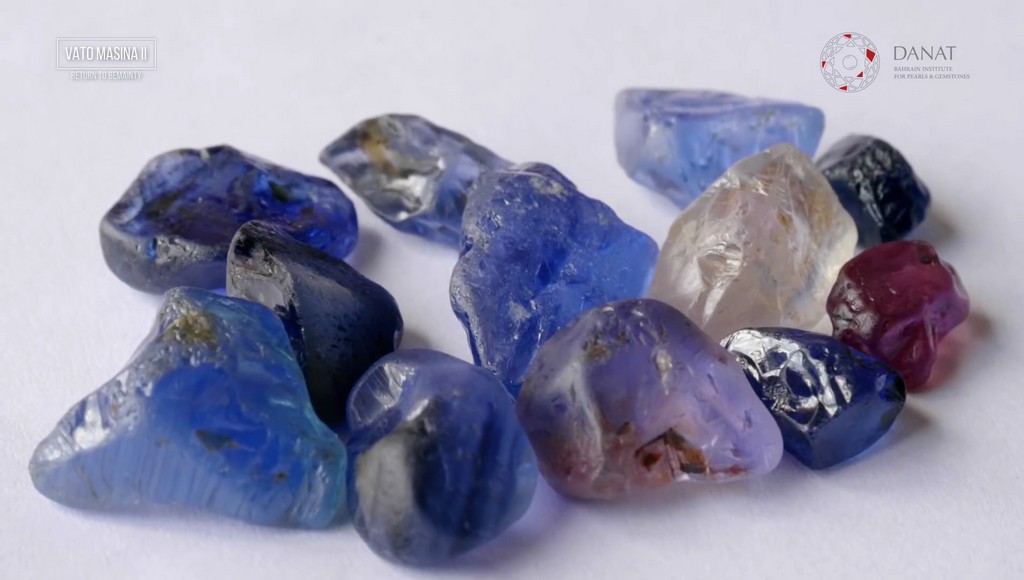
In 2016, high-quality sapphires were discovered near Bemainty, Madagascar, drawing tens of thousands artisanal miners to the area. By mid-2017, many had migrated to Ambodipaiso, where the deposits were less valuable. Renowned gemologist Vincent Pardieu(1) extensively documented both the mineralogical and social aspects of these findings. However, his reports were misinterpreted and misused by some international media outlets, which accused the miners of causing deforestation and threatening the survival of lemurs. Pardieu refuted these claims using satellite data, showing that deforestation was the result of prior agricultural activities. Despite his position, which was recently supported by a British scientific study, the media have yet to retract their unfounded defamatory campaign against artisanal sapphire mining in Madagascar, perpetuating a sensationalistic and incomplete narrative.
Characters and Cast
1) The David side or those who may appear weaker but have grounded and valid arguments to make:
- Vincent Pardieu, a renowned French gemologist and the leading global authority in “Field Gemology”.
- Alongside him, anyone who shares his views, including this magazine(2) and those who feel betrayed by media sensationalism disguised as (false) ethics. They instead hope for the establishment of true and authentic ethical principles.
- The natural Gems of the Mineral Kingdom: from Diamonds to Colored Stones which are increasingly being painted as enemies of the rest of the Creation(3), including plants, animals, and planet Earth itself. This perspective aligns with a growing eco-ideological belief rooted in what might be called the “Thunbergist” Creed. This belief system, laden with new ideologies, risks morphing into a kind of new Faith of a pseudo-religion as it intertwines with ethics and morality. From there, it’s only a short leap to revolutionary movements or quasi-religious ideologies where «everything that serves the (eco-ethical) revolution becomes moral», echoing the view of Vladimir Lenin through a “green fundamentalist” lens.
- Those poor, desperate gem searchers and miners (Malagasy, in this case) who endure such wretched living and working conditions. And certainly they do not do so for amusement. Their driving force is sheer survival, with no viable alternatives available to them.
It is unlikely, however, that these realities resonate among the glasses of caviar and champagne clinking at the parties of eco-conscious Radical Chic. These individuals “make a living” in upscale, restricted urban areas (LTZ zones), where the cost per square meter is equivalent to countless years of work for one of the aforementioned impoverished souls.
2) The Goliath side or the Dominant, Seemingly Invincible Media:
• National Geographic Magazine, a monthly magazine published by the National Geographic Society (The Walt Disney Company), founded in Washington on September 22, 1888, published in many countries around the world and translated into 31 different languages, counting the number of as many as 50 million readers per year(4). This publishing behemoth — a true Goliath — fires off an all-out investigative article by its journalist Paul Tullis in its March 6, 2019 issue. The article hurls heavy (and false) accusations at Malagasy miners and gem searchers, as well as the broader gem mining industry. For further analysis, see Act II.
• Other Goliaths, the titans of the information age, including traditional media outlets such as press, radio, and television, alongside social media platforms, digital services, and even Artificial Intelligence. These forces increasingly shape and control our lives — sometimes overtly, at other times subtly, subliminally, or even deceptively.
Need examples? Consider Associated Press, The Guardian, CNN and the BBC, to name just four. We’ll return to this topic later. For now, if you’re skeptical, try using a word or phrase on Facebook that the omnipotent algorithm deems “non-compliant”. Witness how swiftly censorship or bans are applied. Or challenge the growing restrictions enforced by the custodians of “political or sexual correctness”, the self-proclaimed “woke” arbiters, or the enforcers of the “cancel culture”. Go ahead, try it.
Journalists know all too well what it’s like to navigate this minefield. Perhaps it was simpler in a time when one’s primary fear was having to face the wrath of the original Almighty, known in Zulu as Lo Nkulunkulu Lhapa Pezulu (“The Most Ancient of All, High Above”).
• David Brindley, Managing Editor & SVP of National Geographic Media. He comes across as a modern-day Pontius Pilate(5) in a do-gooder version. No crucifixions for now — just a wait-and-see strategy made of honey and washing hands. In short, the classic “bend over, reed, till the flood flows away” attitude. He responded to Vincent Pardieu’s repeated requests to correct the blatant falsehoods in Tullis’s article by a masterclass in indecision, the classic evasion: delay, deflect, and postpone.
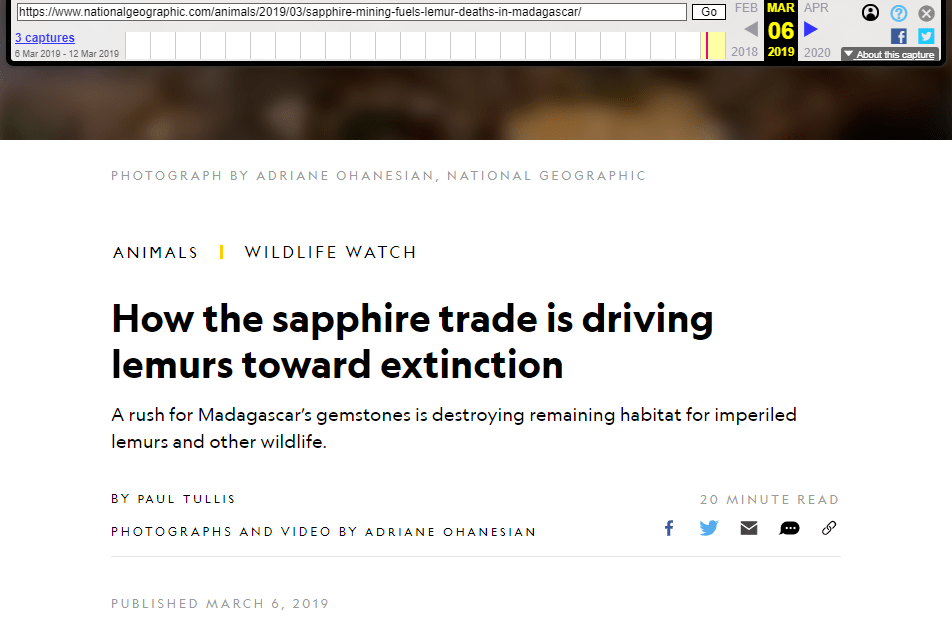
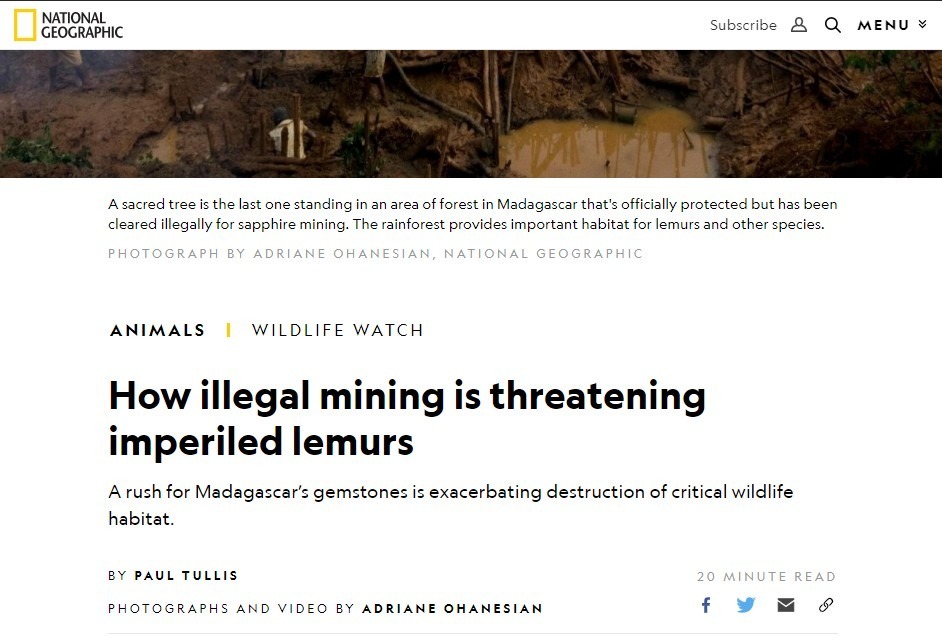
• Paul Tullis, the Caiaphas(6) of this story, is a staff writer at National Geographic. His article distorts facts, subtly demonizes sapphire mining, and genuflects to the Pontiffs and Priests of the new Faith: Fundamentalist Ethical Environmentalism. This Faith has become a refuge for those abandoning older religions, offering a substitute belief system.
Its devotees and clergy are basking in their unexpected fortune: even the Pontiff of the Holy Roman Church has blessed the ethicality of synthetic diamonds. In doing so, he has effectively given his imprimatur to this New Creed, reframing it in Neo-Testamentary terms, perhaps intending to assimilate it.
Faced with Vincent Pardieu’s refutations, which dismantle his biased and one-sided claims with irrefutable data, Tullis reacts like a modern Caiaphas: obstinate, furious, and even menacing. To borrow from the aforementioned Vladimir: «Everything useful to the (Ethical-Environmental) Revolution is inherently moral». A true champion of ethics, our Paul. For more, see Act II.
• The Synthetic Diamonds Manufacturers. Clinging onto the New Creed like mussels to a rock, the synthetic diamond producers have seized the opportunity to anoint themselves as Messiahs and Apostles of this new Religion, ready to redeem and save the entire world — why not the galaxy while they’re at it?
In the meantime, they throw mud at natural diamonds and, by extension, all other natural gemstones. Of course, all of this comes wrapped in an impeccable “Ethical Sensibility”, ça va sans dire. For a deeper dive into this topic, refer to previous issues of this magazine(7).
• The “Holy Monster” of information, the Associated Press(8), which sent one of its “missionaries”, a Carver named Edward, to investigate the alleged “destruction of thousands of acres of Malagasy forest” by the aforementioned gem hunters and miners. The result? A sensationalist report designed to make the skin crawl — and not just the skin — of followers of the Ethical-Ecological Creed, as well as anyone who cares about RESPECT for «Sora Nostra Madre Terra ke ci sustenta e ci gubierna» (“Sister Mother Earth, who sustains us and governs us”, St. Francis(9)).
This respect, however, does not mean ideological ecologism, but rational ecology, based on common sense and correct analysis of data, which are two very different concepts. Too bad that Edward Carver no way went to inspect “the thousands of acres of destroyed forest” in person, but preferred to explore those lands only in his dreams. For more details, see also Act II.
• Even the Guardian, CNN and the BBC joins in. The legendary BBC (tu quoque?/you too?) is represented by its special correspondent Angus Crawford, who, bitten by the bug of sensationalist reporting, misrepresents and plagiarizes a video by Vincent Pardieu. Crawford fires cannons at miners searching for gemstones, alleging the slaughter of Madagascar’s lemurs. This, all while barely getting off his butt from the comfort of his cushy chair in the hushed offices of London’s Broadcasting House. A quick field visit sufficed to gather a few more images to supplement the plagiarized content. See Act II for more.
Other characters and cast:
- Extras: Dr. Katie Devenish, Ph.D., a researcher at Bangor University (UK), who, like a modern-day Simon of Cyrene, stepped in to support David (Vincent Pardieu), bearing his cross on her shoulders(10). See also Act III.
- The Chorus: Popes, High Priests, Priests, Adepts, Neophytes, Messiahs, Apostles, Theologians, and Ideologists of the Eco-Ethical Creed, along with the common herd (referred to as “cricket-herd” in Cricketland) — that is, all of us (humans and crickets alike), who are fed a steady diet of everything and more, according to the famous saying: «The people must be guided, not educated» (François-Marie Arouet — Voltaire, 1694–1778). Not bad for a founding father of the Enlightenment, and a convenient dictum for the aforementioned Messiahs, Apostles, Popes, Priests, etc. See also Act II.
Act I
The curtain rises on two wide valleys:
- One, called “Tananarivo”, lies to the east of a village named Bemainty, which in turn is located north of Antananarivo, the capital of Madagascar. Here, in September 2016, stunning high-quality sapphires were discovered. In a short time, 40,000 prospectors and miners flocked to the area(11). However, by May 2017, the sapphires began to dwindle, prompting many miners to migrate to “Ambodipaiso”.
- The other, “Ambodipaiso” (also referred to as “Ambodipecho”), located west of Bemainty, had been active since 2012 and provided sapphires of lower quality, often with greenish or grayish hues.
Here comes on stage “our” Vincent Pardieu:
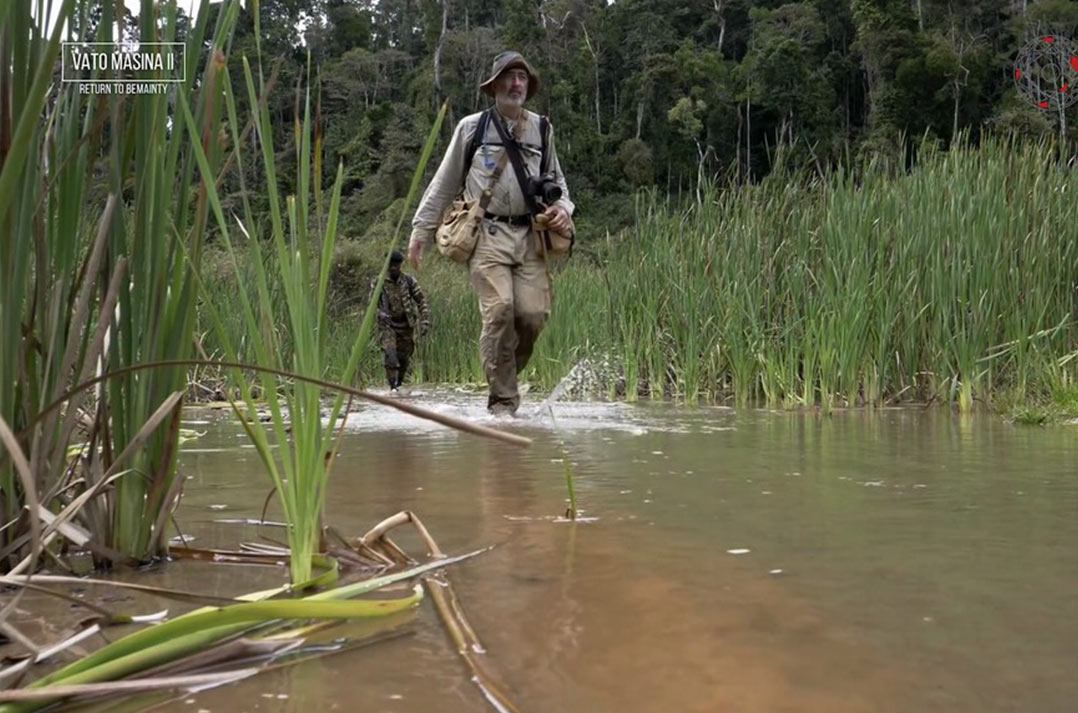
- In February 2017, Vincent makes an on-site appearance at “Ambodipaiso”(12a)(13). Part of his mission is to visit any new source of colored gemstones anywhere in the world, collecting representative samples to verify their authenticity and determine their chemical, physical, and mineralogical properties. These include identifying characteristic inclusions and spectrometric reactions, as well as insights into their geological origins.
- Equipped with electronic tools, Vincent uses Google Earth to log his exact coordinates and document the site through satellite imagery and photographs(13). These records form the basis for the findings presented in Act IV(14).
- Pardieu stands out for a rare and commendable trait: he conducts hands-on fieldwork, traveling to remote and challenging locations. He braves hardships, risks, infectious diseases, and all the unpleasant realities that come with this kind of work, unlike many who rely solely on secondhand information.
- He is committed to sharing his findings with the gemological community through industry publications, multimedia presentations, and his own video productions(12a)(12b).

Act II
«Slander, slander; something will stick»
— François-Marie Arouet — Voltaire (1694–1778), French writer and philosopher
«Repeat a lie a hundred, a thousand, a million times, and it will become the truth»
— Joseph Goebbels (1897–1945), Minister of Propaganda for the Third Reich
They stormed the stage with great fanfare, drawn like sharks to blood (in order of appearance):
- Edward Carver of the “Holy Monster” Associated Press, who, accusing this crowd of destroying thousands of acres (1 acre = 4,046.87 m2) of forest he allegedly visited (perhaps in a dream, as if he were an Old Testament prophet), pierced the hearts of millions of believers and non-believers in the Eco-Ethical Ideology/Religion. Entrusting his article to The Guardian on April 4, 2017, a «preeminent liberal voice» (highly authoritative, of course), Carver effectively stamped his claims with the seal of absolute truth(15)(16). Too bad Pardieu debunked him by revealing his own investigation’s findings! See Act IV.

- Here come the lemurs. On April 8th, 2017, few days later, CNN editor decided to illustrate a well-balanced article by their journalist Kieron Monks with a photo of a lemur and modified Kieron Monks original title into «New sapphire rush in Madagascar may threaten rare species»(17).
- Angus Crawford of the “Legendary” BBC who, on July 24, 2017, aired his plagiarized and deceptive film-report on the horrendous extermination of Madagascar’s lemurs, cannibalized by a frenzied mob of miners(18). How can one remain indifferent to such havoc? Madagascar is home to as many as 113 species of lemurs and, with the Comoro Islands, is the only place in the world where this species is present. Ditto for 300 species of reptiles, 300 of amphibians and 62 of chameleons. And thankfully, the searchers/miners don’t munch on those too, I say…
- Paul Tullis of the “Monstrous Giant” National Geographic, a modern-day Don Quixote of La Mancha, charged forth on March 6, 2019, like a madman, lance in hand, against the colored gems mining world, portrayed as if it was one of the Horsemen of the (ecological) Apocalypse. Blowing the trumpets of the Last Judgement with his piece, «How the sapphire trade is driving lemurs toward extinction. A rush for Madagascar’s gemstones is destroying remaining habitat for imperiled lemurs and other wildlife»(19), Tullis delivers a detailed eco-socio-economic analysis of Madagascar. His narrative ties mining-induced environmental devastation to far-reaching consequences that extend well beyond the survival of Malagasy lemurs, conjuring the specter of that Island’s human survival as well.
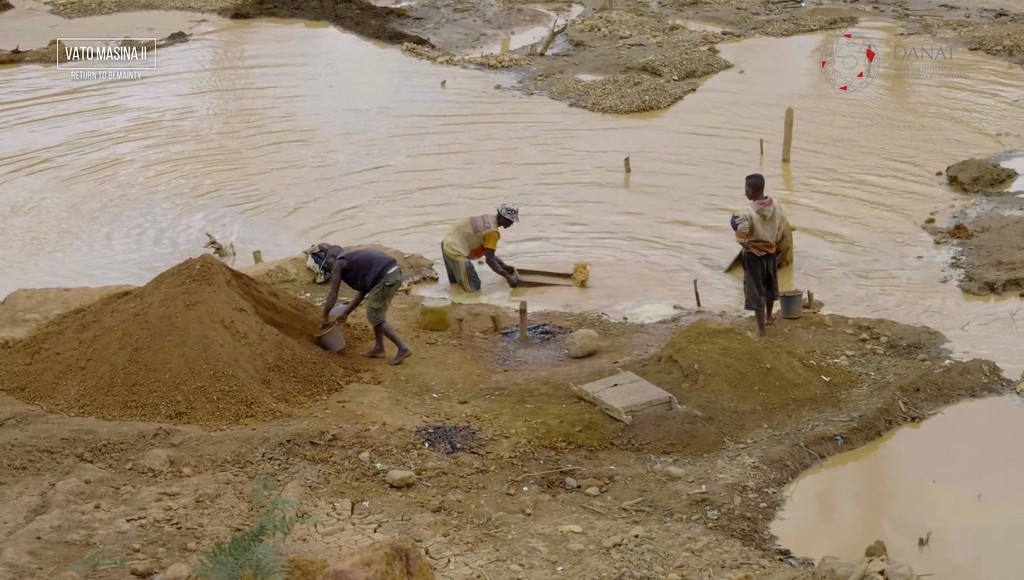
But what if the rainforest devastation attributed to miners never actually occurred? What if the poor lemurs were still there, merrily leaping from branch to branch? And who dares to contradict such a narrative? How dares that rustic Vincent Pardieu? Oh, but he dares — indeed, he dares. See Act IV.
From the Chorus rise wailing laments, sobs of horror and dread, and piercing cries, as though they were the mourners of a Greek tragedy — Aeschylus, Sophocles, perhaps? Even from the balconies, the stalls, and the gallery, the credulous masses bellow ominously, foreseeing the fin du monde! (Steady now, for according to astrophysicists, the end is at least 4 to 4.5 billion years away, depending on what our beloved Sun decides to do).
Yes, he truly dares — and his boldness paid off. He successfully persuaded National Geographic to revise the original title of their March 2019 article, which initially read «How the sapphire trade is driving lemurs toward extinction. A rush for Madagascar’s gemstones is destroying remaining habitat for imperiled lemurs and other wildlife»(19), into something softer in June 2019, «How illegal mining is threatening imperiled lemurs. A rush for Madagascar’s gemstones is exacerbating destruction of critical wildlife habitat»(20).
Act III
«Education is a weapon, the effect of which depends on who holds it and to whom it is aimed»
— Joseph Vissarionovich Dzhugashvili — Stalin (1878–1953)
From behind the curtain, now appearing on stage are the Extras: Dr. Katie Devenish and her team of researchers from Bangor University, UK.
They, very well versed and experienced in field research on deforestation issues around the world, published — in late 2024 — a well-documented and articulate study entitled: «No evidence of increased forest loss from a mining rush in Madagascar’s eastern rainforest»(21). Get it? No evidence. And so also for lemurs: no extermination or threatened extermination.
Act IV
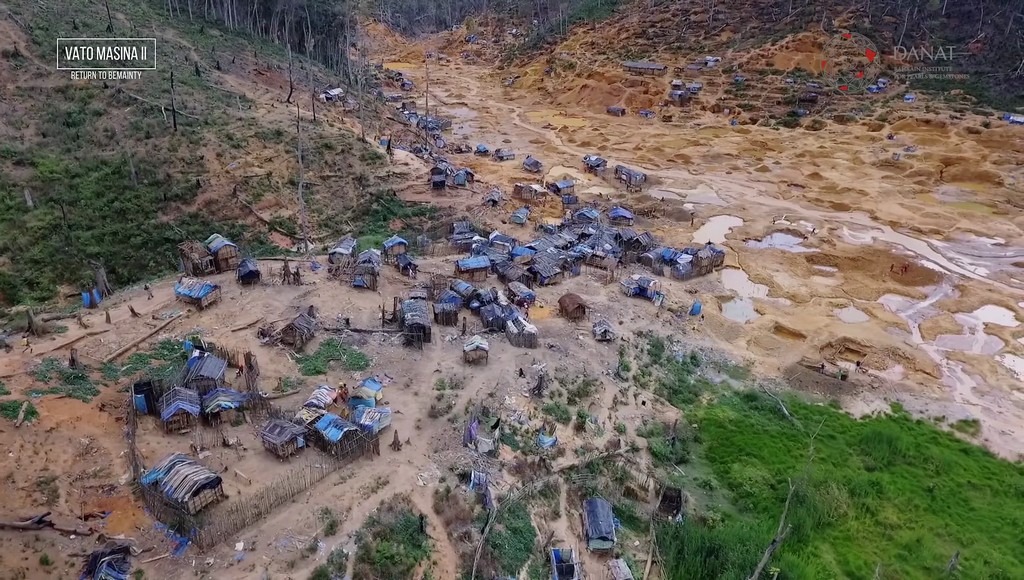
The ever-diligent Vincent, now back in the spotlight, strikes back. He presents his photographic documentation, video footage, and satellite observations from Google Earth taken in 2017. When these are compared to Google Earth images from 2005 of the same area, combined with findings by Dr. Katie Devenish, they lead to the following incontrovertible conclusions:
1) Mining activities have only impacted areas adjacent to a small stream (secondary deposit zones), where the absence of trees is evident, including the temporary settlements of miners. Beyond this, the surrounding forest remains intact, with lemurs alive, well, and both visible and audible to anyone who has visited the area — Vincent Pardieu himself, foremost among them.
2) Comparing the 2005 Google Earth satellite images of the same location (a full seven years before the sapphire discovery) with those of 2017 shows the area remained unchanged. However, there were no signs of mining or shacks back in 2005.
3) Consequently:
- The deforestation was not caused by miners but by others, prior to 2005. Likely culprits include slash-and-burn farmers, timber merchants, and charcoal producers.
- The deforested area is far from the «thousands of acres» alleged by Associated Press, being instead a confined and limited section near the small stream.
- There has been no mass slaughter of lemurs or any other significant animal deaths.
4) Thus, the claims made by Paul Tullis in his March 6, 2019, article for National Geographic are a complete fabrication, defying the very principles of Ethical Ecologism. The same applies to the aforementioned Edward Carver and Angus Crawford.
These findings are supported by a detailed report dated March 22, 2019, titled: «Is the sapphire trade really driving lemurs towards extinction as journalist Paul Tullis claims on National Geographic? A response by Vincent Pardieu»(14).

Finale
The diligent Vincent Pardieu, who has also seen his footage and reports plagiarized, not to mention statements falsely attributed to him, might reasonably expect — at the very least — that his response be published, in the name of truth and basic honesty. But I suppose the prevailing rule here is the old adage: «I’m me, and you’re nothing». Isn’t that right, dear Goliaths?
So, while waiting for this tangled mess to unravel, let me pose a couple of questions:
- Isn’t it, perhaps, the case that what truly harms lemurs in Madagascar is deforestation caused by actors far removed from gem miners? And isn’t the destruction of forests there largely a consequence of the widespread poverty afflicting that Country? Might the solutions to these issues lie elsewhere than in so-called Eco-Ethics? This has nothing to do with miners…
- Isn’t it, dear Goliaths, that words like RESPECT and RECTITUDE — and their synonyms — are glaringly absent from your internal lexicon? Anything but Eco-Ethics!
With somber regards from your increasingly disheartened,
Bad-Mouthed Jiminy Cricket
Notes
(1) Vincent Pardieu has worked for AIGS and Gübelin, gaining international recognition for his work at GIA, where he established the Field Gemology Department at their Bangkok headquarters. He was also affiliated with DANAT — the gemological laboratory based in Bahrain, Greenland Ruby, DAI (for a lab project in Afghanistan). Today, he offers services through his company “VP Consulting WLL” for labs like the LFG — Laboratoire Français de Gemmologie among other customers.
(2) For further context, see the editorial by Paolo Minieri, «For sensationalistic ecological parades, gems are an easy target» on page 3 of issue no. 7/2019 of IGR — Rivista Italiana di Gemmologia — Italian Gemological Review, and the article «The version of Field Gemologist Vincent Pardieu» by Simon Dussart on pages 56–62 of the same issue.
(3) Additionally, refer to:
- a) The article «Counter-Gemology – The strange cases of Pope’s “Blessed Diamond” and “The non-ordinary” one», issue no. 14/2022 of IGR — Rivista Italiana di Gemmologia — Italian Gemological Review.
- b) The article «Counter-Gemology – Cheats, Impostures, Deceptions, Mystifications, Frauds», issue no. 16/2023 of IGR — Rivista Italiana di Gemmologia — Italian Gemological Review.
- c) The article «Counter-Gemology –“Nothing Lasts Forever” is a Documentary Film about Diamonds Crafted with a Hefty Dose of American-style Dezinformatsiya, Served with a Berlin Twist», issue no. 17/2023 of IGR — Rivista Italiana di Gemmologia — Italian Gemological Review.
(4) Wikipedia entry on National Geographic: https://en.wikipedia.org/wiki/National_Geographic
(5) Pontius Pilate: Governor of Judea under the Roman Emperor Tiberius, before whom Jesus Christ was brought for validation of the death sentence imposed by the Sanhedrin.
(6) Caiaphas: Jewish high priest and head of the Sanhedrin, who had Jesus Christ arrested and demanded his crucifixion.
(7) See Note (3), Point a., above.
(8) Associated Press: An international news agency headquartered in the United States, founded in New York in 1846 and regarded as one of the world’s most authoritative news organizations.
(9) “The Canticle of the Creatures” — St. Francis of Assisi.
(10) Simon of Cyrene, who helped Jesus Christ carry the cross on the way to Golgotha for the crucifixion.
(11) In Nov 3rd, 2016, Rosey Perkins first visited the area with Pardieu’s support. She published the following:
- «Sapphire Rush in the Jungle. East of Ambatondrazaka, Madagascar. An expedition report by Rosey Perkins. October 21st – 26th 2016».
- «Thoughts on a Visit to the Sapphire Rush in Madagascar’s Rainforest. October 2016», Rosey Perkins.
In Nov 22nd, 2016, Julia P. G. Jones (not visited the area) published the following after discussing with Rosey:
- «A ‘sapphire rush’ has sent at least 45,000 miners into Madagascar’s protected rainforests», Julia P. G. Jones.
(12a) «Sapphires from the gem rush Bemainty area, Ambatondrazaka (Madagascar)», Vincent Pardieu, Wim Vertriest, Vararut Weeramonkhonlert, Victoria Raynaud, Ungkhana Atikarnsakul and Rosey Perkins, GIA Laboratory, Bangkok, February 1st, 2017.
(12b) «Bemainty Sapphire Deposit in Madagascar Faces Multiple Challenges», Vincent Pardieu, published on InColor no. 35, Spring 2017.
(13) «“Vato Masina I”: Sapphires rush near Bemainty, Madagascar (first part)», video published on the YouTube Channel “Field Gemology by Vincent Pardieu”.
(14) “Answer to P. Tullis – Vincent Pardieu”. «A response by Vincent Pardieu – Is the sapphire trade really driving lemurs towards extinction as journalist Paul Tullis claims on National Geographic?», March 21–25, 2019.
(15) «Madagascar forest overwhelmed by thousands seeking sapphires», Edward Carver, April 2, 2017.
(16) «’Sapphire rush’ threatens rainforests of Madagascar», Associated Press in Antananarivo, April 2, 2017.
(17) «New sapphire rush in Madagascar may threaten rare species», Kieron Monks, April 6, 2017.
(18) «Madagascar’s illegal sapphire mines», video published on the YouTube Channel “BBC News Africa”.
(19) «How the sapphire trade is driving lemurs toward extinction. A rush for Madagascar’s gemstones is destroying remaining habitat for imperiled lemurs and other wildlife», Paul Tullis, March 6, 2019.
(20) «How illegal mining is threatening imperiled lemurs. A rush for Madagascar’s gemstones is exacerbating destruction of critical wildlife habitat», Paul Tullis, March 6, 2019.
(21) The study is available at: https://research.bangor.ac.uk/portal/files/70895351/2024_Devenish_K_PhD.pdf
Counter-Current Gemology from the “Bad-Mouthed Jiminy Cricket” Luigi Costantini, published on IGR – Italian Gemological Review #20, Winter 2024/25