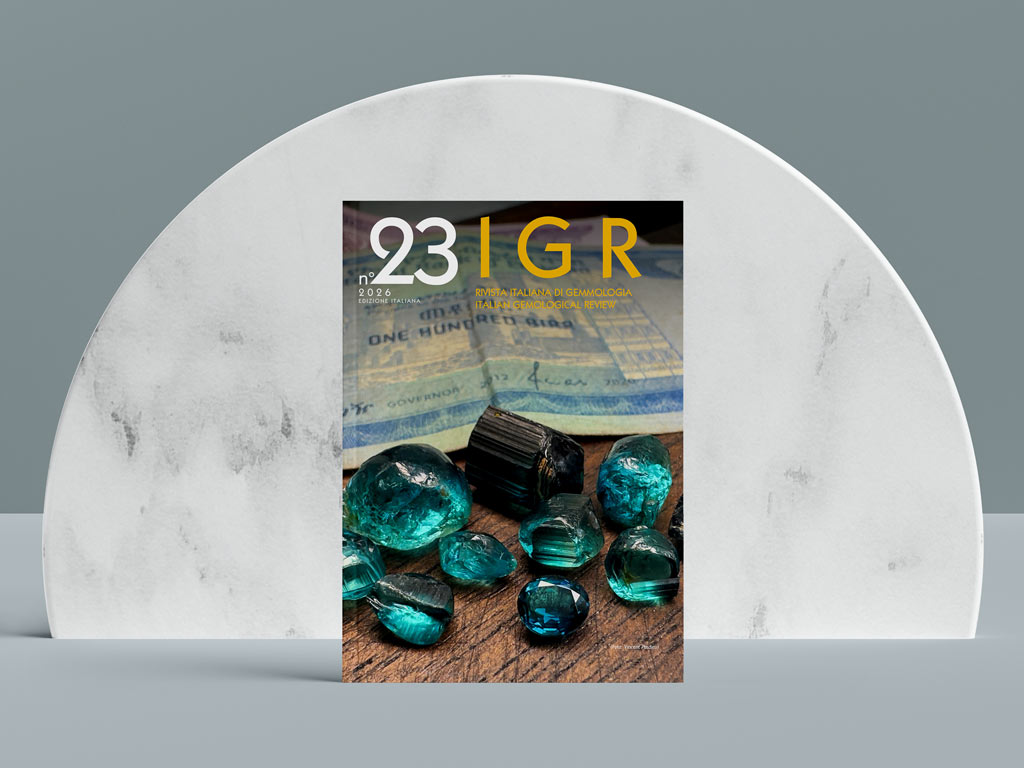
This content was first published on IGR – Italian Gemological Review no. 21 in 2025. The information provided here is therefore current as of the original publication date.

The 7th National Conference of Gemmology, “Diamond and Colored Stones”, held in Naples on June 16–17, 2025, marked an important milestone in gemmological communication. For the first time in Italy, photography took centre stage as one of the main themes of the event.
At the heart of this innovation was a section entirely devoted to imagery, curated by Liviano Soprani, one of the foremost experts in the field. He coordinated the photomicrography exhibition “Fragments of Wonder” and delivered a technical presentation on photographic methods applied to gemstones.
The highlight of the initiative was the 1st edition of the photo contest “The Soul of Precious Stones: From Earth to Light”, promoted by IGR – Italian Gemological Review. The competition invited photographers, gemmologists, and enthusiasts to tell the story of gemstones through images — tracing their journey from the earth where they are found, through cutting and craftsmanship, to the hidden microcosms within their internal structures.
The contest attracted 45 entries from 15 international participants, showcasing a wide range of creative approaches — from scientific photography to artistic interpretation, as well as editorial and promotional imagery. What united them all was a shared goal: to reveal gemstones in their full aesthetic and geological complexity, expressing their origins, transformations, and inherent beauty.
A jury composed of members of the organizing and scientific committees evaluated the works through an anonymous voting system. Four photographs emerged at the top of the ranking: first place went to Francesco Protopapas; second place to Muhammad Ayub; and third place, shared between Giovanni Pace and another image by Muhammad Ayub.
The editorial board of IGR also selected one image for a Special Mention of Honor and for the cover of this issue. The honor was awarded to Francesco Protopapas for his remarkable photomicrograph of a sapphire that evokes an imaginary underwater world, transforming the gem into a visual story of rare evocative power.

| Francesco Protopapas
Winner of the 1st Edition of “The Soul of Precious Stones: From Earth to Light” “The ocean sunfish” – Crystal in sapphire. |
In the following pages, readers can admire the award-winning photographs, along with the most popular image voted by the contest participants.
Photomicrography: A Tool for Discovery and Communication
The 45 images submitted to the contest stand out for their exceptional quality, with a particular peak of excellence in photomicrography — a discipline that replaces the traditional camera lens with a microscope to reveal details invisible to the naked eye, yet essential for gemmological analysis.
Together, these works achieve a mature balance of technical precision and aesthetic awareness. Light becomes a language, exposure a form of measurement, and carefully calibrated color transforms inclusions into scenes that not only fascinate but also educate the viewer’s eye.
Many of the photographers showed impressive skill in controlling light sources, selecting angles of incidence, and balancing contrast and saturation. Their images capture internal landscapes rich in structural beauty — micro-worlds of tension, broken symmetries, growth planes, and crystalline forms that serve as both mineralogical clues and fully realized visual compositions.
What emerges is a collective vision that reflects deep understanding — not only of optical instruments, but also of the physical limits of materials and the creative possibilities offered by advanced lighting techniques.
The jury’s decisions combined both artistic sensitivity and scientific judgment, recognizing images that were not only visually striking but also informative about the origin and nature of gemstones. This dual focus reflects the very essence of gemmological photomicrography: both a tool for investigation and a means of communication that transforms crystallographic complexity into an aesthetic experience accessible to all.The winning photograph is a textbook example of pareidolia — an inclusion whose form and tonal balance suggest the silhouette of a majestic Mola mola (ocean sunfish). By illuminating the gem from below, Francesco Protopapas created a natural emphasis on the subject’s “belly,” echoing the characteristic difference in brightness between the underside and upper body, and reinforcing the morphological illusion. The resulting sense of volume, achieved through delicate control of micro-contrast and internal reflections, demonstrates a sophisticated grasp of optical behavior under the microscope and a fine command of tonal transitions.

| Muhammad Ayub
Second place at the 1st Edition of “The Soul of Precious Stones: From Earth to Light” A columbite crystal penetrating through a fluorite crystal inside a topaz host from Nigeria. |
The second-place image features a sharply defined octahedral fluorite crystal containing an acicular columbite inclusion within Nigerian topaz — a technically demanding composition executed by Muhammad Ayub with impressive precision. Despite the topaz’s strong birefringence, which can cause doubling and loss of clarity along crystal edges, the octahedron appears clean and crisp — the result of meticulous optical setup, focus calibration, and careful control of polarization and observation angle.

| Giovanni Pace
Third place ex aequo at the 1st Edition of “The Soul of Precious Stones: From Earth to Light” Surface of a rough diamond captured under UV light at 365 nm combined with polarized light. This play of color results from alternating light position. Photograph obtained by stacking 12 images at 60x magnification. |
The joint third-place photographs offer two very different yet equally effective perspectives. In Giovanni Pace’s image, the surface of a rough diamond reveals octahedral forms and growth patterns enhanced by a nuanced combination of multiple light sources, including ultraviolet. The resulting chromatic interplay recalls the Rheinberg illumination technique, reinterpreted here in a modern way suited to the diamond’s high reflectivity. Muhammad Ayub’s second awarded image, featuring a spinel within spinel, shows how an apparently simple subject can become extraordinary when centering, depth of field, and lighting come together in harmony. The included crystal glows with vivid red tones, surrounded by a delicate iridescent halo that adds a subtle optical counterpoint to the composition.

| Muhammad Ayub
Third place ex aequo at the 1st Edition of “The Soul of Precious Stones: From Earth to Light” A spinel crystal with halo in spinel host from Myanmar. |
It is only right to acknowledge the many other participants who, though not among the winners, demonstrated talent, perseverance, and deep familiarity with the limits and potential of their equipment. The diversity of approaches — from transmitted to oblique lighting, controlled reflection to mixed setups — reveals a vibrant and engaged community eager to learn, experiment, and share techniques for the benefit of all.
Looking ahead, we hope this community of passionate photomicrographers will continue to grow and collaborate — and one day contribute to the creation of open-access image databases recognized internationally. Such a shared visual heritage would serve not only professional gemmologists but also researchers and enthusiasts worldwide, advancing knowledge, inspiration, and the art and science of gemstones.


Article by Liviano Soprani, published on IGR – Italian Gemological Review #21 – Autumn 2025.