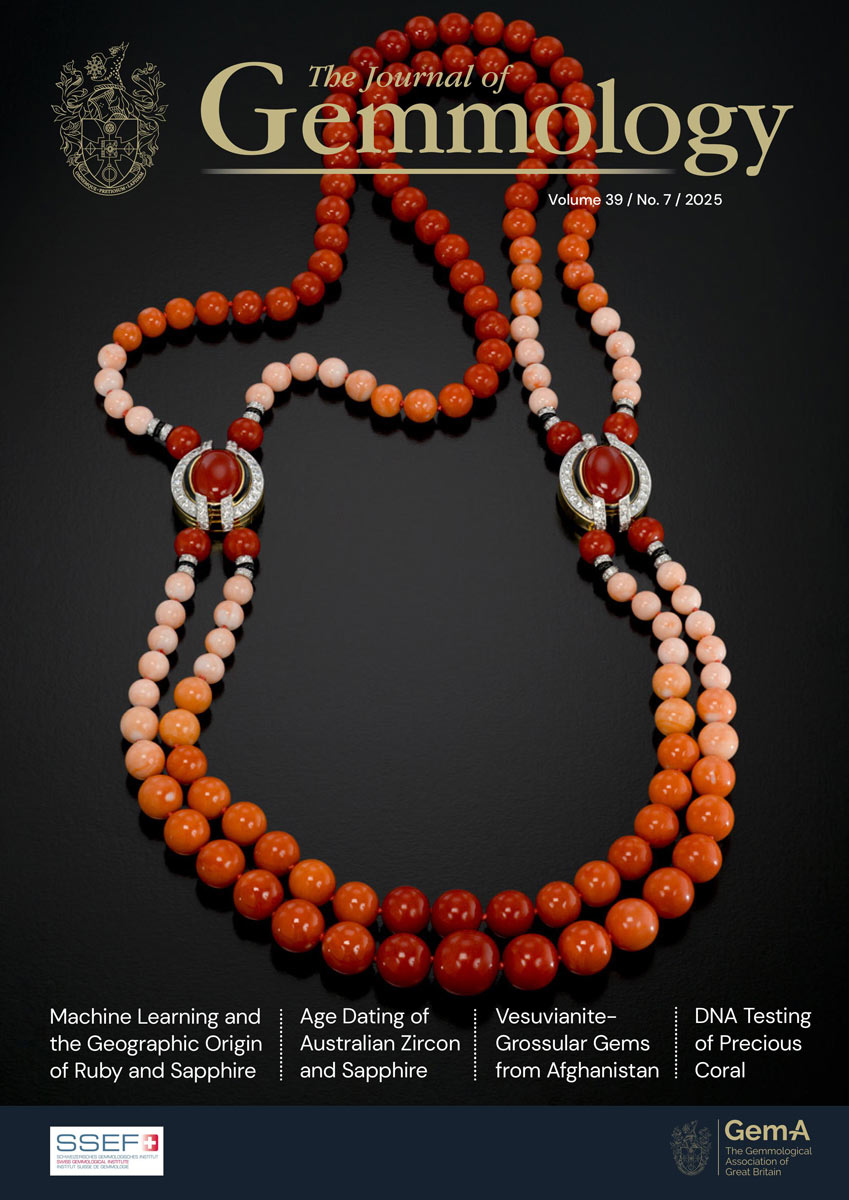
The new edition of The Journal of Gemmology (Vol. 39, No. 7, 2025), published by Gem-A in collaboration with SSEF, features articles that explore the application of innovative technologies and in-depth geological investigations. The four main articles range from the use of machine learning to determine the geographic origin of rubies and sapphires, to geochronological dating of zircons and Australian sapphires to reveal their geological history, to the characterization of a new gem material from Afghanistan, and the use of DNA testing for the identification of precious coral species.
The article “Machine-learning Applications in Gemmology: Classifying the Geographic Origin of Ruby and Sapphire Using Chemical Data”, by Montira Seneewong-Na-Ayutthaya, Tasnara Sripoonjan, Bhuwadol Wanthanachaisaeng, Thanong Leelawatanasuk, Thanapong Lhuaamporn and Waratchanok Suwanmanee, tackles the challenge of determining the geographic origin of rubies and sapphires, a process traditionally based on the gemologist’s expertise but often subjective. To improve objectivity and accuracy, the researchers applied machine-learning (ML) algorithms to trace-element geochemical data obtained using two analytical techniques: EDXRF and LA-ICP-MS.
The results showed conclusively that LA-ICP-MS data, thanks to its greater sensitivity and ability to detect a wide range of elements at very low concentrations, significantly outperforms EDXRF. Among the four ML models tested (ANN, KNN, RF, and SVM), Random Forests (RF) and Artificial Neural Networks (ANN) achieved the highest accuracy, exceeding 90% for both rubies and sapphires when trained on LA-ICP-MS data. The study also highlighted that metamorphic sapphires remain the most difficult to classify due to the overlap of their chemical signatures.
Ahmadjan Abduriyim, Frederick “Lin” Sutherland, Terry Coldham, and Elena Belousova investigate the geological origin of sapphires from the alluvial deposits of the New England gem fields in Australia through U-Pb dating of zircons in “Age Dating of Gem-quality Zircon and Sapphire from the New England Gem Fields, New South Wales, Australia, and its Application to the Geological Origin of the Sapphires”. Analysis of zircon megacrysts identified two major formation events: an older one in the Late Triassic–Early Jurassic (216–174 million years ago), and a younger one in the Eocene (45–37.7 million years ago). The focus of the research was the dating of zircon inclusions within two sapphires — one from Kings Plains and the other from Mary Anne Gully. These analyses yielded concordant average ages of 37 ± 1.7 Ma and 35.1 ± 1.6 Ma. Combined with the gemological characteristics and chemical fingerprints of the sapphires (typical of a magmatic origin), these data provide a direct and unequivocal genetic link between the crystallization of corundum at depth (lower crust or mantle) and its subsequent transport to the surface by alkaline basaltic magma during the Eocene.
“Massive Cryptocrystalline Vesuvianite-Grossular from Eastern Afghanistan: Gemmological and Geological Considerations”, by Lola Jougla, Féodor Blumentritt, and Franck Notari, characterizes a gem material from a deposit in eastern Afghanistan, revealing it to be vesuvianite intergrown with grossular. Standard gemological properties, such as refractive index (average 1.708) and specific gravity (average 3.37), are insufficient to distinguish the two minerals, as their values overlap. The study, however, demonstrates the effectiveness of long-wave UV luminescence (365 nm) as a rapid and reliable separation method: vesuvianite-dominant material shows a weak whitish-blue luminescence, while grossular-dominant material displays a strong pink luminescence. Analyses also identified several associated minerals, including amorphous carbon, millerite (NiS), covellite (CuS), and amesite. Spectroscopic studies (FTIR and Raman) revealed the presence of bands associated with hydroxyl (OH⁻) groups, indicating a low-temperature geological formation.
Finally, Bertalan Lendvay, Laurent E. Cartier, Akitsugu Sato, Michael S. Krzemnicki, and Nadja V. Morf, in “Species Identification of Coral Jewellery by Genetic Testing: Case Studies, Experiences and Prospects”, review the use of DNA testing for precise identification of precious coral species, a crucial need given that some species are listed under CITES (the Convention on International Trade in Endangered Species of Wild Fauna and Flora). The method developed is minimally destructive, requiring less than 10 mg of coral powder, typically taken from pre-existing drill holes. Several case studies illustrate the limitations of traditional gemological methods and the superiority of genetic testing. Significant results include:
- Correction of misidentifications based on visual appearance: a necklace thought to be Corallium rubrum was found to be Corallium japonicum.
- Identification of a mixed bead lot containing both CITES-listed species (Pleurocorallium elatius) and non-CITES species (Corallium rubrum).
- Discovery, in an “angel skin” coral necklace, of a species new to the gem trade, belonging to the Pleurocorallium norfolkicum species complex and probably originating from the Vietnam region.