




This content was first published on IGR – Italian Gemological Review no. 1 in 2017. The information provided here is therefore current as of the original publication date.

Gübelin Proof of Provenance, new IDs for gems? Gübelin has recently presented a system called Proof of Provenance based on new filling materials able to contain data and supply a differentiated and sure identity to rough and cut emeralds. This was made possible thanks to a research program started to support such traceability procedures that are now deemed as ineludible in the establishment of the Custody Chain, the method devised to trace back and validate the regulated passages of the gem supply chains, going back to the extraction areas. The identified technique exploits the thinnest emerging cleavages to permanently deposit inside the coloured gems substances suitable to “stamp” products ensuring their recognizability. We obtain a virtual identity card (univocal, like a fiscal ID) for the gemmological materials to be traced. This function must be carried out with systems that do not prove to be invasive or that, during classification, alter the native features of gems.

The complex and innovative work of Gübelin is a milestone also because it can be considered a reference point, in gemmology, in the research for a data physical indicator. In order to obtain the recognizability, laser inscriptions on belt are already available, but the diamond industry shows that this method is mainly used for a commercial scope, being too expensive and, therefore, technically not applicable to small size batches. Therefore, the new availability of this technique based on nanoparticles is as much a point of arrival as a starting one. Now that we have it, what shall we do? In order to answer this question, we need to contextualize the Proof of Provenance within the framework of the studies concerning the sustainable and responsible management of precious rough materials. In fact, it seems that the true issue will no longer focus on how to devise traceability by physically marking materials. It is a question of finding answers on how to manage, under a CSR perspective, the interesting and original application possibilities that open, once a name and a surname can be given to both rough and cut materials. As a matter of fact, the presentation by Gübelin on its site, illustrates in full the strictly technological features of nanoparticles, though referring to a Code of Conduct that has not been made public yet. The hand is passed over to those, relying on other competences, will be able to treasure the offered potentials to build the traced paths. Therefore, the prestigious Swiss Institute addresses to those subjects that will benefit from this new tracing instrument, that is the companies and communities in the varied extraction world, trade associations and, ultimately, to all those parties that could be interested in associating gemstones with a folder of additional information on origin and route. Thus, it rests with the CSR analysts to surpass this limit that was once precluded and prepare to assess conditions, methods, contexts of all possible applications, treasuring the current conditions as well as the previous experiences in the knotty territory of ethical legitimation.

Information about the Corporate Social Responsibility gemmologists should be aware of CSR (Corporate Social Responsibility, in Italian RSI) is, according to the European Union (just to choose a definition among the manifold), the voluntary integration of social and environmental concerns of companies in their business operations and relationships with the involved parties. Practically, it is an extremely wide and heterogeneous field to which the experts of business economy have been giving an enormous strategic value for decades, as the company performance is and will always be influenced by the satisfaction of the involved parties (employees, suppliers of rough materials and services, consumers and many others). Generally speaking, CSR identifies new and decisive groups, stakeholders (involved parties) where in the past shareholders were the only authorities to report to. As a consequence, under a CSR perspective, a new urgency required by the whole society adds to the traditional demand by the market of mere goods and services: the request to companies of ethical credentials (environmental sustainability, the protection of communities and of workers’ rights, emancipation from abuses and by implications or financing of conflicts, etc.). Though big international organizations urged through guidelines the circulation of articulate conduct practices in the CSR domain, the protagonists of the entrepreneurial scenario concretely adopt specific intervention only on a voluntary basis. Ensuring rights, in London or New York, to employers working below the Management can be as easy as asking them to dispose of the printer cartridges in an eco friendly way or publish some pages on the philanthropic activities of the group. What is difficult is to ensure the process that conveys, in different stages, the various passages of the rough materials extracted in remote lands or transformed in sheds located in inaccessible suburbs of far off continents. A jewel is in no way different from a cup of tea: we will be asked by a consumer if we had whipped slaves or paid salaries to obtain the stones and leaves we needed. A 2012 UNCTAD report can represent an efficient synthesis to assess the company conduct as a whole, in particular as far as the supply chain is concerned. Interesting conclusions can be drawn from such document: CSR is not yet considered by small and medium companies as they can not rely on the adequate means to address it; CSR, mainly adopted by big companies, is focused on codes of conduct each enterprise draws for its use and, therefore, they are not standardised; the audit carried out by independent third parties is the only instrument to ensure that the conduct of the farthest suppliers complies with ethical standards.

After the dive into the Ethical Sea, emeralds and cocoa are not so different All the companies in the world generating tangible revenues with the safe logistics of well-protected ports, must get used to making intangible revenues sailing on the still unexplored oceans of social responsibility, often considered more a passive compliance rather than an opportunity. All in all, in many cases it is civil society that wins the reluctance of players. The public opinion launches the alarms determining and updating the agenda of the ethical compliances required to the companies addressing to wide consumption that, in their turn, will expect from their own Supply Chain. The luxury operators still unaware of the impact of public opinion on their products should study again such phenomena as the decline of furs under the blows of animalist organizations or the parallel (that risked to prove fatal) of diamonds with armed conflicts. This is why it wouldn’t be advisable to postpone an evaluation of the new ethical management deriving by the methods of use of these gem tracing systems. How will Gübelin nanoparticles be used?

In order to try to find an answer let us relate gems with other goods. To some extent, the activation procedures of the Custody Chain will have a general applicability. For example, coffee, cocoa, cotton and sugar have long supply chains and passages among operators similar to those relating to gems and a critical side in common: their raw material is scattered in many places located in various continents and is obtained with the aid of small or very small companies. Ethical authentication is of an exclusive interest of companies that are closer to the release of goods towards consumption, that is those having bigger sizes and being more structured, the ones on top of the supply chain. The small manufacturers of coffee, to make an example, can adhere to responsible Codes of Conduct only for the drive coming from big multinational groups. So far, companies purchasing coffee, cocoa and emeralds have adopted the same standard of conduct towards their Supply Chains using an instrument called MSI (Multi-Stakeholder Initiatives). Groups consisting in enterprises, unions and NGOs agree on a Code of Conduct, often not shared and not even applied across the industry. The Code implies a monitoring and certification program showing that rough materials (or the first manufacturing phases) are obtained meeting the set standards concerning environmental sustainability and work protection. This context virtually obliges small companies to give their product to intermediaries able to meet this ethical compliance required to the big ones. When they fail to do it, they must commit to solve their shortfalls through CAPs (Corrective Action Plans). Therefore, ASMs, the small mining companies accounting for 80% of the production of gemstone rough, can not rely alone on such refined means to participate to the process aiming at the building of ethical value, if not in a subordinate position.

Ensuring the supply chain? It is not for miners-artisans to do ASMs, practically the groups of diggers settling in promising extractive areas of miners or villages near usable rough (often alluvial deposits more easily exploitable without big means) are therefore mainly excluded and today a remarkable quantity of stones eludes the ethical screening, even if they may have satisfactory requirements. These materials are currently being put on the market without credentials and will find themselves in a position of weak competitiveness when the stones that do not possess the requirements will visibly activate their ethical value thanks to the possibility of documentation offered by the system implemented by Gübelin. After all, we can treasure the previous teachings we learnt from diamonds, a sector that can be considered as a pioneer in CSR “precious applications”. Here the huge performance gap concerning the ethical compliance between very big and medium or small companies is evident. They have tried to remedy by establishing, in 2005, the DDI (Diamond Development Initiative), a body promoted by the United Nations together with international governments and agencies, NGOs and trade associations. In fact, the new Kimberley scenario, the legitimation scheme of rough diamonds not involved in conflicts started in 2002, if on the one hand provided the ethical licence needed to dissipate the clouds of suspect of civil society, has, on the other, made some complex legal and administrative procedures compulsory, protecting at best only the players of industrial extractions. Whole diamond realities as Sierra Leone, Liberia, RDC, Central African Republic have long been cut off from the Responsibility paths. Facts show that, as for colour stones, we ran the risk to be confronted with an exclusion mechanism.
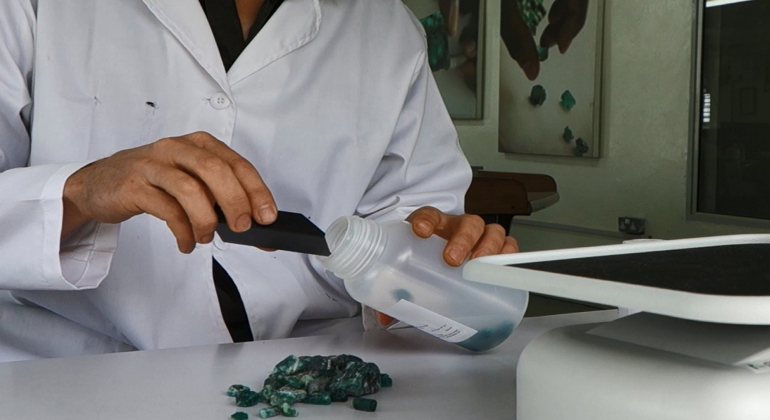
The use code of nanoparticles for the identification will not replace the Codes of Conduct of companies towards their stakeholders Now let us try to reconstruct the specific reflections on the supply chain of colour stones. Rough diamonds in the Kimberley scheme are identified as per batches through expensive administrative procedures implying more passages testified by third parties. This mechanism has already been borrowed by the few extracting companies of emeralds and rubies of such big sizes as to be able to afford the true Ethical engine, the Code of Conduct. This can already work even without injecting identification nanoparticles into the raw gemmological materials. On the contrary, obtaining the data needed to the identification of secondary mines, minor extraction companies, finding date, batch, lot, etc. can be a winning weapon to urge the coloured gemstone sector to get equipped with collection points protected by third parties and of a preliminary screening phase of the rough materials collected by small artisan companies, reducing the mixing of lots. This would oppose the hemorrhage of resources in the sourcing areas caused by smuggling, helping both communities and governments while offering a scheme similar to the Kimberly one for those coloured gems found in a fragmentary and pulverised form. However, having the licence to use the device by Gübelin, in case this would be made accessible to all, will not open ipso facto the doors of a sort of Ethical Eldorado to that 80% of under dimensioned operators not prepared for any procedure. In fact, irrespective of the use of the tracing device that is nothing but a collection of data, they should in any case draw their own Code of Conduct and shoulder the costs of Audits and of all other required compliances to ensure the licitness and responsibility of their actions. Even if the tracing device had an affordable cost it would still be just an instrument to record the good practices efficiently implemented and validated by that wide number of above mentioned procedures that remain inaccessible, without elaborating a supporting program, to most of the small extracting companies.
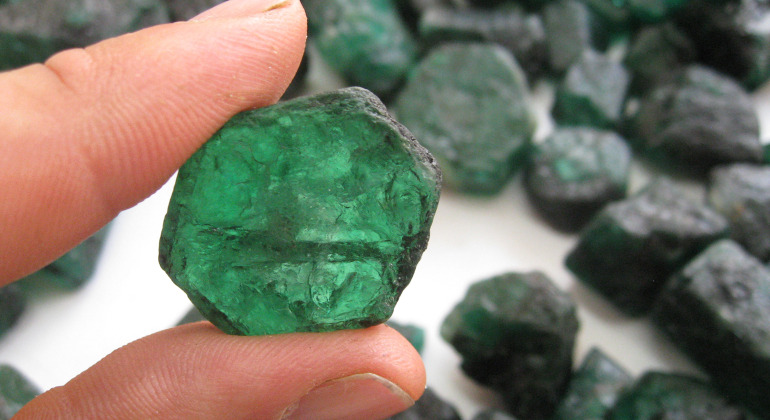
Why that specific gem and not that peculiar cotton, teak or coffee? Ethical ID will produce added value To conclude we go back to the parallel between gems and coffee, cocoa, sugar and cotton. These latter are all commodities, undifferentiated fungible goods: sugar is identical for both quality and quantity in all ports of discharge as well as in all bars and no one would ever think to mark that specific bag of sugar or that particular cotton thread. The ethical legitimation of these goods is also found when looked after in the documents of the Custody Chain. Instead, diamonds and gems, each with its own peculiarity, often enter the market accompanied by quality documents, reports or certificates. Coloured gems reflect the wonderful and endless wealth and type range of mineralogy with diversified features that the market exalts or penalizes. Gübelin, one of the pillars in the evaluation of this type of built-in features, with its new proof of provenance, virtually introduced an added meaning that will be contained in the information entered by the DNA of the injected nanoparticles. While diamonds will maintain de facto an ethical meaning of the same level as cocoa, that is essentially validated by an assessment chain verified by witnesses, coloured gems could be displayed on jewellery window shops with an additional message. This new message will add to the built-in qualities information concerning intrinsic values (why not, printable like a certificate) as a warranty of responsible extraction, manufacturing and transport. The univocal availability, stone by stone, of ethical attributes through the group of printable data will create the conditions for the establishment of an Ethical Certificate that, like the gemmological one, will not leave the market of cut stones indifferent. An added value will be assigned, broadened by the possibility of extending the use of the information concerning the geographical proveniences from the responsibility level to a qualitative statement. In fact gemmologists are well aware of how important the indication of mining areas that have become synonym of rarity and beauty is for the appreciation. To conclude, while we are injecting Gübelin nanoparticles into marketed emeralds we are already including the technique for the proof of provenance into the channel of CSR studies. And today they evidence the danger that big groups raise the bar of ethical compliance in order to set complex procedures that will perpetuate privileges and conditions of superiority. The danger lies in the creation of a market for few and selected gems, complete with ID that will be exclusively marked with the new “conflict free” or “responsibility source” brand.
References
ASM-PACE, “Artisanal and Small-Scale Mining in Protected Areas and Critical Ecosystems Programme: A Global Solutions Study”. WWF Report, 2012, www.estellelevin.com/wp-content/uploads/2013/11/Global- Solutions-Study.pdf A.A.V.V., “Due Diligence for Responsible Sourcing of Precious Stones: A Study Commissioned by Jewelers of America on behalf of the Precious Stones”, Multi-Stakeholder Working Group (PS-MSWG), 2015, Report by Sustainable & Responsible Solutions and Estelle Levin Ltd., www.dmia.diamonds/wp-content /uploads/2014/11/PS-MSWGPreciousStonesReportFinal.pdf Archuleta, Jennifer-Lynn, “The Color of Responsibility: Ethical Issues and Solutions in Colored Gemstones”, Gems & Gemology . Summer2016, Vol. 52 Issue 2, p144-16 Cross J., van der Wal S., de Haan E., Rough Cut: Sustainability Issues in the Coloured Gemstone Industry. Stichting Onderzoek Multinationale Ondernemingen (Centre for Research on Multinational Corporations), 2010, http://www.somo.nl /publications-en/Publication_3418/?searchterm= Brondoni S.M, Pepe C, “Ouverture de ‘Ethics in Global Supply Chains’”, Symphonya. Emerging Issues in Management, no. 2, 2007 Fonseca A, McAllister M.L, Fitzpatrick P, “Sustainability reporting among mining corporations: a constructive critique of the GRI approach”, Journal of Cleaner Production, 2012 Hamann R, Kapelus P, “Corporate Social Responsibility in Mining in Southern Africa: Fair Accountability or just Greenwash?”, Society for International Development, vol. 47, no. 3, 2004 McAllister M.L, Fitzpatrick P.J., “Canadian Mineral Resource Development: a Sustainable Enterprise?” In Mitchell, B. (Ed.), “Resource and Environmental Management in Canada: Addressing Conflict and Uncertainty”, Oxford University Press, Toronto, Ontario, p. 356–381, 2010. Prno J, “An Analysis of Factors Leading to the Establishment of a Social Licence to Operate in the Mining Industry”, Resources Policy, vol. 38, no. 4, pp. 577– 590, 2013 Tilton J.E, “Mineral Wealth and Economic Development: An Overview” in “Mineral Wealth and Economic Development”, Tilton J.E (eds.), 1992, Resources for the Future, Washington DC. UNCTAD, “Corporate Social Responsibility in Global Value Chains”, 2012, UNCTAD/DIAE/ED/2012/3 U.N. publications.
Request your copy of Rivista Italiana di Gemmologia or buy a yearly subscription
Article by Paolo Minieri, published on Rivista Italiana di Gemmologia #1, May 2017.


