This content was first published on IGR – Italian Gemological Review no. 9 in 2020. The information provided here is therefore current as of the original publication date.

On Greenlandic primary corundum deposits gemologists have already given accurate reports. They are concentrated in the North Atlantic Craton, mainly near anorthosites, amphibolites and ultramafic bodies and are often related to intruding felsic sheets. Rubies, have been associated with the iron rich material of Mozambique, though they have their own geological identity.
In 2017 fully mechanized gemstone mining operations started in the most promising location, the mountainous terrains surrounded by fjords named Aappaluttoq (red in Greenlandic), 150 km away from the country’s capital, Nuuk. The isolated site is a true challenge to the extreme conditions imposed by nature can operate at temperatures as low as -17° Celsius. Paradoxically the presence of snow facilitates the extraction while the warmer season provokes difficulties because of mud.

The operating mining company is Greenland Ruby AS, owned by North Norwegian Leonhard Nilsen & Sons (LNS) which in 2016 took over its debtor True North Gems Inc. (TNG), a Canadian company that went bankrupt. TNG got involved and soon put all its resources in Greenlander rubies as early as in 2004, after focusing on emerald in southeast Yukon and sapphire discovered in southern Baffin Island.
The ambitious program was to process 7 tonnes of raw corundum with a 35% gem or near-gem quality yield. 15 million US$ have been invested until 2016 under a strategy aiming at penetrating the international ruby market following the embargo imposed to rubies from Myanmar. But by the time the environmental assessment plan was approved in 2014 and the concession was eventually granted by the local government, the huge industrialized production coming from Mozambique had definitely modified the international scene, compared to a decade earlier.
The reason why getting the mine started took such a long time consists in the fact that Greenland is politically a new country. After gaining administrative autonomy from Denmark the government considered exploration and exploitation of its mineral wealth (50% of the world’s rare earth, gold, iron-ore and uranium) a key factor for development. Yet the implementation of gemstone mining in Aappaluttoq, indicated as the starting move of the industry, was hampered by opposition and criticism raised from the 16th August Union, a local miners association claiming that the new mining laws and concessions would virtually exclude locals from the benefits brought by ruby deposits.
“I know some groups around the world would like to have the Arctic as a prehistoric natural museum” – the mayor of South Greenland, Jorgen Waever Johansen declared in 2014 in response to complaints – “but there are people here who want a good standard of living and want to be part of a global world”.

So when Greenland Ruby AS assumed the task of completing the investments at the infrastructural and marketing level the responsible sourcing policy as well as the environmental sustainability were unquestionable choices. For this particular purpose Hayley Henning, involved for years in the tanzanite business, was engaged as vice president of sales and marketing. She founded Pink Bear, a foundation shaped after the Tanzanite Foundation successful model, a CSR arm to support “international polar research in all disciplines, especially protecting the inhabitants (humans, animals and vegetation) of Greenland, who are affected by climate change and accompanying cultural changes”.
In addition to this in 2019 Greenland Ruby has become the first colored gem miner to join the Responsible Jewelery Council. These are proving to be effective steps to introduce rubies on the market molded into a precise identity made of environmental and social integrity, traceability of the supply chain in combination with the fascinating appeal derived by their being three billion years old. The iconic image of red crystals on the white of the arctic ice is a feast for the eyes. “The rubies and pink sapphires from Greenland” – Hayley Henning noted – “range in sizes from 0.9mm right up to around 50 carats! Due to the nature of the gems, beautiful cabochons are our specialty, so while we do have quite a few faceted gems, especially in smaller sizes, the larger are most likely to be the cabs”.
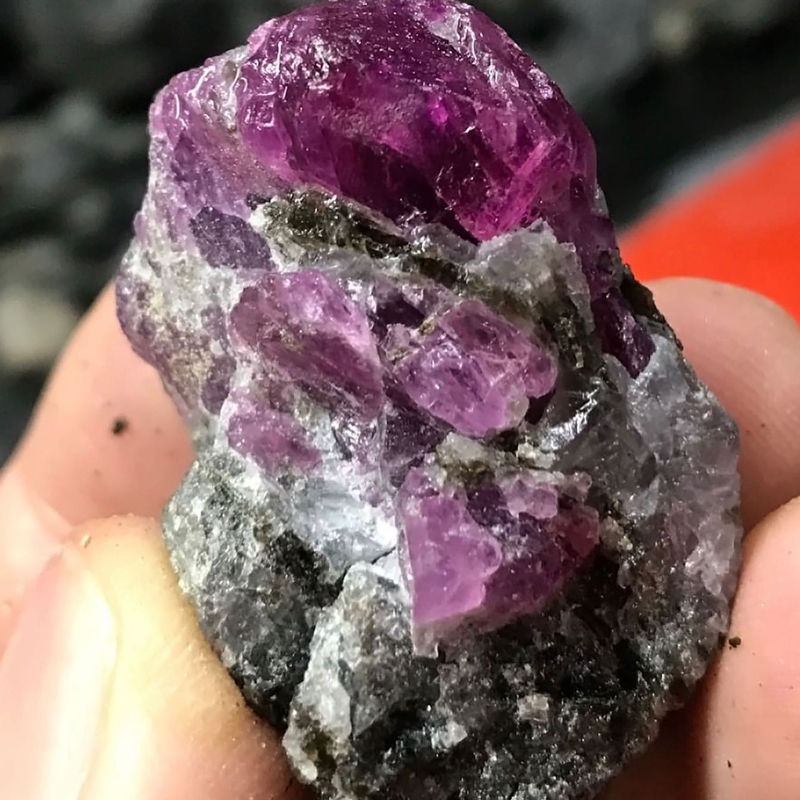
Showing a pleasant saturation with flux-healed fractures Greenlander rubies lend themselves to be cut as cabochon rather then faceted and therefore occupy a medium commercial position in the market. Yet their strength can be enhanced by advanced marketing tools included in their certificate of origin. In December 2018 the Danish retail partner Hartmann created a 70 piece collection with the rubies from Greenland Ruby AS. The jewels were sold out before Christmas Eve. A good start.
Gem News published on IGR – Italian Gemological Review #9, Spring 2020