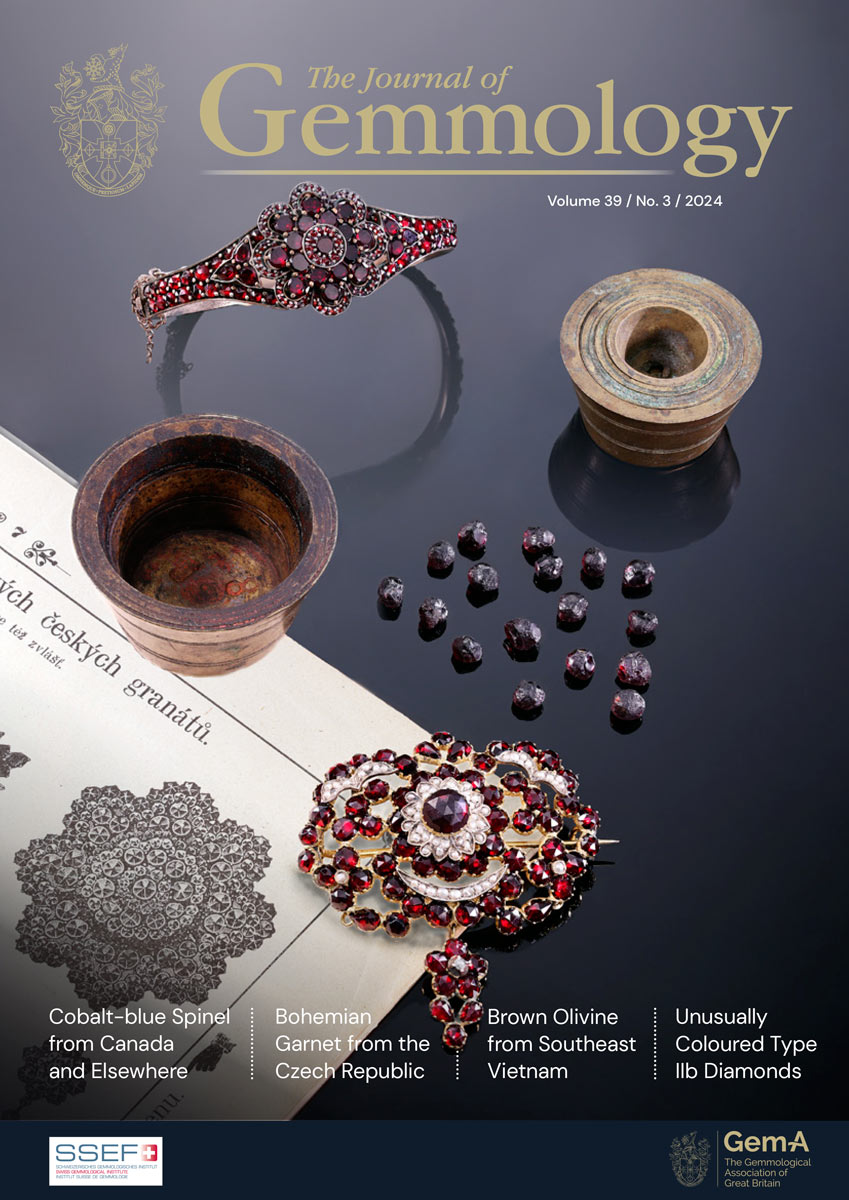
The Gem-A (Gemmological Association of Great Britain) has recently published the new issue of Volume 39 of the Journal of Gemmology, the third release of 2024. This prestigious journal, rich in articles, presents four main research papers, along with news and gemmological notes.
In the first study, Philippe Maxime Belley, Klaus Schollenbruch, Lee Andrew Groat, and Bradley S. Wilson compare cobalt-blue spinels from Qila and Trailside, Canada, with other spinels found in the same area and some from different origins. The article is titled “Cobalt-Blue Spinel from Baffin Island, Canada: Comparison to Other Mg-Al Spinels and a Chemical Discrimination Approach for the Colouration of Spinel”.
Radek Hanus, Pavel Hladký, and Aleš Hladký, in the article “A Review of Bohemian Garnet (Cr-bearing Pyrope) from the Czech Republic”, focus on Bohemian garnet, a red pyrope with a chromium concentration ranging from 1.5% to 4.0%. Mined in the Czech Republic since the 5th century BC, Bohemian garnet is considered the national gem of the country. The article reveals how this gem can be identified through photoluminescence and spectroscopy.
From the Czech Republic, the research moves to Vietnam, with the study by Le Ngoc Nang, Pham Minh Tien, Pham Minh, Ho Nguyen Tri Man, and Pham Trung Hieu. In “Gemmological Characteristics and Origin of Brown Olivine from Southeast Vietnam”, the authors examine brown olivine from Southeast Vietnam, which stands out for its dark brown color, as opposed to the classic greenish-yellow of gem-quality peridot. Discovered in 2020, this material has relatively low birefringence (0.022–0.035), and its inclusions consist of serpentine fibers and amphibole particles, which give it a cloudy appearance.
The article “Large and Unusually Coloured Type IIb Diamonds, Possibly Cut from the Same Rough”, written by Aurélien Delaunay, Stefanos Karampelas, Annabelle Herreweghe, and Emmanuel Fritsch, is dedicated to two pear-shaped diamonds, 7.79 and 5.90 carats, with rare colors: dark brownish-green and dark greenish-gray. These diamonds, classified as type IIb, contain around 0.1 ppm of uncompensated boron and may have been cut from the same rough, as they exhibit similar spectroscopic and structural characteristics. Luminescence imaging has suggested hypotheses regarding the rough’s shape and the position of the two stones within it.