This content was first published on IGR – Italian Gemological Review no. 13 in 2021. The information provided here is therefore current as of the original publication date.
Diamonds have been written about for centuries, yet even today the most precious gemstone on the market has something to tell us. In this issue, diamond formation has already been discussed thanks to Fabrizio Nestola’s (University of Padua) talk at last July’s gemmological conference in Bari.
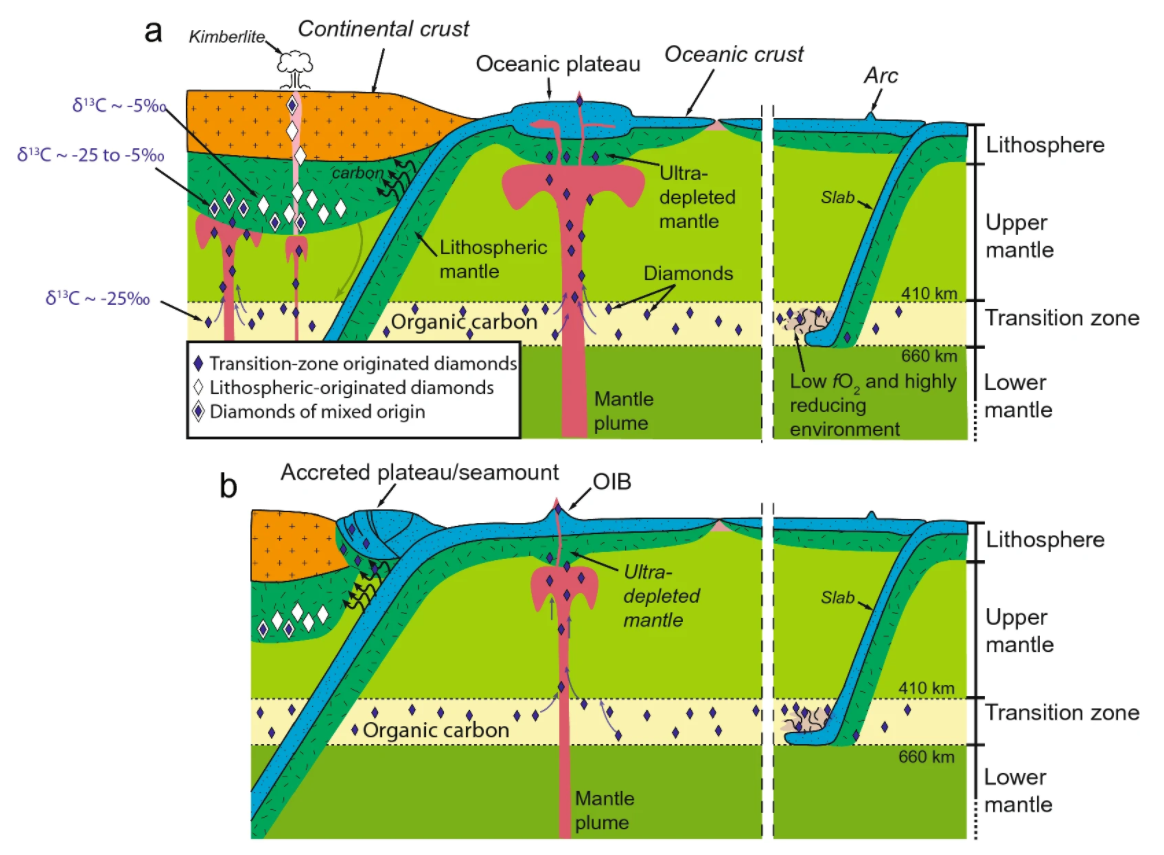
Model for the genesis of three types of diamonds. (Photo: Doucet, L.S., Li, ZX. & Gamal El Dien, H. Oceanic and super-deep continental diamonds share a transition zone origin and mantle plume transportation. Sci Rep 11, 16958 [2021], License: CC BY 4.0)It is certain that there are two origins: lithospheric diamonds formed between 120 and 200 km in the Earth’s mantle and superdeep continental diamonds between 300 and 1000 km. But it is uncertain whether these had anything in common. Although the former have homogeneous carbon isotope contents (δ13C from -28 to -20‰) and the latter are highly variable (δ13C from -25‰ to +3.5‰) researchers at Australia’s Curtin University claimed in a publication in August this year that the source of the carbon is the same and is attributable to organic carbon recycled in the Earth’s mantle. The research clarifies not only the formation of diamonds but also provides insight into the route carbon takes during its cycle.
Content created by the editorial team of IGR (Rivista Italiana di Gemmologia/Italian Gemological Review), a broad information framework for Gemologists as well as professionals involved daily in the gemstone business.
We use cookies on our website to give you the most relevant experience by remembering your preferences and repeat visits. By clicking “Accept”, you consent to the use of ALL the cookies. // Sul nostro sito web utilizziamo i cookie proprietari e di partner accuratamente selezionati per migliorare la tua esperienza di navigazione. Cliccando su "Accetta tutto", acconsenti all'uso di tutti i cookie. Puoi selezionare "Personalizza" per fornire un consenso personalizzato.
This website uses cookies to improve your experience while you navigate through the website. Out of these, the cookies that are categorized as necessary are stored on your browser as they are essential for the working of basic functionalities of the website. We also use third-party cookies that help us analyze and understand how you use this website. These cookies will be stored in your browser only with your consent. You also have the option to opt-out of these cookies. But opting out of some of these cookies may affect your browsing experience.