This content was first published on IGR – Italian Gemological Review no. 7 in 2019. The information provided here is therefore current as of the original publication date.

Poly-material ornaments include a variety of luxury products characterized by a stratification of different materials, which in turn can communicate multiple meanings. They combine inorganic materials such as metals including bronze, gold, silver and iron, and organic materials such as amber, ivory and wood. To this class of objects belong the amber fibulae: brooches composed of a metal support part and an amber decoration, often combined with other materials. They were particularly common between the 8th and 7th century BC and were used as an accessory to fasten the various clothing to each other or to embellish the garments of both the daily dress and the female funeral costume. In fact, the purpose of these luxury items was also to show the socio-economic level of the family during the funerary rite. Amber fibulae are nowadays found out by archaeologists in a great number of grave sets, both inhumation or cremation tombs, in Italy and central Europe (Austria, Slovenia, Germany, Poland, Hungary, Czech Republic), Balkan peninsula, Greece and Turkey.
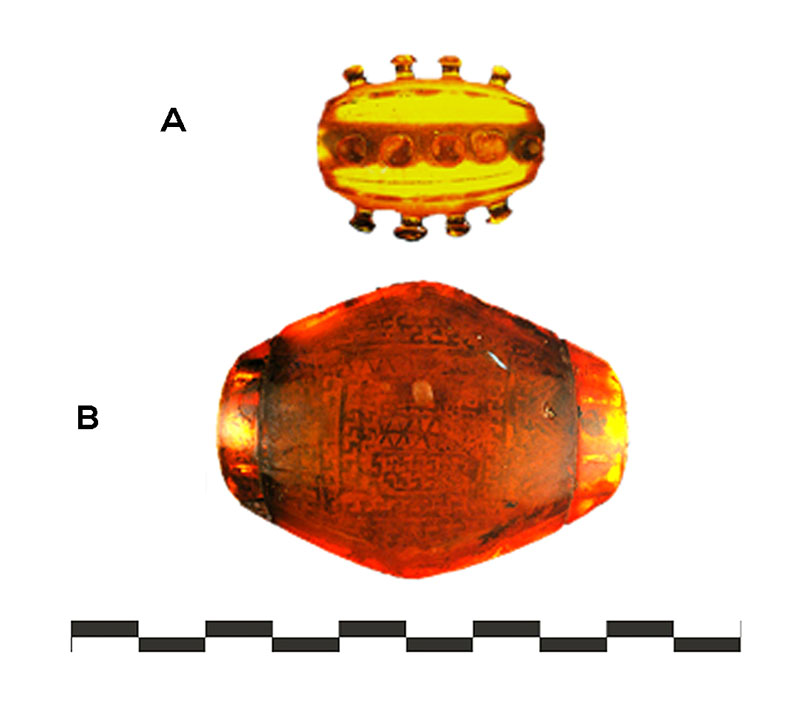
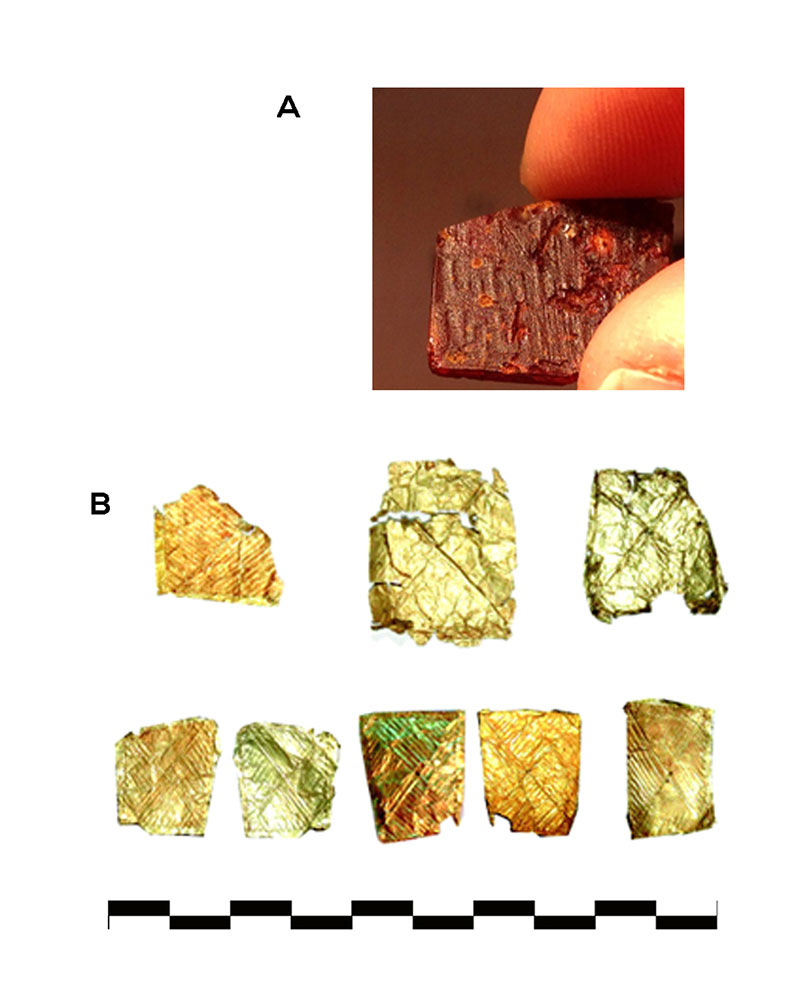
B: an amber element of fibula with painted tinfoil from Verucchio, necropolis Le Pegge, grave 3/1970 (picture by von Eles 2015 DVD, Type 79, variante a, p. 84, pl. 181 n. 1700).
The chrono-typological classification carried out in recent years has allowed me to verify similarities and differences between specimens scattered across different geographical areas. I could therefore assume the existence of different artisanal productions in activity especially between the 8th and 7th centuries. BC. The highest concentration of amber fibulae is in Piceno area (Beinhauer 1985) – roughly corresponding to the current Marche region – and in the Villanovan and Etruscan centers in Emilia-Romagna. The extraordinary abundance of amber artefacts coming from the necropolis of Verucchio (in the province of Rimini) (Von Eles 2015) and their high level craftsmanship are there to prove that it was the main center of circulation, sorting and distribution of amber in Italy. Among the most refined artifacts we can mention the fibulae with an amber multiholed core and inserted amber knurls with knobs protruding into the holes; or yet some fibulae with elements in amber hollowed out with a painted tin foil inside. These technical devices exploit the transparency of amber and therefore create special chromatic effects. The composite inlaid fibulae, instead, were made of segments in hard organic material obtained by animals with recesses on the surface where circular or polygonal inlays of amber could be inserted. The most complex specimens come from Verucchio too and it is sufficient to mention that some of them that are a bit more than 10 cm long could be made up of 350-400 pieces.
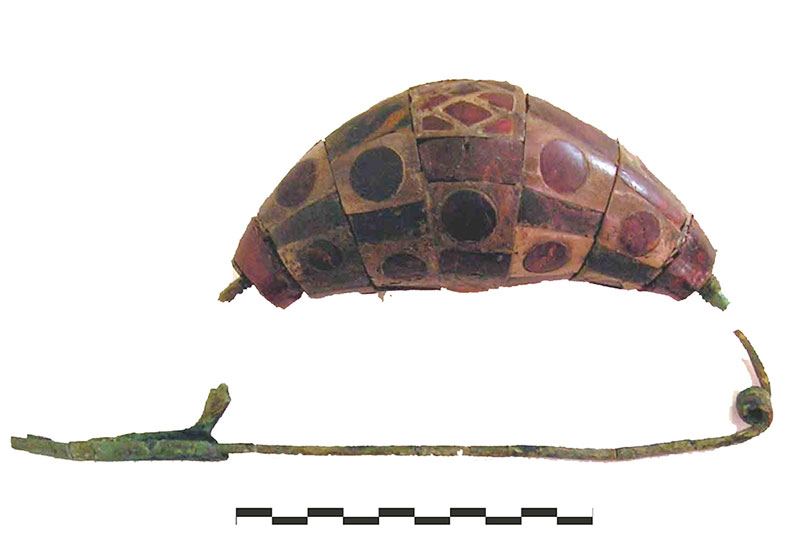
The Piceno area became predominant in the monopoly of trade and processing of amber artefacts, after the collapse of Verucchio occurred around 650 BC. The most representative amber fibulae in this area are characterized by a bronze brooch with a short and symmetrical catch-plate presenting an arch decorated by a single parabole shaped amber element.
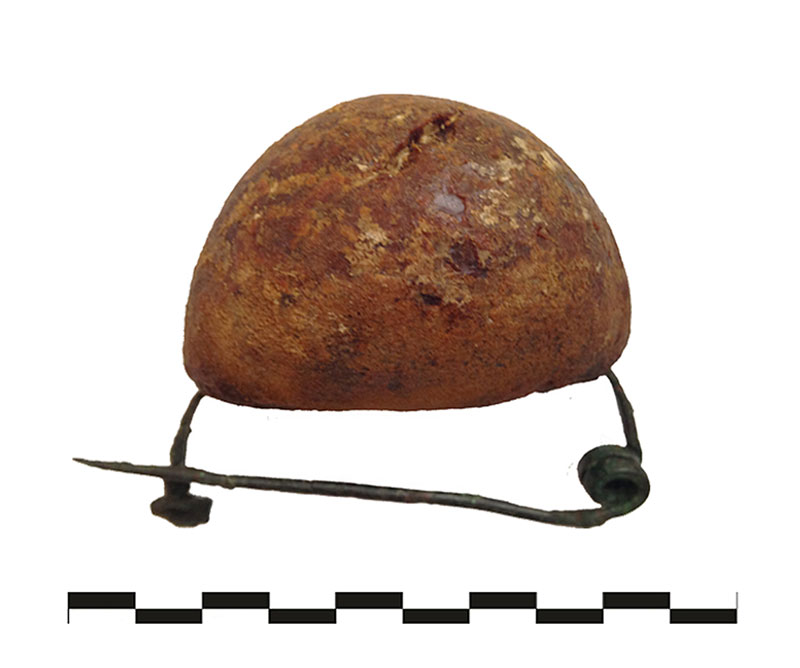
Recent research has highlighted the similarities between specimens from the Piceno and other findings coming from the opposite shore of the Adriatic, in today’s Croatia (Glogović 2003). Fibulae with a single element in amber can also be characterized by an elongated or long catch-plate as the ones which were most common in southern Italy during the VIII and VII century BC (Nava, Salerno 2007). Most of these present by the sides of the central amber element, long, smooth conoids in hard animal matter. Sometimes the latter is decorated with fluted longitudinal lines. Several elements comparable to these types have been found in Greece, not surprisingly, in a historical period when the first Greek colonies were founded in southern Italy.

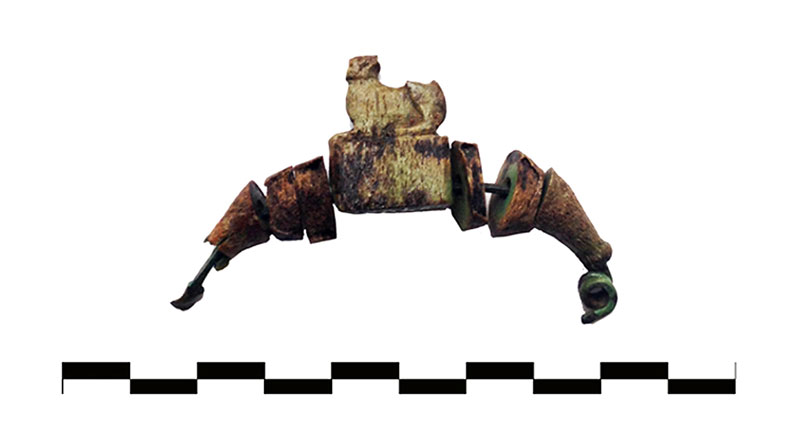
B: amber element showing at its sides two bone cone shaped end-pieces from Nola, necropolis loc. Torricelle (picture by Cocca, D’Orazio, Santagata 2007, 190-192).
Other fibulae are formed not by a single amber element but by several segments in amber (3 to 11) alternated with thin graduated discs in bone or ivory single inserted or in groups. Some fibulae constituted by segments of amber alternated with graduated segments of amber or wood covered with decorated gold foil were found in some prince tombs of Etruria and Latium vetus – the area between the Arno and the Tiber rivers, currently Tuscany, Lazio and Umbria – (Arancio 2012)
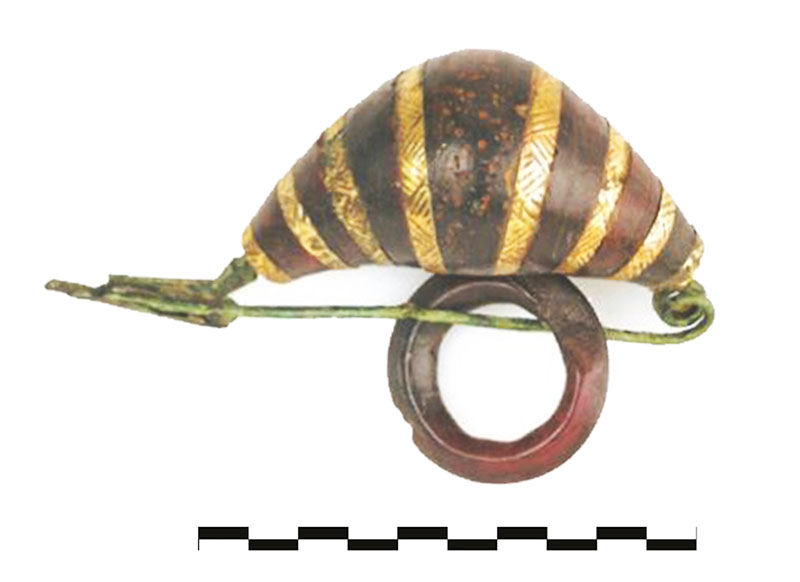
This combination is very rare and another exceptional example comes from the tomb 133 of Calatia – current Maddaloni (province of Caserta). The tomb of a woman in the south-western necropolis, dated between 725-720 BC, has revealed an exceptional ornamental kit, showing the high social status of the deceased woman.
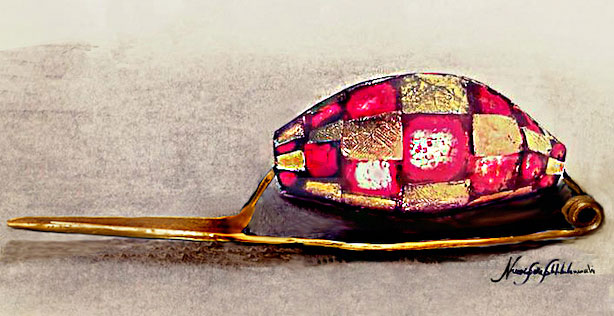
Among the ornaments, two 32 cm amber fibulas stand out, as well as a number of gold plates and amber dowels that belong to a particular type of amber fibula called “mosaic” (Saldalamacchia 2016, 2016a).
A peculiar production has come out in northern Italy as a part of the Golasecca culture, attested also in Austria and Slovenia. These fibulae have a central element in animal hard material or animal-shaped amber, felines and waterfowl are common (with an example from Hallstatt, see Kromer 1959).
The direct analysis of the findings allowed me to observe the impressive complexity of these objects, which is reflected into the very complexity of the technological processes. However, this sophistication is often spoiled by the poor state of preservation of the fibulae. However, through experiments aimed at the realization of philological reproductions of some amber fibulae, it was possible to investigate the processing techniques.
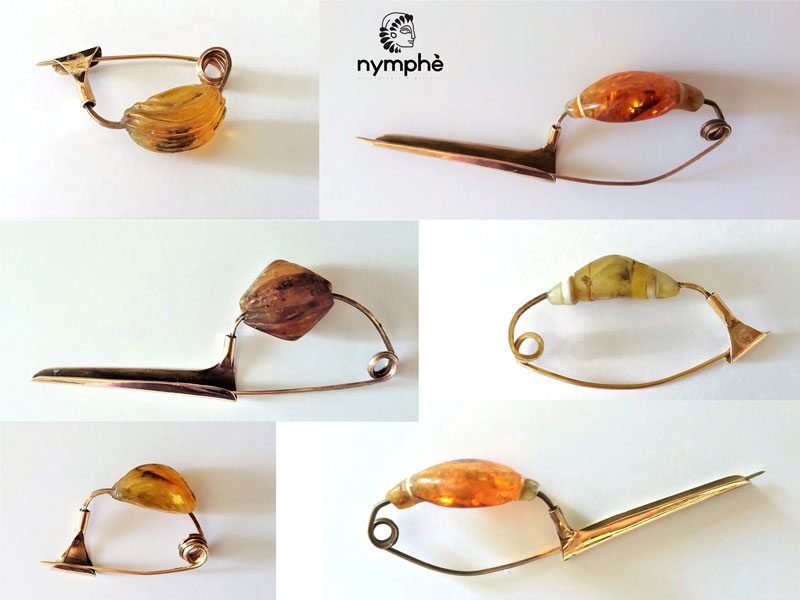
Moreover, modern replicas have given back the original image of the amber fibulae, often corroded and already lacking the original colors and transparency. Each of these ornaments has its own uniqueness but, if analyzed in correlation with the original context, it reveals a lot of information about the woman who used it: age, social status, role in the family, cultural roots.
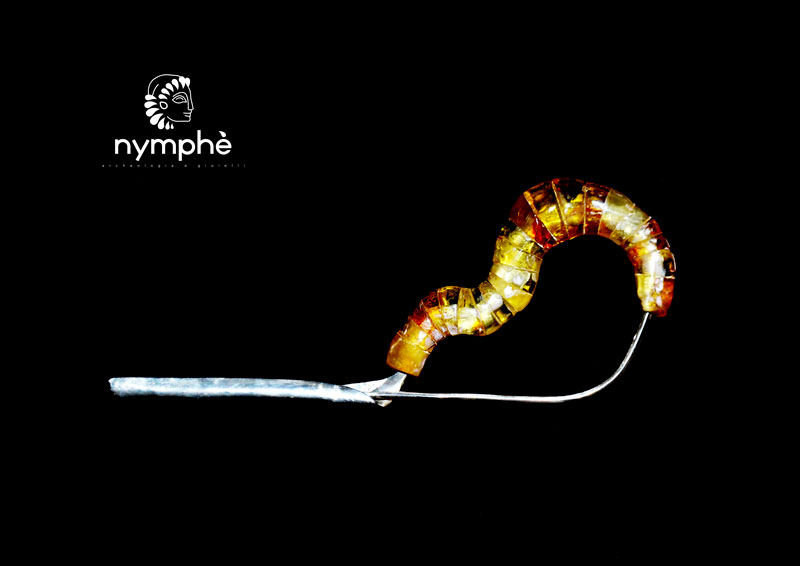
The craftmanship of poly-material ornaments also tells us about processes which were used at that time, in which luxury products were functional to the new emerging elites‘ exercise of power. Instead, the variety of the components of each object shows much about the trade of raw materials and semi-finished products, technology and craft traditions. Finally, the technical and figurative similarities reveal the circulation of ideas and models in the international sphere and the mixture of different western and eastern craft traditions.
References
Arancio, M.L. et alii (2012), Ambra. Dalle rive del Baltico all’Etruria, Exhibition Catalogue (Rome 2012-2013), Arancio M.L e Massini E. (Eds.).
Beinhauer, K.W. (1985), Untersuchungen zu den eisenzeitlichen Betsattungsplätzen von Novilara (Provinz Pesaro und Urbino/Italien).
Borriello, M. R. (2007), La tomba 201 di Calatia, Schede di Catalogo in Nava, Salerno 2007, 198-200.
Cocca, M., D’Orazio, L., Santagata, C. (2007), Natura e origine di reperti rinvenuti nelle tombe 112 e 308 della necropoli di Nola-Torricelle, Schede di Catalogo in Nava, Salerno 2007, 196-197.
D’Atri, V. (2012), Schede di catalogo, in Arancio 2012, p. 69.
Gabrovec S., Teržan B., Sticna II/2. Gomile starejśe železne dobe. Razprave / Grabhügel aus der älteren Eisenzeit. Studien, KatMon 38. 2010.
Glogović, D. (2003), Fibeln im kroatischen Küstengebiet, PBF XIV, 13.
Kromer, K. (1959), Das Gräberfeld von Hallstatt / im Auftrage des Naturhistorischen Museums in Wien in Verbindung mit dem Österreichischen Landesmuseum und dem Museum in Hallstatt, K. Kromer (Ed.), texts by W. Ehgartner et alii, in Association internationale d’archéologie classique. Monographie 1.
Laforgia E. et alii (2016), Il Museo archeologico di Calatia, Laforgia E. (Ed.).
Nava, M.L., Salerno, A. (Ed.) (2007), Ambre. Trasparenze dall’Antico, Exhibition Catalogue (Naples, March-September 2007).
Saldalamacchia, N. L. (2016), Fibula in oro e ambra e altri ornamenti della tomba 133 della Necropoli SO di Calatia (Caserta), in Ornarsi per comunicare con con gli uomini e con gli Dei. Gli oggetti di ornamento come status symbol, amuleti, richiesta di protezione. Ricerche e scavi, Atti del XII Incontro di Studi sulla Preistoria e Protostoria in Etruria [Valentano (VT) – Pitigliano (GR) -Manciano (GR)], 12-14 settembre 2014, Negroni Catacchio N. (Ed.), 577-587.
Saldalamacchia, N. L. (2016a), Il costume femminile, in Laforgia 2016, 41-57.
von Eles, P. et alii (2015), Immagini di uomini e di donne dalle necropoli villanoviane di Verucchio, Atti delle giornate di studio (Verucchio, 20-22 April 2011), von Eles P., Bentini L., Poli P., Rodriguez E. (Eds.), QuadAEM 34.
Article by Nunzia Laura Saldalamacchia, published on IGR – Italian Gemological Review #7, Summer 2019.