This content was first published on IGR – Italian Gemological Review no. 8 in 2019. The information provided here is therefore current as of the original publication date.

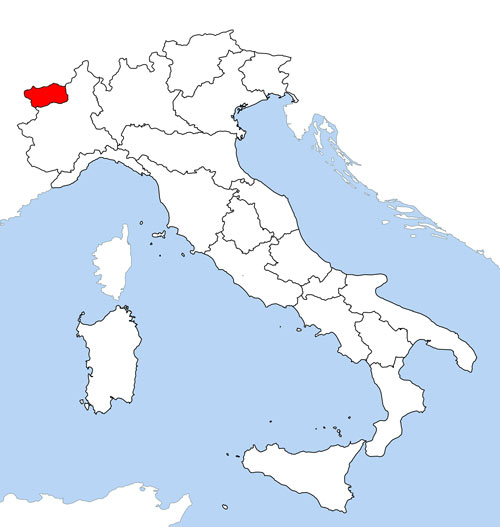
Violano is the purple manganesiferous variety of pyroxene that is found almost exclusively in the manganese mine of Praborna, in the Aosta Valley (Figure 118).

The Praborna deposit
The manganesiferous deposit of Praborna, located in the upper part of the Vallone of St. Marcel in Aosta Valley is one of the most classic Alpine metamorphic deposits of manganese, linked to the Calcareous Shists Formation with Green Stones in of the Pennidic Layers in the Mesozoic age.
The deposit consists of a large lens of braunite included between doritic-sericitic schists and massive prasinites with glaucophane relicts, often with abundant iron sulphides (Huttenlocher, 1934).
Manganese enrichment apparently comes from an ancient ocean seabed where the circulation of hydrothermal fluids resulted in manganese enrichment. The oceanic affinity ophiolitic sequence is then supposed to have been metamorphosed into eclogitic facies during the Alpine orogeny.
The deposit was exploited at the beginning of the 1600s by local aristocracy to be subsequently run by various owners. The deposit reached the production peak in 1881 reaching 120 tons of annual extraction but was later abandoned in the early 1900s. Some authors attribute the beginning of the excavations to the Roman age, but this is not supported by strong evidences. The mineral that was extracted here to obtain manganese was braunite required in the past by the Venetian and southern France glass industries for dying purposes.
In addition to the mineral of economic interest (braunite), St. Marcel is characterized by the presence of numerous gangue minerals containing greater or lesser quantity of manganese.
Among these, the best known ones are: piemontite, alurgite, greenovite (pink variety of titanite) and violano (minerals of which St. Marcel represents a typical location) and also: spessartine, rhodonite, pyrolusite, polianite etc. There are also numerous minerals of which manganese is not an important component, but which nevertheless show characteristics that are attractive for collectors (De Michele, 1974). The mine is located at an altitude of 1900 m in the valley of Saint Marcel. The mine landfill has been and still is the object of numerous researches by mineralogy enthusiasts.
Unfortunately, the old gem hunters note that, compared to the past, almost nothing can be found today, but in any case, thanks to the fact that a fragment of a few grams may be sufficient to cut a gem (and sometimes even the chromatic contrasts with other minerals can be suggestive) a day of research can still give nice gem quality specimens. In addition to violano, other minerals suitable for cutting can be found in the same landfill such as rhodonite, alurgite, spessartine (mostly massive) and sometimes greenovite.
The mineralogical importance of this area is due essentially to the presence of violano, the purple colored variety of two clinopyroxenes (i.e. diopside and omphacite). Violano is found in euhedral and massive crystals in the form of fibrous or lamellar aggregates.
Around the world, the only other place where it is possible to find violano (but in a definitely lower quality) is Canada (Nunavut, in the Canadian Arctic zone, where it is found massive, in aggregates, inside silicatic lenses). In the Praborna mine, on the other hand, violano is found in microcrystalline intense purple-colored veins and lodes inside a black braunitic rock rich in piemontite, a red manganesiferous epidote, and alurgite, a red manganesiferous muscovite. The fame of violano in both the worlds of mineral collectors and gemology, as well as for its rarity, is due to the intense purple color that occasionally turns to blue, presumably due to the presence of manganese ions Mn3+ and Mn2+.

Violano is suitable either for cabochon cutting or for the creation of necklaces (Figure 119). Most of violano is mixed with other minerals that alter the color, so pure violano of good color is extremely rare and sought after. Recently it has been found violano included in quartz from which very interesting gems have been cut. Quartz has a metamorphic origin and is not very clean, but the presence of pure violano clumps of bright color make these stones very fascinating (Figure 120).

The quartz cabochons with violano have had an exceptional success among stone collectors, always looking for new specimens, especially if they are nice looking and come from unusual deposits.
Violano, in fact, is suitable for cutting and polishing, and assuming a particular beauty through curved surface cuts (cabochon, pear-shape and so on).
Its hardness ranges between 5.5 and 6.5 making it subject to damages, so it is therefore more suitable for the making of pendants, necklaces and earrings rather than being mounted as a ring stone. If the masses exceed a size suitable for cutting stones, it can be used with brilliant results to produce small objects.
Visit the Gems of Italy section!
Curated by the qualified group of expert of the section Gems of Italy, published on IGR – Italian Gemological Review #8, Winter 2019.