This content was first published on IGR – Italian Gemological Review no. 4 in 2018. The information provided here is therefore current as of the original publication date.

Cerussite is a lead carbonate belonging to the aragonite group which also include witherite. A colourless and clear cerussite, faceted by a skilled cutter can be distinguished from a diamond…because it is more beautiful! Cerussite shows a diamond brightness, but also a greater dispersion when compared to that of the diamond itself; obviously its very low hardness advises against its use in jewellery and cerussite gems are usually on display in museums or included in private collections without ever being set.
Cerussite is one of the most beautiful and rare gems ever; its beauty is due to the high content of lead, an element contributing to its high brightness, dispersion and refraction index (this is why it is added to the best glasses) and where its rarity lies in its being very difficult to cut.
The formation environment is peculiar, as this mineral develops in the oxidation areas of fields characterised by a high content of lead for the action of carbonate solutions.
As it forms in a peculiar genetic environment, its spread is limited. Therefore, remarkable cutting quality items can be extracted only in Morocco (in the province of Ouja-Angad) Namibia (in the famous mines of Tsumeb) and in Italy (Sardinia).
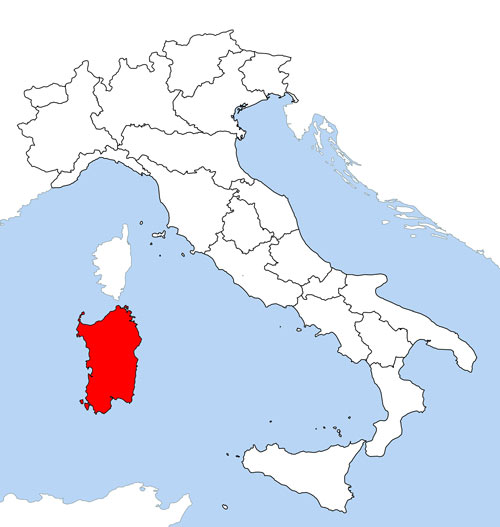
Sardinia is to Cerussite what Colombia is for emerald and then hosting one of the most beautiful gems in the world is a great honour for this island.
The best crystals are found in the mine of Montevecchio from whose oxidation area (west area) the most flamboyant Sardinian samples came from (Conti-Vecchi and Stara, Minerali della Sardegna Ed. Della Torre, 1991). There, it was fond in aggregates of longitudinally striped bacillary items, some ten centimetre long, forming bundles resting on a dark brown limonitic matrix. These crystals are very sought after by mineral collectors and cannot be cut for a gemmological use. Again, in Montevecchio they found beautiful 1-2 cm long prismatic crystals, translucid and often geminated with a 60° angle, as it is typical of such a mineral.
In the mines of Monteponi, S. Giovanni, Seddas Moddizzi, Punta della Torre, Masua, Acquaresi, Malfidano and S. Benedetto, excellent cerussites can be found (Figure 39). Crystals “as big as a fist, transparent and shining like a diamond” of cerussite were found in Campo Pisano, as reported by a nineteenth century writer.

Today in Sardinia gem quality crystals are still found though characterised by small dimensions (micro crystals).
Visit the Gems of Italy section!
Curated by the qualified group of expert of the section Gems of Italy, published on IGR – Italian Gemological Review #4, Summer 2018.