This content was first published on IGR – Italian Gemological Review no. 8 in 2019. The information provided here is therefore current as of the original publication date.

Vesuvianite, more commonly known as Vesuvian, is a mineralogical species very popular in Italy. First of all because Mount Vesuvius in Italy is where it was described but also because its best specimens in the world originate in the Alps. It is one of the most sought after minerals in the Alps, typical for example of rodingites.
Vesuvianite is a complex sorosilicate, described for the first time in the volcanic projectiles of Vesuvius at the end of the 18th century (hence the name) with a rather intricate formula: (Ca,Na,)19(Al,Mg,Fe3+)13(B,Al,Fe3+)5(Si2O7)4(SiO4)10(OH,F,O)10.
This formula is responsible, with the variable percentages of aluminum, magnesium and iron that may occur, for the considerable range of colors this mineral can show.
All the nuances are reported, from green to a more or less intense brown up to black, but also yellow, colorless, red, and rarely light blue and violet (the light blue variety containing copper, typical of some locations in Norway, is called cyprine; a light green massive variety that is mainly extracted in the County of Butte, in California is called Californite and is widely used in the United States as an ornamental material and as a jade imitation. The yellow manganesiferous variety from Orange County – State of New York – is also called xantite).
The mineral is tetragonal, often presenting more or less elongated and striated beautiful prismatic crystals, terminated by obtuse pyramids and pinacoids but occurring frequently in compact granular microcrystalline masses. Its hardness is not particularly high, around 6, with vitreous luster. It’s not very flaky.
Being found in metamorphic rocks (contact metamorphism) and therefore abounding in alpine rodingites (well represented in the Aosta Valley) Vesuvianite is not a very common mineral; in fact, those coming from Bellecombe near Chatillon (Figure 113), from Champoluc in Val d’Ayas, from the Varenche Mine, Valtournanche but also, in a lithologically similar area, in the rodingites of Val d ‘Ala (Pian della Mussa), of the Val di Viù near Lanzo in the Turin area and of the Passo del Faiallo in Liguria (Figures 114 and 115) are among the best specimens in the world. Vesuviana is also found in the metamorphic limestone of the Monzoni in Val di Fiemme, but these crystals, although large, do not offer material worth cutting because they are generally opaque.


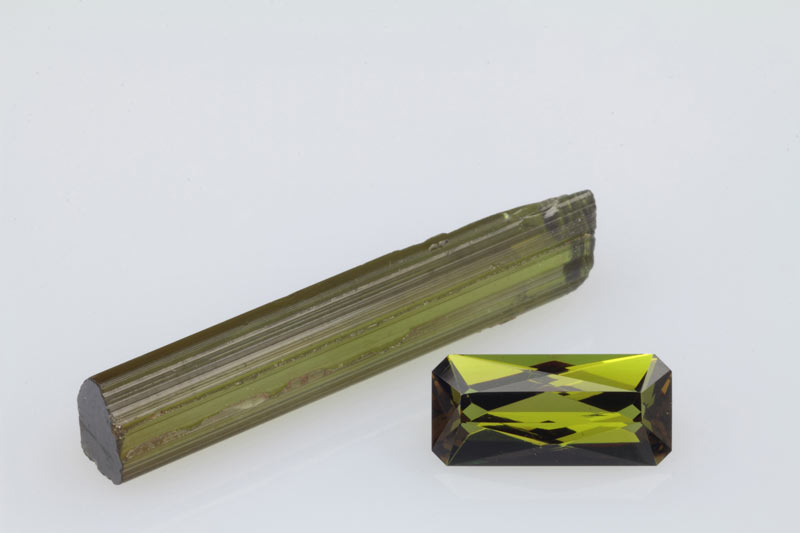
In alpine rodingites, on the other hand, the Vesuvian often presents a clear color, green or brown, although in most cases it is too dark to result in shining stones. Its crystals can take on all the hues from a very light and tender green to the emerald green of the chromium-vesuvian, from dark olive to dark purple red, brown and brown-blackish. Unfortunately the beautiful blue crystals (cyprine), available in some Norwegian or American deposits, are missing in the areas under examination.
The best crystals suitable for cutting present an intense green similar to that of tourmaline. Even some brown crystals can result in nice stones if the color is not too dark.
Vesuvianite has a lower hardness than quartz (about 6.5) and does not have a clear or distinct cleavage, although it is still fragile. Also in this case, therefore, it is convenient to use this mineral as pendants, brooches, earrings rather than rings or bracelets, that certainly go through a greater stress and frequent frictions.
From the gemological point of view, clear specimens of not too saturated color are excellent stones, suitable for cutting, strongly birefringent, fit to respond to fine polishing with a high surface reflectivity, while the microcrystalline varieties (such as the aforementioned Californite) are excellent for carving art objects.
The massive variety of Vesuvianite, commonly called Californite, can provide interesting and lively material for cabochons and similar cuts (Figure 116). Vesuvianite also occurs in volcanic projections, where limestone blocks have undergone a strong thermal metamorphism. The best groups of Vesuvianite are found in the lava ejecta of Monte Somma, but beautiful specimens can also be found in Ariccia (Colli Albani) and Pitigliano (Figure 117). However these crystals in spite of their large size, being generally opaque, are not suitable for cutting.


Outside of Italy, the specimens from Mont Saint Hilaire in Canada (where rare bicolor green-purple specimens come from) from Zermatt-Saas in Valais in Switzerland, from Outokumpu in Finland and from the Skardu mountain complex in Pakistan must be mentioned.

Visit the Gems of Italy section!
Curated by the qualified group of expert of the section Gems of Italy, published on IGR – Italian Gemological Review #8, Winter 2019.